

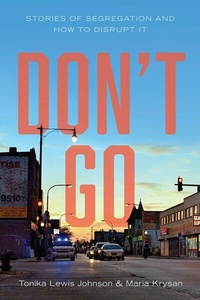
Don't Go
Description

Multiple times a day, in cities across the US and beyond, a simple yet powerful message is repeated by the well-meaning, the ill-informed, and the bigoted: "don't go" - avoid at all costs those Black and Brown disinvested neighborhoods that have become bywords for social disorder and urban decay.
This book is a collection of intimate stories and evocative photos that uncover the hidden influence of both subtle and overt "don't go" messages and the segregation they perpetuate in Chicago. Told by everyday people to Tonika Lewis Johnson and Maria Krysan - a Black artist and a White academic who met through their shared passion for anti-segregation work - the stories paint a rich picture of life in a segregated city.
One by one, the storytellers upend pessimism with candid, deeply personal, humorous, and heartbreaking tales, and with novel ideas for simple actions that can serve as antidotes to both racism and "place-ism."
By inviting readers into the lives of regular people who have ignored the warning to stay away from "don't go" neighborhoods or who live in those very same neighborhoods, the stories in Don't Go illuminate the devastating consequences of racial segregation and disinvestment as well as the inevitable rewards of coming together. Also available as an audiobook.
More details
Other editions
Additional editions
Persons
Tonika Lewis Johnson is a photographer and multi-media artist, and creator of the Folded Map Project. She is recipient of the 2024 Gordon Parks Foundation Fellowship and one of Chicago Magazine's 2017 Chicagoans of the Year.
Maria Krysan is LAS Distinguished Professor of Sociology at the University of Illinois Chicago, and co-author of the multiple award-winning book Cycle of Segregation.
Content
Foreword - Mary Schmich
What This Book Is About
Tonika's Story
Maria's Story
The Story of "Don't Go" - Tonika + Maria's Story
The Sociologist's Notebook
Section 1: Fear
Grandma's No Go Zone - Adrianne's Story
Adventures of a White Dude - Jerry's Story
Dear Grandma - Jeff's Story
Context is Everything - Aleya's Story
Trains, Robbers, and Coffee - Soren's Story
Fulfilling Prophecies - Danica's Story
Reflections on Stories of Fear
Section 2: Messengers
Let's Get Something on the Books - Joey's Story
Racist Worms - Eva's Story
Following the Pack - Tom's Story
Glitter - Zachary's Story
At the Center of Everything - Katherine's Story
Reflections on the Messengers
Section 3: Shortcuts
What Am I Supposed To Say? - Jenny's Story
Harmful Mundane/Helpful Mundane - Sara's Story
The City Doesn't Eat You Alive - Becky's Story
The Bubbles - Halle's Story
Rent a White Lady - Caroline's Story
Whistling While You Segregate - Jamaine's Story
Reflections on Shortcuts
Section 4: From Hurt to Healing
Accordingly - Leslie's Story
Engineering Change - Tiana's Story
From Mad Max to Lady Dates - Kristine's Story
Curiosity Passports - Roberto's Story
Questions and Answers - Amy's Story
Saying No to Hate - Jenny S's Story
Jumping Rope - Dominic's Story
Reflections on From Hurt to Healing
Section 5: Taking a Step to Take One More
Talking
Feeling
Acting
TONIKA'S STORY
FOR AS LONG AS I CAN REMEMBER, I HAVE BEEN SURROUNDED by art and artists. If you walked through my home when I was a little girl, you'd see my mom writing a script, my grandma singing and playing piano, my uncles working on paintings and me smiling in front of my dad's ever-present camera. Art was normalized as a career choice in my family. All I had to do was pick my medium. Even after my parents divorced when I was a toddler, I still lived in my grandma's 2-flat with my mom, my grandma, and my uncles all in the same building. A typical day in my childhood included laughing with my favorite uncle, hugs from my grandma, and riding a bike to the corner store with my friends. My dad lived nearby, and I still saw him (and his camera) frequently. I still have a scar on my face from when my best friend Raymond and I tried to climb up a tree on one of our neighborhood adventures and I fell on a gate.
I grew up in Englewood, a neighborhood on the South Side of Chicago. According to the Census, Englewood's population consisted of 48,244 Black residents and 190 White residents in 1990. Multi-generational living was the rule in my neighborhood. Books and magazines were constant companions. I attended Englewood's Gershwin Elementary school in first grade, where I loved going to the assemblies in the auditorium where we did poetry readings and little shows. When I was seven, my mom and I moved to an apartment on the North Side, and I went to a public school there in third grade. Then my mom enrolled me in a Catholic school that was near her job. We took the train together every morning and then my mom would pick me up for our train ride back home after school. I was addicted to Dr. Seuss, then Shel Silverstein, then R.L. Stine's Fear Street series, and of course the Baby-Sitters Club series. It tickles me to remember how many times I re-read 20,000 Leagues Under the Sea. Then my grandma got sick when I was eleven and my mom and I moved back to Englewood to be with her. I continued to ride the train most days with my mom to the same Catholic school I attended when we lived on the North Side. One of my favorite shopping centers had disappeared by then and my friends from other neighborhoods were never allowed to come over to my house. I didn't know this at the time, but their parents thought it was too dangerous. Also, there were places I was told not to go. But I still had a great time. One of my favorite memories is reading hour in sixth grade, when an older White teacher named Ms. Hawkins would open the windows to let some fresh air in and give us lemonade while we took turns reading books like Catcher in the Rye. Reading is still one of my favorite things. My childhood was mostly magical, better than most. But when I tell people where I'm from, they usually ask just two questions (in one form or another) about my upbringing:
"How did you make it out?!" and/or "Have you ever seen a shooting?"
To be honest, I had no idea that I lived in the "poster child" of bad neighborhoods until I got to high school on the North Side. I remember telling other students where I was from and feeling so surprised when they said "oh my gosh! Are you ok?" I couldn't understand why they were acting like it was so bad to grow up where I grew up. I was a typical 13-year-old kid - I didn't watch the news.
Ever since that time, I've had to deal with people thinking that I must have been exposed to drugs and violence, that my childhood must have been awful, but it wasn't. In fact, my first and only encounter with the police as a child didn't happen in Englewood - it happened on the North Side when I was a sophomore in high school. Three of my Black high school friends and I were pulled over and frisked for no reason on the way to drop me off at my train stop after school. I did so well in grade school that I was accepted at Lane Tech, a prestigious selective enrollment public high school in the North Side neighborhood of Roscoe Village. The distance between my home and my high school was a little less than 15 miles, which might not sound that far, but for 13-year-old me, it was like traveling to another state; I caught a city bus every morning at 5:45, then transferred to a train, then to another city bus to arrive at school just in time for the 8:00 a.m. bell.
To be honest, I had no idea that I lived in the "poster child" of bad neighborhoods
As I listened to Common, Mobb Deep, Nas and Wu-Tang on my Walkman and stared out the bus window then the train window then the bus window each day, I couldn't help but notice how the neighborhoods changed even as the street names didn't. As we traveled north, I saw retail stores, all kinds of grocery stores, crosswalks, well-kept parks, playgrounds, and restaurants; and as we traveled back south, I noticed the lack of these resources and the abandoned lots and boarded up houses in my own neighborhood. I felt terrible when I realized that my neighborhood was ugly compared to the neighborhoods on the North Side. I was an artist. I couldn't help but see that. I started to feel the unfairness of it all. Even though all during my childhood, my family was always joking, arguing, and talking about Black social and political issues, I didn't see the direct impact of racism on my neighborhood until I started traveling to Lane Tech. Over time my awareness of these issues grew, and I became determined to disrupt segregation with my art.
At the same time, I was exposed to the life-changing benefits of diversity at Lane Tech. Because the school is so highly rated, people from all over the city apply there to be one of the 4,000 students who score high enough on the entrance exams to attend. There were students with families from Puerto Rico, Philippines, Poland, Nigeria, Mexico, China, Haiti, Panama, Belize, Jamaica, and all over the world. This experience expanded my worldview, especially because we were just kids who weren't yet corrupted by the idea that we should know everything about each other or only socialize with our own "kind." We were curious and we made mistakes. We learned how to talk to each other by talking to each other. All of us said something offensive at one time or another because we didn't know the right way to say something about another culture. I had no idea that Chinese had many dialects, and Mandarin was the most common. I didn't know the difference between Puerto Rican and Mexican culture.
My dad's passion for photography was really helpful too. It was natural for me to take photos all the time and people felt so good when I took their picture - just like I did when my dad took pictures of me and my family. My photo-covered locker was like a "little museum of me and my friends kickin' it," according to my classmates. This was before the days of digital photography, so we were always excited when I got the negatives, laughing and looking forward to seeing the pictures.
One of my other favorite high school memories is the international food days - where students and their families would bring in food from their cultures and we could go to different booths and sample the food and talk. I loved learning about all the spices and the various ways that people cooked food. We learned all about the customs in different cultures by visiting each other in our homes. I mean sure you can go to a restaurant to taste food from all over the world, but that is nowhere near as good as sitting in someone's kitchen and having their mom or grandma cook a meal, seeing the spices they use and the stuff they keep in their refrigerator. I remember being so surprised that home-cooked Jamaican food tasted so much better than the restaurant versions I had tried. I had never even heard of Caribbean green soup, and I still love Belizean fry jacks.
I also loved sleepovers. Like most kids, I wanted to host friends at my house. My parents were fine with this, but my friends' parents would never let their kids come to my neighborhood. By the time I was five years old, I knew on some level that friends would never be able to come to my house in Englewood but I still invited them. I couldn't articulate what was happening at the time, but now I realize that I didn't have this core childhood experience of friends visiting my home and meeting my family and neighborhood friends. It wasn't until after I started high school that it dawned on me that this wasn't right, that something was messed up about the fact that if someone from my neighborhood wanted to host a graduation party or a sleepover, they had to rent a hotel room downtown. This still happens - parents are still afraid to let their kids come visit my kids in Englewood. This is a real shame, not only because it's so unfair to my kids, but also because I love to host and I'm proud of my home-cooking and having my kids' friends over is one of my favorite things too. I am raising my kids in Greater Englewood not because we are stuck, but because we love it here - the sense of family and community and the art, the resilience of this community - it's special. My childhood friend Raymond cuts my son's hair now. It doesn't get much better than that.
When I enrolled in a summer photography workshop after my freshman year in high school, I got my first real camera and became even more obsessed with the power of photography. After he had introduced me to the work of Black...
