

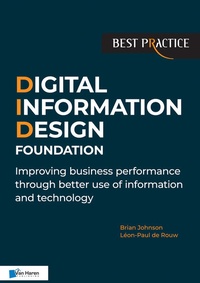
Digital Information Design (DID) Foundation
1st Edition
Published on 9. March 2021
305 pages
978-94-018-0724-1 (ISBN)
Description

Digital Information Design (DID) is primarily a business information management (BIM) model. As with any model it is used to help you to describe problems and test potential solutions. DID is not like any other method or framework model; it is independent of any other existing model or framework and does not claim to manage the entirety of the design of business information services. DID identifies useful and widely used best practices that are designed specifically for use in any phase of business information service development from idea, conception, specification, design, test, handover, service management and operation, or managing architectural issues or hardware and software installation.
Primarily, DID was developed to manage the quality of information, and how to put it to good use. The DID model has been designed for you to identify what you need and when you need it when designing business information services and as a broad guide, identifies key points in existing frameworks that are particularly useful. The model is wholly independent of all other frameworks (including BiSL and BiSL Next in which the basic design is rooted). You can choose and use whatever you wish, the model will help you to assess the validity of your choice(s) and identify strengths and weaknesses in your approach.
The DID model focuses on the common languages to describe key elements of design (need and value, mission and capability), key business information perspectives (business, information/data, services and technology) and the high-level domains (governance, strategy, improvement and operation) that must be managed in order to effectively run any business.
DID helps you to identify only what you need to ensure that business information design reflects what is needed by your enterprise. The model can be used entirely separately from the framework level guidance discussed and it can be used at any level in the organization.
The essentials of DID are explained in two books: this book, Foundation and the Practitioner book that will be published later.
More details
Other editions
Additional editions

Van Haren Publishing
Digital Information Design (Did) Foundation
Improving Business Performance Through Better Use of Information and Technology
Book
03/2021
Van Haren Publishing
€75.20
Article exhausted; check different version
Brian Johnson | Leon-Paul de Rouw
Digital Information Design (DID) Foundation
E-Book
03/2021
1st Edition
Van Haren Publishing
€47.99
Available for download
Content
- Cover
- Title
- Copyright
- Contents
- 1 Why do i need BIM?
- 1.1 Introduction
- 1.2 What is BIM?
- 1.3 Business information services
- 1.4 Digital Information Design
- 1.5 Benefits of DID
- 1.6 Target audience
- 1.7 Structure of this book
- Part 1: Digital Information design model (DID)
- 2 Get to know the DID model
- 2.1 Introduction
- 2.2 DID framework
- 2.2.1 Operating model
- 2.2.2 Enterprise architecture
- 2.2.3 Business model
- 2.2.4 A holistic model
- 2.3 Drivers in the business model
- 2.3.1 Need and Value
- 2.3.2 Mission and Capability
- 2.4 Domains in the operating model
- 2.4.1 Governance domain
- 2.4.2 Strategy domain
- 2.4.3 The Improvement domain
- 2.4.4 Operation domain
- 2.5 Four perspectives
- 2.5.1 Business perspective
- 2.5.2 Data perspective
- 2.5.3 Service perspective
- 2.5.4 Technology perspective
- 2.6 Draw the DID framework yourself
- 2.7 Explore the DID model
- 2.8 How to use DID
- 2.8.1 Example 1: Service Improvement (3.3)
- 2.8.2 Example 2: Service Operation (4.3)
- 2.9 To summarize
- 3 The Heart of DID Framework: Drivers
- 3.1 Introduction
- 3.2 Need
- 3.2.1 Annual planning
- 3.2.2 Administration
- 3.3 Value
- 3.3.1 Value chain
- 3.3.2 Catalogs
- 3.4 Capability
- 3.4.1 BIM processes that provide the capability for managing services
- 3.4.2 Mind the gap
- 3.4.3 Managing the capabilities
- 3.4.4 Business capabilities can also be IT capabilities
- 3.5 Mission
- 3.5.1 Sample mission statements
- 3.5.2 Fulfilling the enterprise strategy
- 3.6 Challenges
- 3.6.1 Enterprise
- 3.6.2 Organizational issues
- 3.7 Conclusion
- 4 The Governance Domain
- 4.1 Introduction
- 4.1.1 Governance
- 4.1.2 Policy
- 4.1.3 Benefits realization
- 4.1.4 Risk
- 4.2 Business governance
- 4.2.1 Responsibilities and policy making
- 4.2.2 Business change governance and P3O®
- 4.2.3 Standardization policies
- 4.2.4 Knowledge management
- 4.3 Data and information governance
- 4.3.1 Data exchange policies and contracts
- 4.3.2 Data Governance Committee
- 4.3.3 Master data management policies
- 4.3.4 Identity and access policies
- 4.4 Service governance
- 4.4.1 External executive relationships
- 4.4.2 Sourcing policy
- 4.4.3 Service portfolio policies
- 4.4.4 Service integration
- 4.5 Technology governance
- 4.5.1 Technology policies
- 4.5.2 Guidance on technology related topics
- 4.5.3 Shared technology
- 4.5.4 Technology driving change
- 4.6 Challenges
- 4.6.1 Governance of service design
- 4.6.2 Communicating the good things
- 4.6.3 Geography
- 4.6.4 Competition for resources
- 4.6.5 Compliance and conformance
- 4.7 Conclusion
- 5 The Strategy Domain
- 5.1 Introduction
- 5.1.1 Enterprise information services strategy
- 5.1.2 Strategies and the stages of strategy development
- 5.1.3 Strategic issues
- 5.1.4 Wicked issues
- 5.1.5 Strategic themes
- 5.2 Business strategy
- 5.2.1 Enterprise vision for BIM
- 5.2.2 Business architecture
- 5.2.3 Agenda of strategic themes
- 5.2.4 Portfolio of improvements
- 5.3 Data strategy
- 5.3.1 Information/data architecture
- 5.3.2 Information service lifecycle
- 5.3.3 Key Performance Indicator (KPI) models
- 5.3.4 Master Data Management (MDM) and models
- 5.4 Service strategy
- 5.4.1 Service portfolio management
- 5.4.2 Sourcing strategy
- 5.4.3 Service architecture
- 5.4.4 Service integration and management
- 5.5 Technology strategy
- 5.5.1 Importance of the technology strategy
- 5.5.2 Technology integration
- 5.5.3 Information technology infrastructure
- 5.5.4 Joint procurement
- 5.6 Challenges
- 5.6.1 Dependencies
- 5.6.2 Review
- 5.7 Conclusion
- 6 The Improvement Domain
- 6.1 Introduction
- 6.1.1 Waterfall or Agile?
- 6.2 Business improvement
- 6.2.1 Business requirements
- 6.2.2 Description of information service offerings
- 6.2.3 Testing: user acceptance
- 6.2.4 Training and documentation
- 6.3 Data improvement
- 6.3.1 Data requirements
- 6.3.2 Enterprise data environment
- 6.3.3 The cost of information quality
- 6.3.4 Automated and non-automated information
- 6.4 Service improvement
- 6.4.1 Build a service organization
- 6.4.2 Service requirements
- 6.4.3 Assembly
- 6.4.4 Service validation
- 6.5 Technology improvement
- 6.5.1 Deployment
- 6.5.2 Non-functional requirements
- 6.5.3 Testing: automated testing
- 6.5.4 Technology watch
- 6.6 Challenges
- 6.6.1 Dependencies
- 6.6.2 Audit
- 6.6.3 Focus on successful improvements
- 6.7 Conclusion
- 7 The Operation Domain
- 7.1 Introduction
- 7.2 Business operation
- 7.2.1 User support
- 7.2.2 Service desk
- 7.2.3 Communication and training
- 7.2.4 Authorization
- 7.3 Data operation
- 7.3.1 Master data management
- 7.3.2 Implementing quality plans
- 7.3.3 Data quality
- 7.3.4 Operating the data environment
- 7.4 Service operation
- 7.4.1 Service support procedures
- 7.4.2 Service measurement
- 7.4.3 Service monitoring
- 7.4.4 Operational supplier management
- 7.5 Technology operation
- 7.5.1 Availability
- 7.5.2 Partner and supply chain liaison
- 7.5.3 Suppliers
- 7.5.4 Incident management
- 7.6 Challenges
- 7.6.1 Executive-led BIM
- 7.6.2 "It's all being done by someone else. . ."
- 7.6.3 User support
- 7.6.4 Resources
- 7.7 Conclusion
- Part 2: DID in practice
- 8 Using The DID Model
- 8.1 Introduction
- 8.2 Added value of DID as a resource for information managers
- 8.3 Who uses the DID model?
- 8.3.1 "Single point of contact" information management
- 8.3.2 System owner
- 8.3.3 Areas of tension
- 8.3.4 Skills and capacity
- 8.4 What are the products and services and when are they used?
- 8.5 Consistency with processes, procedures, technical handling
- 8.6 Example: Single Point of Contact (SPOC-IM)
- 8.6.1 Interaction with customers: user support for business information management (BIM)
- 8.6.2 Analysis of "user support in business operation" using DID model
- 8.6.3 Formulating ambitions and operations for a SPOC-IM
- 8.7 Conclusion
- 9 Using DID to Develop a Digital Strategy
- 9.1 Introduction
- 9.2 Starting the analysis
- 9.2.1 Spotting trends and developments (step 1)
- 9.2.2 Identifying strategic themes (step 2)
- 9.2.3 Governance (step 3)
- 9.2.4 Outcome and output
- 9.2.5 Strategy for digital "ambitions" (step 4)
- 9.2.6 Business case for the strategy
- 10 Developing Business Services, Supported by DID
- 10.1 Introduction
- 10.2 What is a business service?
- 10.3 Service definition
- 10.4 From business vision to operation
- 10.4.1 Determine strategic business justification
- 10.4.2 Service design architecture
- 10.4.3 Description and justification of the service offering
- 10.5 Problem and requirement analysis and logical design
- 10.6 Build
- 10.6.1 Design phase
- 10.6.2 Build phase
- 10.7 Test management
- 10.7.1 Purpose
- 10.7.2 Key elements of test management
- 10.8 Review and validation
- 10.9 Operation
- 11 Kick-Starting BIM with DID, A Project Primer
- 11.1 Introduction
- 11.2 Governance strategy and business transformation
- 11.3 Gather essential supporting information
- 11.4 IT Planning
- 11.5 Performance
- 11.6 Architectural issues
- 11.6.1 Strategy and performance
- 11.6.2 Quality and efficiency
- 11.6.3 Capabilities
- 11.6.4 How does business service design differ from BIM?
- 11.7 Summary and final checklist
- 11.8 Final comments
- Appendix A: Terms and definitions
- Index
