

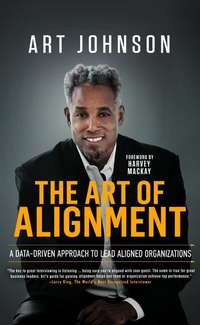
The A Data-Driven Approach to Lead Aligned Organizations
Description

'The key to great interviewing is listening-concentrating solely on the answer to be sure you're aligned with your guest. The same is true for great business leaders. Art's guide for gaining greater alignment can help any team or organization achieve top performance.'-Larry King, the world's most recognized interviewer
Leading organizations worldwide are evolving from the idea of employee engagement to that of organizational alignment. More important in today's virtual work environment, The Art of Alignment provides a roadmap to creating alignment to your mission and vision to distributed teams. Readers will discover the answers to:
- How bought in to the mission and vision are your employees?
- Are leaders across your organization aligned?
- How are your KPIs integrated into the organizational alignment?
The Art of Alignment takes a data-driven approach to organizational alignment. When executives add PURPOSE to engagement, coupled with measurement, your organization will experience market-leading performance. By following the 9-Pillars approach to leadership, your organization can increase key metrics by as much as 28% with each percentage point improvement in alignment.
The approach to organizational alignment is organized into four parts; how it can be measured, practiced and analyzed:
Part 1 - Alignment is the Responsibility of Leadership Part 2 - The Nine Pillars of Alignment Part 3 - The Data-Driven Leadership Playbook Part 4 - The Scientific Leader - Where Data Science Meets Leadership Decisions
By adopting a scientific approach to your leadership style, leaders are able to visualize how to improve employee engagement and performance.
Art realized the importance of alignment as his career job responsibilities have spanned multiple disciplines and industries. His competitive spirit, highlighted in collegiate athletics, inspired him to leverage his experience, knowledge and network to form ISI. Art developed a reputation for strong team leadership, cost savings and revenue generation. The creation of Orgametrics? has given Art the platform to share his successes on a broader scale.
Throughout his career, Art has had an impressive background in both sales and marketing. A strategic thinker and leader, he has an established record of driving revenue and growth through direct and indirect sales organizations. Art is known for delivering a mix of strategy, innovation, and process excellence that expand corporate capability and market leadership, strengthen competitive positions, and increase profitability in highly competitive industries. This dynamic leader is adept at driving alignment, developing executive-level relationships and fostering collaboration among diverse teams to consistently exceed expectations, increase productivity, and optimize performance.
In 1989, Art began his career in Information Technology with International Business Machines (IBM). He moved up in the ranks quickly and obtained a Master's degree from the University of St. Thomas, while working as a branch manager. US West (Qwest Communications) recruited Art for vice president of internet services in telecommunications. Soon after, he was promoted to corporate officer when he accepted the position of vice president and general manager of large business sales. In 2008, Art joined Medtronic Incorporated. Until 2013, he was vice president of sales in the Cardio Vascular Group. His successes in medical device, telecommunications and information technology are evident by his President Club participation in every industry.
Art holds a Bachelor's degree from Drake University, Des Moines, IA, an MBA from the University of St. Thomas, St. Paul, MN and he participated in the Executive Development Program at The Wharton School of Business in Philadelphia, Pennsylvania.
More details
Content
Chapter 1
The Role of Leadership in Alignment
"People buy into the leader before they buy into the vision."
- John Maxwell
There are a number of challenges to address when taking on a new leadership role. Perhaps your peers doubt you or, if you've been promoted ahead of them, are jealous of you. Perhaps those you've been assigned to lead have had bad past experiences with previous leaders or have had multiple leaders over a relatively short period of time. It could be a situation where you're coming into the position from outside the industry. There could even be preconceived notions about you due to your gender, race, age, education, or experience that need to be overcome. In fact, those are just a few issues new leaders-as well as experienced leaders taking on new positions-face every day. It comes with the territory. The important thing is to recognize what your specific challenges are and prepare to address them in a direct manner.
No matter your level of experience, coming in with grand plans to make sweeping changes is rarely the answer. You may have a desire, or even an executive order, to achieve drastically improved results, but doing so without first getting the lay of the land is a huge mistake. Getting an accurate picture of where you're starting from requires not only getting to know your direct reports and the culture of the organization, but the data related to current performance.
It should be relatively simple to get the statistics generated by past performance of the individuals on the team from the finance department. Determining why they performed at that level and what you can do about improving it is a whole different ballgame. Through the correct analytical processes, leaders can quickly figure out where their organizations stand relative to alignment and what it will take to become more aligned.
Why Alignment Matters
Alignment is defined as being in a position of agreement or an appropriate relative position. According to learning and development leader Steven W. Semler: "?Organizational alignment is the degree to which an organization's design, strategy and culture are cooperating to achieve the same desired goals. It is a measurement of the agreement or relative distance between several ideal and real elements of organizational life. Strong alignment requires agreement rather than conflict among the strategic, structural and cultural variables."1 Alignment occurs when individuals, systems, and processes are operating at optimal performance for the benefit of all an organization's stakeholders-both internal and external.
Measuring employee engagement has been a standard practice in organizations for decades. It was the next evolution after determining levels of employee job satisfaction that began in the 1970s. With measurement of engagement, employers learn not only if their people are satisfied with their jobs and leadership, but whether they really want to do their jobs at high levels.
The thought behind engagement is that employees who are engaged in their work will perform better. That makes perfect sense until it is revealed that individuals can be well-engaged but doing the wrong things. With alignment, on the other hand, there is a wholehearted match made between employee engagement and the mission and vision of the organization, which leads to an entirely different level of performance results.
When organizations are out of alignment, here's what happens:
-
1. Individuals are disconnected from the mission and vision.
-
2. Departments and teams rarely interact with each other. They become closed off to what is considered "outside interference."
-
3. There's a sense of mistrust of management and a lot of water cooler conversations, which are nothing more than a waste of valuable work time.
-
4. All or nearly all allotted sick days are taken each year.
-
5. Turnover is high-often due to burnout.
-
6. Training budgets are high because new individuals are constantly being onboarded.
On the flip side, when individuals, teams, divisions, and entire organizations operate in alignment, performance levels skyrocket in areas that truly make a difference:
-
1. Customer satisfaction increases.
-
2. Turnover is reduced.
-
3. There are fewer sick days taken.
-
4. Strategies for improvement come from every direction, not just from the top down.
-
5. There is a strong sense of purpose exhibited.
-
6. Individuals readily work across departments, teams, and divisions for the betterment of all.
-
7. Market share and profitability increase.
Having individuals perform better is a fundamental goal for any organization. However, having them do so while aligned to the common goal or purpose of the organization takes the cumulative effect of high performance to a new level. This higher level benefits the organization, the various individuals working there, and the end-user of the products and services produced.
Matching Performance to Purpose
Jack Welch is famous for saying, "Having the best idea doesn't mean you have a winner. You need the best people aligned to your mission who are excited every day to deliver results." In a data-driven business environment, working in alignment takes engagement a step further and adds a critical layer of purpose. It's one thing for employees to like their jobs and the people on their teams, which engagement reveals. However, when employees don't have any idea of how their roles connect to the reason the organization exists, they can't see their purpose, and there's a disconnect to the mission and vision. The result is a lower level of performance, especially when challenges arise.
There's a great story about John F. Kennedy that demonstrates this. In 1961, JFK was visiting NASA headquarters after challenging them to put a man on the moon. While touring the facility, he introduced himself to a man in the hallway and asked what he did there. The man explained that he was a janitor. Then, he stated, "I'm helping put a man on the moon!" The janitor recognized that by doing his job well, he was contributing to the bigger picture. He was engaged, recognized his purpose, and was aligned to the mission and vision of NASA.
Engagement + Purpose = Alignment
This book is committed to teaching what has been learned through the process of gaining and utilizing the right data to better understand the skills and talents of team members; getting commitment from employees around the company's structure and strategy, and building a culture that enables both the company and its employees to succeed at a higher level of performance through alignment.
Medtronic: Where It All Began
The genesis of this alignment process was through my experience at a company called Medtronic. While Medtronic is the world's largest medical device company, the majority of its sales and profits are generated from the U.S. health care system. Its devices include pacemakers, cardiac rhythm devices, electrosurgical hardware and instruments, cardiac mapping products and monitors, insulin pumps, testing products, and bone-conductive hearing devices. The goal of Medtronic's sales team is to provide quality products that improve patients' lives. The salespeople work directly and in-?person with physicians, making recommendations on which products would be in the best therapeutic interests of patients based on the physician's evaluations of their conditions.
As a reminder, I was brought into Medtronic from outside the industry as a diversity hire. In the minds of some, that gave me two strikes before I even got started. Bringing in those without industry experience was a very rare, if not unheard-of, occurrence in the medical device field. It was believed by most insiders that the possibility of achieving success was quite limited if you did not have solid industry experience. And, with those who focused on me as being a diversity hire, my track record of success at a Fortune 500 company meant very little.
I received a fair amount of rejection early on. This rejection came from my peers, who didn't believe I could succeed because of my lack of experience inside the industry, as well as the reps in that region who had been underserved by corporate. I was the third vice president they'd had in this role in a relatively short...
