

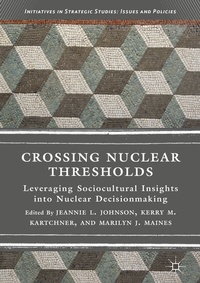
Crossing Nuclear Thresholds
Description

This book applies the cutting-edge socio-cultural model Cultural Topography Analytic Framework (CTAF) pioneered in the authors' earlier volume Strategic Culture and Weapons of Mass Destruction: Culturally Based Insights into Comparative National Security Policymaking (Palgrave Macmillan, 2009) with an eye towards isolating those vectors of nuclear decision-making on which the US might exert influence within a foreign state. The case studies included in this volume tackle a number of the nuclear challenges-termed "nuclear thresholds"-likely to be faced by the US and identify the most promising points of leverage available to American policymakers in ameliorating a wide range of over-the-horizon nuclear challenges. Because near and medium-term nuclear thresholds are likely to involve both allies and adversaries simultaneously, meaning that US response will require strategies tailored to both the perception of threat experienced by the actors in question, the value the actorsplace on their relationship with the US, and the domestic context driving decision-making. This volume offers a nuanced look at each actor's identity, national norms, values, and perceptual lens in order to offer culturally-focused insights into behavior and intentions.
More details
Other editions
Additional editions
Persons
Jeannie L. Johnson is Assistant Professor in the Political Science Department at Utah State University, USA.
Kerry M. Kartchner is Visiting Lecturer at the Bush School of Government and Public Policy at Texas A&M University, USA.
Marilyn Maines is Faculty Member at the Center for Advanced Study of Language at the University of Maryland in College Park, USA.
Content
1. Introduction: Sociocultural Approaches to Understanding Nuclear Thresholds.- 2. The Cultural Topography Analytic Framework.- 3. Iran's Strategic Culture: Implications for Nuclear Policy.- 4. Prospects for Proliferation in Saudi Arabia.- 5. Israeli Strategic Culture and the Iran "Preemption Scare" of 2009-2013.- 6. Cultural Underpinnings of Current Russian Nuclear and Security Strategy.- 7. Ukraine's Nuclear Culture: Past, Present, and Future.- 8. North Korea's Strategic Culture and its Evolving Nuclear Strategy.- 9. Conclusion: Using Strategic Culture to Explain Real-World Decisionmaking.
