

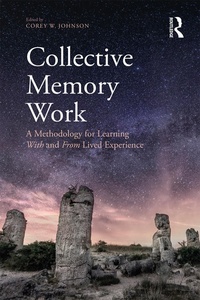
Collective Memory Work
A Methodology for Learning With and From Lived Experience
1st Edition
Published on 13. June 2018
166 pages
978-1-315-29869-6 (ISBN)
Description

The seemingly mundane events of daily life create a complex knowledge base of lived experience to be explored. But how does one research common experiences and account for context, culture, and identity? A dilemma arises because experience is not just embedded in events, but also in the socially constructed meanings associated with those events.
This book details the philosophical underpinnings, design features and implementation strategies of Collective Memory Work - a methodology frequently employed by social justice activists/scholars. Collective Memory Work can provide scholars with unique and nuanced ways to solve problems for and with their participants.
Most importantly, the chapters also detail projects and social justice in action, analysing their participants' real stories and experiences: projects that focus on LGBTQ youth, #blacklivesmatter activists, white faculty working at historically Black colleges and universities, men's media consumption and much more. Written in an engaging and accessible style, readers will come to understand the potential of their own qualitative research using Collective Memory Work.
This book details the philosophical underpinnings, design features and implementation strategies of Collective Memory Work - a methodology frequently employed by social justice activists/scholars. Collective Memory Work can provide scholars with unique and nuanced ways to solve problems for and with their participants.
Most importantly, the chapters also detail projects and social justice in action, analysing their participants' real stories and experiences: projects that focus on LGBTQ youth, #blacklivesmatter activists, white faculty working at historically Black colleges and universities, men's media consumption and much more. Written in an engaging and accessible style, readers will come to understand the potential of their own qualitative research using Collective Memory Work.
Reviews / Votes
This volume puts memory into action to enact a more socially just future. Drawing from rich theoretical terrain, interwoven with innovative and relevant research, the chapters showcase the rich potential of doing collective memory work to critically question the relations of memory, media, gender, sexuality, racialization, education, and more. This is an inspiring collection-looking back, I wish I'd had this book years ago; looking ahead, it'll take an important place in my future teaching and research.Brett Lashua, Reader in Leisure and Popular Culture, Leeds Beckett University
This book provides a compelling account of collective memory work as a methodological approach that wrestles with the complex workings of power in the generation and shared analysis of everyday experiences. The diverse chapters in the collection echo a desire to reveal the subtle and coercive effects of gender, race and sexuality that play out through discursive mediations that perpetuate injustice and normalised imperatives. By attuning to the embodied processes of remembering, speaking, listening, writing and enacting collective memory work this book reinvigorates an important methodological approach to transforming knowledge and also ourselves within it.
Simone Fullagar Chair, Physical Culture, Sport and Health research group, Department for Health, University of Bath
"The book is a very good resource for anybody doing qualitative research interested in working with this approach. This definitely could be graduate students since most of the research discussed in the book is doctoral research. But the book is also highly recommended for researchers and social activists in the broad field of education and social work. If the readers are not already convinced of what collective memory work can do, this book definitely will convince them!"
Brigitte Hipfl, University of Klagenfurt, Austria
More details
Edition
1. Auflage
Language
English
Place of publication
London
United Kingdom
Publishing group
Taylor & Francis Ltd
Target group
College/higher education
Product notice
Reflowable
Illustrations
1 Halftones, black and white; 1 Illustrations, black and white
ISBN-13
978-1-315-29869-6 (9781315298696)
Copyright in bibliographic data and cover images is held by Nielsen Book Services Limited or by the publishers or by their respective licensors: all rights reserved.
Schweitzer Classification
Other editions
Additional editions
Book
06/2018
1st Edition
Routledge
€205.90
Shipment within 10-20 days
Book
06/2018
1st Edition
Routledge
€71.90
Shipment within 10-20 days
Person
Corey W. Johnson is a Professor in the Faculty of Applied Health Sciences at the University of Waterloo. His research focuses on the power relations between dominant (white, male, heterosexual, etc.) and non-dominant populations in the cultural contexts of leisure. He currently co-edits Leisure Sciences and has written Fostering Social Justice through Qualitative Research: A Methodological Guide (Routledge 2015)
Content
Acknowledgements
Part One
1. The History and Methodological Tradition(s) of Collective Memory Work Corey W. Johnson, Dana B. Kivel and Luc S. Cousineau
Part Two
2. How Does Media Consumption Contribute to Understandings of Manhood According to Race and Sexual Identity? Rudy Dunlap and Corey W. Johnson
3. How do Adults Remember Their Parents' Reaction to Gender Non-Conformity? Rebecca Eaker, Anneliese Singh and Corey W. Johnson
4. How Can Memories of Enacted Masculinity Create More Effective Elementary School Teachers? Chris Hansen and Corey W. Johnson
5. What are the Experiences of White faculty at Historically Black Colleges and Universities? Needham Yancey Gulley, Anthony F. Patterson and Corey W. Johnson
6. How Do We Sustain Activism?: LGBTQ and Black People Share Their Positive and Negative Experiences Jemelleh Coes, Needham Yancey Gulley and Corey W. Johnson
7. Using Collective Memory Work to Create Safer Schools for Queer and Trans Students: A Story of Love, Liberation, and Transformation Anneliese A. Singh and Corey W. Johnson
Part Three
8. Why Shouldn't I Do Collective Memory Work? Potential Challenges and Pitfalls Nikki Laird and Corey W. Johnson
9. Are you next? Common Elements of Collective Memory Work Corey W. Johnson and Harrison Oakes
Contributing Authors
Part One
1. The History and Methodological Tradition(s) of Collective Memory Work Corey W. Johnson, Dana B. Kivel and Luc S. Cousineau
Part Two
2. How Does Media Consumption Contribute to Understandings of Manhood According to Race and Sexual Identity? Rudy Dunlap and Corey W. Johnson
3. How do Adults Remember Their Parents' Reaction to Gender Non-Conformity? Rebecca Eaker, Anneliese Singh and Corey W. Johnson
4. How Can Memories of Enacted Masculinity Create More Effective Elementary School Teachers? Chris Hansen and Corey W. Johnson
5. What are the Experiences of White faculty at Historically Black Colleges and Universities? Needham Yancey Gulley, Anthony F. Patterson and Corey W. Johnson
6. How Do We Sustain Activism?: LGBTQ and Black People Share Their Positive and Negative Experiences Jemelleh Coes, Needham Yancey Gulley and Corey W. Johnson
7. Using Collective Memory Work to Create Safer Schools for Queer and Trans Students: A Story of Love, Liberation, and Transformation Anneliese A. Singh and Corey W. Johnson
Part Three
8. Why Shouldn't I Do Collective Memory Work? Potential Challenges and Pitfalls Nikki Laird and Corey W. Johnson
9. Are you next? Common Elements of Collective Memory Work Corey W. Johnson and Harrison Oakes
Contributing Authors
