

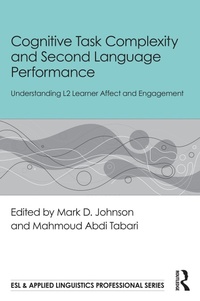
Cognitive Task Complexity and Second Language Performance
Understanding L2 Learner Affect and Engagement
Published on 23. June 2025
276 pages
978-1-040-36814-5 (ISBN)
Description

Cognitive Task Complexity and Second Language Performance provides an overview of research focusing on the effects of cognitive task complexity (CTC) on second language (L2) performance. The edited volume brings together renowned scholars in the field who present data-driven insights into the intricate relationships between CTC and L2 performance, drawing on a combination of empirical studies and theoretical analyses.
Each section summarizes the intersection of task complexity frameworks and models of second language production; synthesizes critical issues and research findings; and moves beyond the routine discussion of task complexity features and models of speaking, extending the discussion to the interface of task complexity features and (a) learner engagement, (b) virtual interaction, and (c) corpus linguistics. It also delves into the interface of CTC and technology, exploring how digital tools and resources can enhance task complexity and ultimately impact L2 performance. Overall, this edited volume not only consolidates the existing research on CTC and L2 performance but also highlights areas that require further investigation.
In charting a course for future research and pedagogy, the book is a valuable resource for students, scholars, researchers, and practitioners seeking to deepen their understanding of CTC and its impact on second language acquisition.
Each section summarizes the intersection of task complexity frameworks and models of second language production; synthesizes critical issues and research findings; and moves beyond the routine discussion of task complexity features and models of speaking, extending the discussion to the interface of task complexity features and (a) learner engagement, (b) virtual interaction, and (c) corpus linguistics. It also delves into the interface of CTC and technology, exploring how digital tools and resources can enhance task complexity and ultimately impact L2 performance. Overall, this edited volume not only consolidates the existing research on CTC and L2 performance but also highlights areas that require further investigation.
In charting a course for future research and pedagogy, the book is a valuable resource for students, scholars, researchers, and practitioners seeking to deepen their understanding of CTC and its impact on second language acquisition.
More details
Series
Language
English
Place of publication
London
United Kingdom
Publishing group
Taylor & Francis Ltd
Target group
College/higher education
Professional and scholarly
ELT/ESL
Illustrations
27 Tables, black and white; 6 Line drawings, black and white; 6 Illustrations, black and white
File size
5,53 MB
ISBN-13
978-1-040-36814-5 (9781040368145)
Copyright in bibliographic data and cover images is held by Nielsen Book Services Limited or by the publishers or by their respective licensors: all rights reserved.
Schweitzer Classification
Other editions
Additional editions
Mark D. Johnson | Mahmoud Abdi Tabari
Cognitive Task Complexity and Second Language Performance
Understanding L2 Learner Affect and Engagement
Book
06/2025
1st Edition
Routledge
€67.90
Shipment within 10-20 days
Mark D. Johnson | Mahmoud Abdi Tabari
Cognitive Task Complexity and Second Language Performance
Understanding L2 Learner Affect and Engagement
Book
06/2025
1st Edition
Routledge
€205.80
Shipment within 10-20 days
Persons
Mark D. Johnson is Associate Professor of TESOL and Applied Linguistics in the Department of English at East Carolina University, where he teaches linguistics and TESOL classes. His research focuses on cognition in second language writing.
Mahmoud Abdi Tabari is Teaching Assistant Professor of TESOL and Writing Studies in the Department of English at the University of Nevada, Reno (UNR). His research focuses on second language acquisition, second language writing, and task-based language teaching.
Mahmoud Abdi Tabari is Teaching Assistant Professor of TESOL and Writing Studies in the Department of English at the University of Nevada, Reno (UNR). His research focuses on second language acquisition, second language writing, and task-based language teaching.
Content
Contents
Part I: Background: CTC and the Skills
Chapter 1: A Brief History of Cognition in L2 Performance
Mark D. Johnson and Mahmoud Abdi Tabari
Chapter 2: The Role of Task Complexity in Speech Production and Dialogue Models
Ana-Maria Nuevo
Chapter 3: A Methodological Review of the Research on Task Complexity in Second Language Oral Production
Hao Lin and Shaofeng Li
Chapter 4: New Insights: Modeling Second Language Writing Integrating Cognitive Task Complexity
Ting Sophia Xu and Lawrence Jun Zhang
Chapter 5: Writing: Critical Issues
Jookyoung Jung and Honglan Wang
Part II: CTC and the Learner
Chapter 6: Learner Engagement: Theoretical Perspectives
Daniel O. Jackson
Chapter 7: Learner Engagement: Critical Issues
Agnes Albert
Chapter 8: Emotions and Task Complexity: Proposing a Theoretical Framework and Setting a Research Agenda
Chengchen Li
Part III: CTC and Technology
Chapter 9: Virtual Interaction
Nicole Ziegler and Ayano Kawasaki
Chapter 10: Task Complexity and Collaborative Writing in a Virtual Environment
Meixiu Zhang
Chapter 11: Corpus Linguistics
Yuanheng (Arthur) Wang and Xiaofei Lu
Part IV: Future Directions and Conclusion
Chapter 12: Future Directions: A Methodological Synthesis of Cognitive Task Complexity Research
Rebecca Adams
Chapter 13: Conclusion: Cognitive Task Complexity-Past, Present, and Future
Mahmoud Abdi Tabari and Mark D. Johnson
Part I: Background: CTC and the Skills
Chapter 1: A Brief History of Cognition in L2 Performance
Mark D. Johnson and Mahmoud Abdi Tabari
Chapter 2: The Role of Task Complexity in Speech Production and Dialogue Models
Ana-Maria Nuevo
Chapter 3: A Methodological Review of the Research on Task Complexity in Second Language Oral Production
Hao Lin and Shaofeng Li
Chapter 4: New Insights: Modeling Second Language Writing Integrating Cognitive Task Complexity
Ting Sophia Xu and Lawrence Jun Zhang
Chapter 5: Writing: Critical Issues
Jookyoung Jung and Honglan Wang
Part II: CTC and the Learner
Chapter 6: Learner Engagement: Theoretical Perspectives
Daniel O. Jackson
Chapter 7: Learner Engagement: Critical Issues
Agnes Albert
Chapter 8: Emotions and Task Complexity: Proposing a Theoretical Framework and Setting a Research Agenda
Chengchen Li
Part III: CTC and Technology
Chapter 9: Virtual Interaction
Nicole Ziegler and Ayano Kawasaki
Chapter 10: Task Complexity and Collaborative Writing in a Virtual Environment
Meixiu Zhang
Chapter 11: Corpus Linguistics
Yuanheng (Arthur) Wang and Xiaofei Lu
Part IV: Future Directions and Conclusion
Chapter 12: Future Directions: A Methodological Synthesis of Cognitive Task Complexity Research
Rebecca Adams
Chapter 13: Conclusion: Cognitive Task Complexity-Past, Present, and Future
Mahmoud Abdi Tabari and Mark D. Johnson
