

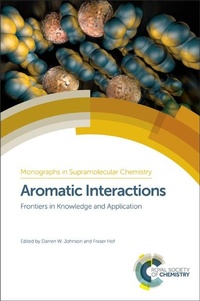
Aromatic Interactions
Frontiers in Knowledge and Application
1st Edition
Published on 15. November 2016
282 pages
978-1-78262-662-6 (ISBN)
Description

The field of aromatic interactions, the fundamental nature of substituent effects and the identification of contacts between anions and aromatic systems have generated stimulating arguments in recent years. New theoretical frameworks have been developed and tested and aromatic interactions have emerged as potential solutions for varied problems in biology and materials science.
This book provides a wide ranging survey of the latest findings and advances surrounding aromatic interactions, stretching from the fundamentals to modern applications in synthesis, biology and materials chemistry. It also discusses computational, experimental and analytical approaches to understanding these interactions, including pi-pi, anion-pi, and cation-pi interactions.
Aromatic Interactions: Frontiers in Knowledge and Application is a useful text for advanced students and researchers, and appeals to those working within the fields of supramolecular chemistry, computational chemistry and thermodynamics.
This book provides a wide ranging survey of the latest findings and advances surrounding aromatic interactions, stretching from the fundamentals to modern applications in synthesis, biology and materials chemistry. It also discusses computational, experimental and analytical approaches to understanding these interactions, including pi-pi, anion-pi, and cation-pi interactions.
Aromatic Interactions: Frontiers in Knowledge and Application is a useful text for advanced students and researchers, and appeals to those working within the fields of supramolecular chemistry, computational chemistry and thermodynamics.
More details
Series
Language
English
Place of publication
Cambridge
United Kingdom
Target group
Professional and scholarly
ISBN-13
978-1-78262-662-6 (9781782626626)
Copyright in bibliographic data and cover images is held by Nielsen Book Services Limited or by the publishers or by their respective licensors: all rights reserved.
Schweitzer Classification
Other editions
Additional editions
Book
11/2016
Royal Society of Chemistry
€205.50
Shipment within 3-4 weeks
E-Book
11/2016
1st Edition
Royal Society of Chemistry
€219.99
Available for download
Persons
Darren W. Johnson received his BS in Chemistry at the University of Texas at Austin in 1996, where he performed undergraduate research under the direction of Prof. Jonathan Sessler. He earned his PhD in Chemistry in 2000 from UC-Berkeley working with Prof. Kenneth Raymond, and he then spent two years at the Scripps Research Institute as an NIH post-doctoral fellow with Prof. Julius Rebek, Jr. He joined the chemistry faculty at the University of Oregon in 2003, where he holds the rank of Professor. Research in his group uses supramolecular chemistry as a tool to explore a variety of problems in coordination chemistry, molecule/ion recognition and inorganic cluster synthesis.
Fraser Hof received his B.Sc. at the University of Alberta in 1998, completing an Honour's thesis with Prof. Neil Branda. He carried out his Ph.D. studies (2003) in self-assembly at the Scripps Research Institute with Julius Rebek, Jr., and was a post-doctoral fellow (2003-2005) in medicinal chemistry with Francois Diederich at ETH Zurich. He has been at the at the University of Victoria, where he is currently the Canada Research Chair in Supramolecular and Medicinal Chemistry, since 2005. His research program revolves around molecular recognition and epigenetic protein methylation pathways. It includes basic research projects in protein binding, molecular recognition in pure water, and solvation and salt effects in competitive media. Applications include efforts to make supramolecular affinity reagents and sensors as tools for epigenetics research, as well as medicinal chemistry approaches that target the 'aromatic cage' binding pockets of several epigenetic reader proteins.
Fraser Hof received his B.Sc. at the University of Alberta in 1998, completing an Honour's thesis with Prof. Neil Branda. He carried out his Ph.D. studies (2003) in self-assembly at the Scripps Research Institute with Julius Rebek, Jr., and was a post-doctoral fellow (2003-2005) in medicinal chemistry with Francois Diederich at ETH Zurich. He has been at the at the University of Victoria, where he is currently the Canada Research Chair in Supramolecular and Medicinal Chemistry, since 2005. His research program revolves around molecular recognition and epigenetic protein methylation pathways. It includes basic research projects in protein binding, molecular recognition in pure water, and solvation and salt effects in competitive media. Applications include efforts to make supramolecular affinity reagents and sensors as tools for epigenetics research, as well as medicinal chemistry approaches that target the 'aromatic cage' binding pockets of several epigenetic reader proteins.
Content
Opening Perspective: Frontiers in Aromatic Interactions from Fundamental Understanding to Applications;
Chapter 1: Rethinking the term 'pi-stacking';
Chapter 2: Modern Computational Approaches in Aromatic Interactions;
Chapter 3: Thermodynamics of Aromatic Interactions;
Chapter 4: Anion-pi Interactions in Solution;
Chapter 5: Developing a Theoretical Understanding of the Interaction of Anions with Aromatic Rings;
Chapter 6: Basic Science in Aromatic Interactions;
Chapter 7: Main Group-pi interactions;
Chapter 8: The role of aromatic interactions in directing organic reactions;
Chapter 9: Applications of aromatic interactions in organic electronics/surface reactions;
Chapter 10: Cation-pi interactions in biomolecular recognition;
Chapter 11: Aromatic interactions in nanomaterials;
Chapter 12: Molecular recognition of aromatic peptides and proteins
Chapter 1: Rethinking the term 'pi-stacking';
Chapter 2: Modern Computational Approaches in Aromatic Interactions;
Chapter 3: Thermodynamics of Aromatic Interactions;
Chapter 4: Anion-pi Interactions in Solution;
Chapter 5: Developing a Theoretical Understanding of the Interaction of Anions with Aromatic Rings;
Chapter 6: Basic Science in Aromatic Interactions;
Chapter 7: Main Group-pi interactions;
Chapter 8: The role of aromatic interactions in directing organic reactions;
Chapter 9: Applications of aromatic interactions in organic electronics/surface reactions;
Chapter 10: Cation-pi interactions in biomolecular recognition;
Chapter 11: Aromatic interactions in nanomaterials;
Chapter 12: Molecular recognition of aromatic peptides and proteins
