

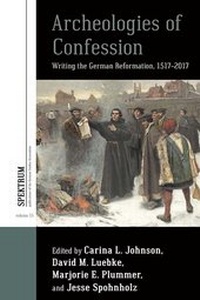
Archeologies of Confession
Writing the German Reformation, 1517-2017
1st Edition
Published on 1. May 2017
352 pages
978-1-78533-541-9 (ISBN)
Description

Modern religious identities are rooted in collective memories that are constantly made and remade across generations. How do these mutations of memory distort our picture of historical change and the ways that historical actors perceive it? Can one give voice to those whom history has forgotten? The essays collected here examine the formation of religious identities during the Reformation in Germany through case studies of remembering and forgetting-instances in which patterns and practices of religious plurality were excised from historical memory. By tracing their ramifications through the centuries, Archeologies of Confession carefully reconstructs the often surprising histories of plurality that have otherwise been lost or obscured.
Reviews / Votes
"Among the many edited volumes that were published 2017 on the occasion of the 350th anniversary of the Reformation this volume stands out because of the variety of its source materials on the one hand and its clear thematic structure on the other. Accordingly, this volume makes an important contribution to the historical reappraisal of the Reformation and maps out paths of future research." * Zeitschrift fuer Historische Forschung"...a valuable collection through and through." * Historische Zeitschrift
"As a group, the essays take up a variety of our predecessors and are carefully researched and argued. There is not a weak link among them." * German History
"This is a wide-ranging collection which raises some challenging questions for historians about the reliability of earlier scholarship. Two key issues emerge: the danger of assuming a confessional clarity and separation in the early years of the Reformation (or even later) which did not actually come into being until later, and the need to check even accepted narratives of identity formation against archival material. The points are well made and the examples adduced are convincing evidence for this double need." * The English Historical Review
"This impressive collection of essays deals effectively with the question of confessional histories, offering a convincing evaluation of how the events of the Reformation were regarded and interpreted by contemporaries as well as later generations." * Andrew Spicer, Oxford Brookes University
"Archeologies of Confession comprises a fascinating series of original and stimulating essays. It will be invaluable for scholars of the Reformation and of German religious history more broadly." * Joachim Whaley, Gonville and Caius College, Cambridge
More details
Series
Language
English
Place of publication
Oxford
United Kingdom
Target group
Professional and scholarly
Illustrations
Bibliography; Index; 1 Illustrations
ISBN-13
978-1-78533-541-9 (9781785335419)
DOI
10.3167/9781785335402
Copyright in bibliographic data and cover images is held by Nielsen Book Services Limited or by the publishers or by their respective licensors: all rights reserved.
Schweitzer Classification
Other editions
Additional editions
Carina L. Johnson | David M. Luebke | Marjorie Elizabeth Plummer
Archeologies of Confession
Writing the German Reformation, 1517-2017
Book
06/2019
1st Edition
Berghahn Books
€42.30
Shipment within 3-4 weeks
Carina L. Johnson | David M. Luebke | Marjorie Elizabeth Plummer
Archeologies of Confession
Writing the German Reformation, 1517-2017
Book
05/2017
1st Edition
Berghahn Books
€147.70
Shipment within 3-4 weeks
Persons
Carina L. Johnson is Professor of History at Pitzer College and serves as extended faculty at Claremont Graduate University. She specializes in the cultural history of the sixteenth-century Habsburg Empire, particularly in relation to the extra-European world. Her publications include Cultural Hierarchy in Sixteenth-Century Europe: The Ottomans and Mexicans (2011).
Content
List of Illustrations
Introduction: Reformations Lost and Found
Carina L. Johnson
PART I: SILENCING PLURALITY
Chapter 1. Misremembering Hybridity: The Myth of Goldenstedt
David M. Luebke
Chapter 2. A Luther for Everyone: Irenicism and Orthodoxy at the German Reformation Anniversaries of 1817
Stan Landry
Chapter 3. Challenging Plurality: Wilhelm Horning and the Histories of Alsatian Lutheranism
Anthony J. Steinhoff
Chapter 4. Confessional Histories of Women and the Reformation from the Eightteenth to the Twenty-First Century
Merry Wiesner-Hanks
Chapter 5. Catholics as Foreign Bodies: The County of Mark as a Protestant Territory in Nineteenth- and Twentieth-Century Prussian Historiography
Ralf-Peter Fuchs
PART II: RECOVERING PLURALITY
Chapter 6. A Catholic Genealogy of Protestant Reason
Richard Schaefer
Chapter 7. Fighting or Fostering Plurality? Ernst Salomon Cyprian as a Historian of Lutheranism in the Early Eighteenth Century
Alexander Schunka
Chapter 8. Heresy and the Protestant Enlightenment: Johann Lorenz von Mosheim's History of Michael Servetus
Michael Printy
Chapter 9. The Great Fire of 1711: Reconceptualizing the Jewish Ghetto and Jewish-Christian Relations in Early Modern Frankfurt am Main
Dean Phillip Bell
PART III: EXCAVATING HISTORIES OF RELIGION
Chapter 10. The Early Roots of Confessional Memory. Martin Luther Burns the Papal Bull on 10 December 1520
Natalie Krentz
Chapter 11. Early Modern German Historians Confront the Reformation's First Executions
Robert Christman
Chapter 12. Prison Tales: The Miraculous Escape of Stephen Agricola and the Creation of Lutheran Heroes during the Sixteenth Century
Marjorie E. Plummer
Chapter 13. Invented Memories: The 'Convent of Wesel' and the Origins of German and Dutch Calvinism
Jesse Spohnholz
PART IV: REMEMBERING AND FORGETTING
Chapter 14. 'Our Misfortune': National Unity versus Religious Plurality in the Making of Modern Germany
Thomas A. Brady, Jr.
Index
Introduction: Reformations Lost and Found
Carina L. Johnson
PART I: SILENCING PLURALITY
Chapter 1. Misremembering Hybridity: The Myth of Goldenstedt
David M. Luebke
Chapter 2. A Luther for Everyone: Irenicism and Orthodoxy at the German Reformation Anniversaries of 1817
Stan Landry
Chapter 3. Challenging Plurality: Wilhelm Horning and the Histories of Alsatian Lutheranism
Anthony J. Steinhoff
Chapter 4. Confessional Histories of Women and the Reformation from the Eightteenth to the Twenty-First Century
Merry Wiesner-Hanks
Chapter 5. Catholics as Foreign Bodies: The County of Mark as a Protestant Territory in Nineteenth- and Twentieth-Century Prussian Historiography
Ralf-Peter Fuchs
PART II: RECOVERING PLURALITY
Chapter 6. A Catholic Genealogy of Protestant Reason
Richard Schaefer
Chapter 7. Fighting or Fostering Plurality? Ernst Salomon Cyprian as a Historian of Lutheranism in the Early Eighteenth Century
Alexander Schunka
Chapter 8. Heresy and the Protestant Enlightenment: Johann Lorenz von Mosheim's History of Michael Servetus
Michael Printy
Chapter 9. The Great Fire of 1711: Reconceptualizing the Jewish Ghetto and Jewish-Christian Relations in Early Modern Frankfurt am Main
Dean Phillip Bell
PART III: EXCAVATING HISTORIES OF RELIGION
Chapter 10. The Early Roots of Confessional Memory. Martin Luther Burns the Papal Bull on 10 December 1520
Natalie Krentz
Chapter 11. Early Modern German Historians Confront the Reformation's First Executions
Robert Christman
Chapter 12. Prison Tales: The Miraculous Escape of Stephen Agricola and the Creation of Lutheran Heroes during the Sixteenth Century
Marjorie E. Plummer
Chapter 13. Invented Memories: The 'Convent of Wesel' and the Origins of German and Dutch Calvinism
Jesse Spohnholz
PART IV: REMEMBERING AND FORGETTING
Chapter 14. 'Our Misfortune': National Unity versus Religious Plurality in the Making of Modern Germany
Thomas A. Brady, Jr.
Index
