

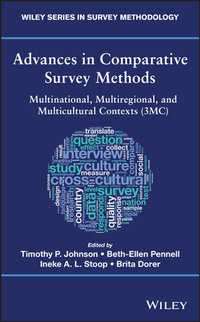
Advances in Comparative Survey Methods
Description

Advances in Comparative Survey Methodology examines the most recent advances in methodology and operations as well as the technical developments in international survey research. With contributions from a panel of international experts, the text includes information on the use of Big Data in concert with survey data, collecting biomarkers, the human subject regulatory environment, innovations in data collection methodology and sampling techniques, use of paradata across the survey lifecycle, metadata standards for dissemination, and new analytical techniques.
This important resource:
* Contains contributions from key experts in their respective fields of study from around the globe
* Highlights innovative approaches in resource poor settings, and innovative approaches to combining survey and other data
* Includes material that is organized within the total survey error framework
* Presents extensive and up-to-date references throughout the book
Written for students and academic survey researchers and market researchers engaged in comparative projects, this text represents a unique collaboration that features the latest methodologies and research on global comparative surveys.
More details
Other editions
Additional editions
Persons
Timothy P. Johnson, PhD, Director of the Survey Research Laboratory and Professor of Public Administration, University of Illinois at Chicago.
Beth-Ellen Pennell, Director of International Survey Operations at the Survey Research Center, Institute for Social Research, University of Michigan.
Ineke A. L. Stoop, PhD, Head Methodology Department at The Netherlands Institute for Social Research|SCP and member of the Core Scientific Team of the European Social Survey.
Brita Dorer, researcher at GESIS - Leibniz Institute for the Social Sciences in Mannheim, Germany and head of the translation team of the European Social Survey (ESS).
Content
Preface xix
Notes on Contributors xxiii
Section I Introduction 1
1 The Promise and Challenge of 3MC Research 3
Timothy P. Johnson, Beth-Ellen Pennell, Ineke A.L. Stoop, and Brita Dorer
2 Improving Multinational, Multiregional, and Multicultural (3MC) Comparability Using the Total Survey Error (TSE) Paradigm 13
Tom W. Smith
3 Addressing Equivalence and Bias in Cross-cultural Survey Research Within a Mixed Methods Framework 45
Jose-Luis Padilla, Isabel Benitez, and Fons J.R. van de Vijver
Section II Sampling Approaches 65
4 Innovative Sample Designs Using GIS Technology 67
Stephanie Eckman, Kristen Himelein, and Jill A. Dever
5 Within-household Selection of Respondents 93
Achim Koch
Section III Cross-cultural Questionnaire Design and Testing 113
6 Overview of Questionnaire Design and Testing 115
Julie A.J. de Jong, Brita Dorer, Sunghee Lee, Ting Yan, and Ana Villar
7 Sensitive Questions in Comparative Surveys 139
Anna V. Andreenkova and Debra Javeline
8 Implementing a Multinational Study of Questionnaire Design 161
Henning Silber, Tobias H. Stark, Annelies G. Blom, and Jon A. Krosnick
9 Using Anchoring Vignettes to Correct for Differential Response Scale Usage in 3MC Surveys 181
Mengyao Hu, Sunghee Lee, and Hongwei Xu
10 Conducting Cognitive Interviewing Studies to Examine Survey Question Comparability 203
Kristen Miller
11 Setting Up the Cognitive Interview Task for Non-English-speaking Participants in the United States 227
Hyunjoo Park and Patricia L. Goerman
12 Working Toward Comparable Meaning of Different Language Versions of Survey Instruments: Do Monolingual and Bilingual Cognitive Testing Respondents Help to Uncover the Same Issues? 251
Patricia L. Goerman, Mikelyn Meyers, Mandy Sha, Hyunjoo Park, and Alisu Schoua-Glusberg
13 Examining the Comparability of Behavior Coding Across Cultures 271
Timothy P. Johnson, Allyson Holbrook, Young Ik Cho, Sharon Shavitt,Noel Chavez, and Saul Weiner
Section IV Languages, Translation, and Adaptation 293
14 How to Choose Interview Language in Different Countries 295
Anna V. Andreenkova
15 Can the Language of Survey Administration Influence Respondents' Answers? 325
Emilia Peytcheva
16 Documenting the Survey Translation and Monitoring Process 341
Dorothée Behr, Steve Dept, and Elica Krajceva
17 Preventing Differences in Translated Survey Items Using the Survey Quality Predictor 357
Diana Zavala-Rojas, Willem E. Saris, and Irmtraud N. Gallhofer
Section V Mixed Mode and Mixed Methods 385
18 The Design and Implementation of Mixed-mode Surveys 387
Edith D. de Leeuw, Z. Tuba Suzer-Gurtekin, and Joop J. Hox
19 Mixed-mode Surveys: Design, Estimation, and Adjustment Methods 409
Z. Tuba Suzer-Gurtekin, Richard Valliant, Steven G. Heeringa,and Edith D. de Leeuw
20 Mixed Methods in a Comparative Context: Technology and New Opportunities for Social Science Research 431
Nathalie E. Williams and Dirgha J. Ghimire
Section VI Response Styles 455
21 Cross-cultural Comparability of Response Patterns of Subjective Probability Questions 457
Sunghee Lee, Florian Keusch, Norbert Schwarz, Mingnan Liu, and Z. Tuba Suzer-Gurtekin
22 Response Styles in Cross-cultural Surveys 477
Mingnan Liu, Z. Tuba Suzer-Gurtekin, Florian Keusch, and Sunghee Lee
23 Examining Translation and Respondents' Use of Response Scales in 3MC Surveys 501
Ting Yan and Mengyao Hu
Section VII Data Collection Challenges and Approaches 519
24 Data Collection in Cross-national and International Surveys:Regional Case Studies 521
Kristen Cibelli Hibben, Beth-Ellen Pennell, Sarah M. Hughes,Yu-chieh (Jay) Lin, and Jennifer Kelley
25 Survey Data Collection in Sub-Saharan Africa (SSA): Challenges, Strategies, and Opportunities 533
Sarah M. Hughes and Yu-chieh (Jay) Lin
26 Survey Challenges and Strategies in the Middle East and Arab Gulf Regions 555
Justin Gengler, Kien Trung Le, and David Howell
27 Data Collection in Cross-national and International Surveys: Latin America and the Caribbean 569
J. Daniel Montalvo, Mitchell A. Seligson, and Elizabeth J. Zechmeister
28 Survey Research in India and China 583
Charles Q. Lau, Ellen Marks, and Ashish Kumar Gupta
29 Best Practices for Panel Maintenance and Retention 597
Nicole Watson, Eva Leissou, Heidi Guyer, and Mark Wooden
30 Collection of Biomeasures in a Cross-national Setting: Experiences in SHARE 623
Luzia M. Weiss, Joseph W. Sakshaug, and Axel Borsch-Supan
31 Multinational Event History Calendar Interviewing 643
Yfke P. Ongena, Marieke Haan, and Wil Dijkstra
32 Ethical Considerations in the Total Survey Error Context 665
Julie A.J. de Jong
33 Linking Auxiliary Data to Survey Data: Ethical and Legal Challenges in Europe and the United States 683
Kirstine Kolsrud, Linn-Merethe Rød, and Katrine U. Segadal
Section VIII Quality Control and Monitoring 705
34 Organizing and Managing Comparative Surveys 707
Lesli Scott, Peter Ph. Mohler, and Kristen Cibelli Hibben
35 Case Studies on Monitoring Interviewer Behavior in International and Multinational Surveys 731
Zeina Mneimneh, Lars Lyberg, Sharan Sharma, Mahesh Vyas,Dhananjay Bal Sathe, Frederic Malter, and Yasmin Altwaijri
36 New Frontiers in Detecting Data Fabrication 771
Michael Robbins
Section IX Nonresponse 807
37 Comparing Nonresponse and Nonresponse Biases in Multinational,Multiregional, and Multicultural Contexts 809
James Wagner and Ineke A.L. Stoop
38 Geographic Correlates of Nonresponse in California: A Cultural Ecosystems Perspective 835
Matt Jans, Kevin McLaughlin, Joseph Viana, David Grant, Royce Park and Ninez A. Ponce
39 Additional Languages and Representativeness 859
Oliver Lipps and Michael Ochsner
Section X Multi-group Analysis 879
40 Measurement Invariance in International Large-scale Assessments:Integrating Theory and Method 881
Deana Desa, Fons J.R. van de Vijver, Ralph Carstens and Wolfram Schulz
41 Approximate Measurement Invariance 911
Kimberley Lek, Daniel Oberski, Eldad Davidov, Jan Cieciuch, Daniel Seddig, and Peter Schmidt
42 Data Harmonization, Data Documentation, and Dissemination 933
Peter Granda
43 Basic Principles of Survey Data Recycling 937
Kazimierz M. Slomczynski and Irina Tomescu-Dubrow
44 Survey Data Harmonization and the Quality of Data Documentation in Cross-national Surveys 963
Marta Kolczynska and Matthew Schoene
45 Identification of Processing Errors in Cross-national Surveys 985
Olena Oleksiyenko, Ilona Wysmulek, and Anastas Vangeli
46 Item Metadata as Controls for Ex Post Harmonization of International Survey Projects 1011
Marta Kolczynska and Kazimierz M. Slomczynski
47 The Past, Present, and Future of Statistical Weights in International Survey Projects: Implications for Survey Data Harmonization 1035
Marcin W. Zielinski, Przemek Powalko, and Marta Kolczynska
Section XII Looking Forward 1053
48 Prevailing Issues and the Future of Comparative Surveys 1055
Lars Lyberg, Lilli Japec, and Can Tongur
Wiley Series In Survey Methodology 1083
Index 1087
Notes on Contributors
Yasmin Altwaijri
King Faisal Specialized Hospital and Research Center
Riyadh
Kingdom Saudi Arabia
Anna V. Andreenkova
Institute for Comparative Social Research (CESSI)
Moscow
Russia
Dorothée Behr
GESIS - Leibniz Institute for the Social Sciences
Mannheim
Germany
Isabel Benitez
Department of Psychology
Universidad Loyola Andalucía
Seville
Spain
Annelies G. Blom
Department of Political Science and Collaborative Research Center 884 "Political Economy of Reforms"
University of Mannheim
Mannheim
Germany
Axel Börsch-Supan
Max Planck Institute for Social Law and Social Policy
Munich
Germany
Ralph Carstens
International Association for the Evaluation of Educational Achievement (IEA)
Hamburg
Germany
Noel Chavez
School of Public Health
University of Illinois at Chicago
Chicago, IL
USA
Young Ik Cho
Zilber School of Public Health
University of Wisconsin-Milwaukee
Milwaukee, WI
USA
Kristen Cibelli Hibben
Survey Research Center
University of Michigan
Ann Arbor, MI
USA
Jan Cieciuch
University Research Priority Program "Social Networks"
University of Zurich
Zurich
Switzerland
and
Institute of Psychology
Cardinal Wyszynski University in Warsaw
Warsaw
Poland
Eldad Davidov
Institute of Sociology and Social Psychology
University of Cologne
Cologne
Germany
and
Department of Sociology and University Research Priority Program "Social Networks"
University of Zurich
Zurich
Switzerland
Julie A.J. de Jong
Survey Research Center
University of Michigan
Ann Arbor, MI
USA
Edith D. de Leeuw
Department of Methodology and Statistics
Utrecht University
Utrecht
The Netherlands
Steve Dept
cApStAn Linguistic Quality Control
Brussels
Belgium
Deana Desa
International Association for the Evaluation of Educational Achievement (IEA)
Hamburg
Germany
and
TOM TAILOR GmbHHamburgGermany
Jill A. Dever
RTI International
Washington, DC
USA
Wil Dijkstra
Faculty of Social Sciences
VU University Amsterdam
Amsterdam
The Netherlands
Brita Dorer
GESIS - Leibniz Institute for the Social Sciences
Mannheim
Germany
Stephanie Eckman
RTI International
Washington, DC
USA
Irmtraud N. Gallhofer
European Social Survey
RECSM
Universitat Pompeu Fabra
Barcelona
Spain
Justin Gengler
Social and Economic Survey Research Institute (SESRI)
Qatar University
Doha
Qatar
Dirgha J. Ghimire
Population Studies Center
University of Michigan
Ann Arbor, MI
USA
Patricia L. Goerman
Center for Survey Measurement
US Census Bureau
Washington, DC
USA
Peter Granda
Inter-university Consortium for Political and Social Research
University of Michigan
Ann Arbor, MI
USA
David Grant
RAND
Santa Monica, CA
USA
Heidi Guyer
Survey Research Center
University of Michigan
Ann Arbor, MI
USA
Marieke Haan
Faculty of Behavioural and Social Sciences
Sociology Department
University of Groningen
Groningen
The Netherlands
Steven G. Heeringa
Survey Research Center
University of Michigan
Ann Arbor, MI
USA
Kristen Himelein
World Bank
Washington, DC
USA
Allyson Holbrook
Survey Research Laboratory
University of Illinois at Chicago
Chicago, IL
USA
David Howell
Center for Political Studies
University of Michigan
Ann Arbor, MI
USA
Joop J. Hox
Department of Methodology and Statistics
Utrecht University
Utrecht
The Netherlands
Mengyao Hu
Survey Research Center
University of Michigan
Ann Arbor, MI
USA
Sarah M. Hughes
Mathematica Policy Research
Chicago, IL
USA
Matt Jans
ICF International
Rockville, MD
USA
Lilli Japec
Statistics Sweden
Stockholm
Sweden
Debra Javeline
Department of Political Science
University of Notre Dame
Notre Dame, IN
USA
Timothy P. Johnson
Survey Research Laboratory
University of Illinois at Chicago
Chicago, IL
USA
Jennifer Kelley
Institute for Social and Economic Research
University of Essex
Colchester, UK
and
Survey Research Center
University of Michigan
Ann Arbor, MI
USA
Florian Keusch
Department of Sociology
University of Mannheim
Mannheim
Germany
Achim Koch
GESIS - Leibniz Institute for the Social Sciences
Mannheim
Germany
Marta Kolczynska
Institute of Philosophy and Sociology
Polish Academy of Sciences
Warsaw, Poland
Kirstine Kolsrud
NSD - Norwegian Centre for Research Data
Bergen
Norway
Elica Krajceva
cApStAn Linguistic Quality Control
Brussels
Belgium
Jon A. Krosnick
Departments of Communication, Political Science, and Psychology
Stanford University
Stanford, CA
USA
Ashish Kumar Gupta
Kantar Public
Delhi
India
Charles Q. Lau
RTI International
Durham, NC
USA
Kien Trung Le
Social and Economic Survey Research Institute (SESRI)
Qatar University
Doha
Qatar
Sunghee Lee
Survey Research Center
University of Michigan
Ann Arbor, MI
USA
Eva Leissou
Survey Research Center
University of Michigan
Ann Arbor, MI
USA
Kimberley Lek
Department of Methodology and Statistics
Utrecht University,
Utrecht
The Netherlands
Yu-chieh (Jay) Lin
Survey Research Center
University of Michigan
Ann Arbor, MI
USA
Oliver Lipps
FORS
c/o University of Lausanne
Lausanne
Switzerland
Mingnan Liu
Facebook
Menlo Park, CA
USA
Lars Lyberg
Inizio
Stockholm
Sweden
Frederic Malter
Max-Planck-Institute for Social Law and Social Policy
Munich
Germany
Ellen Marks
RTI International
Durham, NC
USA
Kevin McLaughlin
AT&T, Los Angeles, CAUSA
Mikelyn Meyers
Center for Survey Measurement
US Census Bureau
Washington, DC
USA
Kristen Miller
National Center for Health Statistics
Hyattsville, MD
USA
Zeina Mneimneh
Survey Research Center
University of Michigan
Ann Arbor, MI
USA
Peter Ph. Mohler
COMPASS
and
Department of Sociology
University of Mannheim,
Manheim
Germany
J. Daniel Montalvo
Department of Political Science and Latin American Public Opinion Project
Vanderbilt University
Nashville, TN
USA
Daniel Oberski
Department of Methodology and Statistics
Utrecht University
Utrecht
The Netherlands
Michael Ochsner
FORS
c/o University of Lausanne
Lausanne
Switzerland
Olena Oleksiyenko
Institute of Philosophy and Sociology
Polish Academy of Sciences
Warsaw
Poland
Yfke P. Ongena
Faculty of Arts
Center for Language and Cognition
University of Groningen
Groningen
The Netherlands
Jose-Luis Padilla
Department of Methodology of Behavioral Sciences
University of Granada,
Granada
Spain
Hyunjoo Park
HP Research
Seoul
Korea
Royce Park
California Health Interview Survey
UCLA Center for Health Policy Research
Los Angeles, CA
USA
Beth-Ellen Pennell
Survey Research Center
University of Michigan
Ann Arbor, MI
USA
Emilia Peytcheva
RTI International
Research Triangle Park, NC
USA
Ninez A. Ponce
California Health Interview Survey
UCLA Center for Health Policy Research
Los Angeles, CA
USA
Przemek Powalko
Institute of Philosophy and Sociology
Polish Academy of Sciences
Warsaw
Poland
Michael Robbins
Department of Politics
Princeton University
Princeton, NJ USA
and
Center for Political Studies
University of Michigan
Ann Arbor, MI
USA
Linn-Merethe Rød
NSD - Norwegian Centre for Research Data
Bergen
Norway
Joseph W. Sakshaug
Institute for Employment Research
Nuremberg
Germany
Willem E. Saris
RECSM
Universitat Pompeu...
