

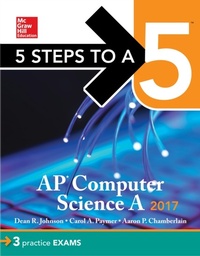
5 Steps to a 5 AP Computer Science 2017 Edition
1st Edition
Published on 5. August 2016
546 pages
978-0-07-184591-5 (ISBN)
Available for download
Description

Get ready for your AP Computer Science exam with this straightforward, easy-to-follow study guide The new addition to McGraw-Hill s popular test prep series 5 Steps to a 5: AP Computer Science 2017 provides a proven strategy to achieving high scores on this demanding Advanced Placement exam. This logical and easy-to-follow instructional guide introduces an effective 5-step study plan to help students build the skills, knowledge, and test-taking confidence they need to reach their full potential. The book helps students master both multiple-choice and free-response questions and offers comprehensive answer explanations and sample responses. Written by three AP Computer Science master teachers, this insider s guide reflects the latest course syllabus and includes 3 full-length practice exams, plus the most up-to-date scoring information. 3 full-length practice exams BONUS interactive AP Planner app delivers a customized study schedule and extra practice questions to students mobile devices The 5 Steps to a 5 series has prepared millions of students for success The 5 Steps to a 5: AP Computer Science 2017 effective 5-step plan breaks down test preparation into stages: 1. Set Up Your Study Program 2. Determine Your Test Readiness 3. Develop Strategies for Success 4. Develop the Knowledge You Need to Score High 5. Build Your Test-Taking Confidence.
More details
Other editions
Additional editions
Dean R. Johnson | Aaron P. Chamberlain | Carol A. Paymer
5 Steps to a 5 AP Computer Science A 2017 Edition
Book
08/2016
McGraw-Hill Professional
€17.32
Article exhausted; check for reprint
Content
- Cover
- Title Page
- Copyright Page
- About the Authors
- Contents
- Preface
- Introduction
- The Five-Step Program
- Acknowledgments
- STEP 1 Set Up Your Study Program
- 1 What You Need to Know About the AP Computer Science A Exam
- Background Information
- Frequently Asked Questions About the Exam
- 2 How to Plan Your Time
- Three Approaches to Preparing for the AP Computer Science A Exam
- Calendars for Preparing for Each of the Plans
- STEP 2 Determine Your Test Readiness
- 3 Take a Diagnostic Exam
- Using the Diagnostic Exam
- AP Computer Science A Diagnostic Exam, Part I
- AP Computer Science A Diagnostic Exam, Part II
- Diagnostic Exam Answers and Explanations
- STEP 3 Develop Strategies for Success
- 4 Strategies to Help You Do Your Best on the Exam
- Strategies for the Multiple-Choice Section
- Strategies for the Free-Response Section
- STEP 4 Review the Knowledge You Need to Score High
- Concept 0 Background on Software Development
- What Is Java?
- What Is a Software Developer?
- What Is OOP (Object-Oriented Programming)?
- Viewing the World Through the Eyes of a Software Developer
- For the Good of All Humankind
- Choosing Your IDE
- HelloWorld
- Rapid Review
- Concept 1 Fundamentals of Programming
- Introduction
- Syntax
- The Console Screen
- Primitive Variables
- Mathematical Operations
- Modifying Number Variables
- Relational Operators
- Logical Operations
- Conditional Statements
- Looping Statements
- Bases Other Than Decimal
- Commenting Your Code
- Types of Errors
- Rapid Review
- Review Questions
- Answers and Explanations
- Concept 2 Classes and Objects (Basic Version)
- Overview of the Relationship Between Classes and Objects
- The class Declaration
- Instance Variables
- Constructors
- Methods
- Putting It All Together: The Circle and CircleRunner Classes
- Understanding the Keyword new When Constructing an Object
- The Reference Variable Versus the Actual Object
- The null Reference
- Rapid Review
- Review Questions
- Answers and Explanations
- Concept 3 The String Class
- The String Variable
- The String Object
- A Visual Representation of a String Object
- String Concatenation
- The Correct Way to Compare Two String Objects
- Important String Methods
- A String Is Immutable
- Escape Sequences
- Rapid Review
- Review Questions
- Answers and Explanations
- Concept 4 The Math, Integer, and Double Classes
- The Java API and the AP Computer Science A Exam Subset
- The Math Class
- The Integer Class
- The Double Class
- Summary of the Integer and Double Classes
- Rapid Review
- Review Questions
- Answers and Explanations
- Concept 5 Data Structures
- What Is a Data Structure?
- The Array
- The 2-D Array
- The ArrayList
- Important ArrayList Methods
- Rapid Review
- Review Questions
- Answers and Explanations
- Concept 6 Algorithms (Basic Version)
- How We Use Algorithms
- Why Algorithms Are Important
- Algorithm Versus Pseudocode Versus Real Java Code
- The Swap Algorithm
- The Copy Algorithm for the Array and ArrayList
- The Sequential Search Algorithm
- The Accumulate Algorithm
- The Find-Highest Algorithm
- Rapid Review
- Review Questions
- Answers and Explanations
- Concept 7 Classes and Objects (Advanced Version)
- Parameters
- Overloaded Constructors
- Overloaded Methods
- static, static, static
- Data Encapsulation
- Scope
- Documentation
- The Keyword this
- IllegalArgumentException
- Rapid Review
- Review Questions
- Answers and Explanations
- Concept 8 Inheritance and Polymorphism
- Inheritance
- Polymorphism
- The Object Class
- Rapid Review
- Review Questions
- Answers and Explanations
- Concept 9 The abstract class and the interface
- The abstract class
- The interface
- Rapid Review
- Review Questions
- Answers and Explanations
- Concept 10 Recursion
- Recursion Versus Looping
- The Base Case
- Beginner Example: The Factorial Recursive Method
- Advanced Example: The Fibonacci Recursive Method
- Rapid Review
- Review Questions
- Answers and Explanations
- Concept 11 Algorithms (Advanced Version)
- The Accumulate Advanced Algorithm
- The Find-Highest Advanced Algorithm
- The Connect-Four Advanced Algorithm
- The Twitter-Sentiment-Analysis Advanced Algorithm
- Rapid Review
- Review Questions
- Answers and Explanations
- Concept 12 Sorting Algorithms and the Binary Search
- Background on Sorting Data
- Insertion Sort
- Selection Sort
- Merge Sort
- Binary Search
- Rapid Review
- Review Questions
- Answers and Explanations
- Concept 13 Seeing the Big Picture: Design
- The Software Development Cycle
- Designing Class Hierarchy
- Testing
- Rapid Review
- Review Questions
- Answers and Explanations
- STEP 5 Building Your Test-Taking Confidence
- AP Computer Science A: Practice Exam 1
- AP Computer Science A: Practice Exam 1, Part I (Multiple Choice)
- AP Computer Science A: Practice Exam 1, Part II (Free Response)
- Practice Exam 1 Answers and Explanations, Part I (Multiple Choice)
- Practice Exam 1 Answers and Explanations, Part II (Free Response)
- Scoring Worksheet
- AP Computer Science A: Practice Exam 2
- AP Computer Science A: Practice Exam 2, Part I (Multiple Choice)
- AP Computer Science A: Practice Exam 2, Part II (Free Response)
- Practice Exam 2 Answers and Explanations, Part I (Multiple Choice)
- Practice Exam 2 Answers and Explanations, Part II (Free Response)
- Scoring Worksheet
- Appendix
- Quick Reference Guide
- Free-Response Scoring Guidelines
- List of Keywords in Java
- List of Required Runtime Exceptions
- Common Syntax Errors for Beginning Java Programmers
- Online Resources

