
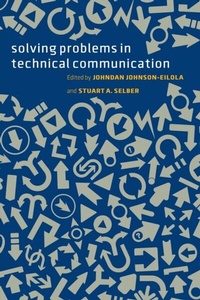
Solving Problems in Technical Communication
Description
Alles über E-Books | Antworten auf Fragen rund um E-Books, Kopierschutz und Dateiformate finden Sie in unserem Info- & Hilfebereich.
The field of technical communication is rapidly expanding in both the academic world and the private sector, yet a problematic divide remains between theory and practice. Here Stuart A. Selber and Johndan Johnson-Eilola, both respected scholars and teachers of technical communication, effectively bridge that gap.
Solving Problems in Technical Communication collects the latest research and theory in the field and applies it to real-world problems faced by practitioners-problems involving ethics, intercultural communication, new media, and other areas that determine the boundaries of the discipline. The book is structured in four parts, offering an overview of the field, situating it historically and culturally, reviewing various theoretical approaches to technical communication, and examining how the field can be advanced by drawing on diverse perspectives.Timely, informed, and practical, Solving Problems in Technical Communication will be an essential tool for undergraduates and graduate students as they begin the transition from classroom to career.All prices
More details
Other editions
Additional editions
Persons
Johndan Johnson-Eilolais professor of communication and media at Clarkson University. He is the author of Datacloud, coauthor of Writing New Media, and coeditor, with Stuart A. Selber, of Central Works in Technical Communication. Stuart A. Selber is associate professor of English at Penn State. He is the author of Multiliteracies for a Digital Age and the editor of Rhetorics and Technologies and Computers and Technical Communication.

System requirements
File format: PDF
Copy-Protection: Adobe-DRM (Digital Rights Management)
System requirements:
- Computer (Windows; MacOS X; Linux): Install the free reader Adobe Digital Editions prior to download (see eBook Help).
- Tablet/smartphone (Android; iOS): Install the free app Adobe Digital Editions or the app PocketBook before downloading (see eBook Help).
- E-reader: Bookeen, Kobo, Pocketbook, Sony, Tolino and many more (only limited: Kindle).
The file format PDF always displays a book page identically on any hardware. This makes PDF suitable for complex layouts such as those used in textbooks and reference books (images, tables, columns, footnotes). Unfortunately, on the small screens of e-readers or smartphones, PDFs are rather annoying, requiring too much scrolling.
This eBook uses Adobe-DRM, a „hard” copy protection. If the necessary requirements are not met, unfortunately you will not be able to open the eBook. You will therefore need to prepare your reading hardware before downloading.
Please note: We strongly recommend that you authorise using your personal Adobe ID after installation of any reading software.
For more information, see our eBook Help page.
File format: ePUB
Copy protection: Watermark-DRM (Digital Rights Management)
System requirements:
- Computer (Windows; MacOS X; Linux): Use a reading software that can process the file format ePUB: e.g., Adobe Digital Editions or FBReader – both free (see eBook Help).
- Tablet/Smartphone (Android; iOS): Before downloading, install the free app Adobe Digital Editions (see eBook Help).
- E-reader: Bookeen, Kobo, Pocketbook, Sony, Tolino and many more (not Kindle).
The file format ePUB works well for novels and non-fiction books – i.e., „flowing” text without complex layout. On an e-reader or smartphone, line and page breaks automatically adjust to fit the small displays.
This eBook uses Watermark-DRM, a „soft” copy protection. This means that there are no technical restrictions to prevent illegal distribution. However, there is a personalised watermark embedded in the eBook that can be used to identify the purchaser of the eBook in the event of misuse and to provide evidence for legal purposes.
For more information, see our eBook Help page.
