

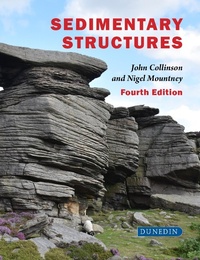
Sedimentary Structures
Published on 1. March 2019
320 pages
978-1-78046-602-6 (ISBN)
Description

Completely revised new edition, in colour for the first time, of an established undergraduate textbook in elementary sedimentology.
More details
Other editions
Additional editions
John Collinson | Nigel Mountney
Sedimentary Structures
Book
01/2019
4th Edition
Dunedin Academic Press
€68.50
Shipment within 3-4 weeks
Content
- Cover
- Book Title
- Copyright
- Contents
- Preface
- Acknowledgements
- 1 Introduction to the study of sedimentary structures
- 1.1 The nature of this book
- 1.2 The wider geological context of sedimentary structures
- 1.3 Sedimentary structures and science
- Study techniques
- 2 Bedding
- 2.1 The nature of bedding
- 2.2 The significance of bedding
- Study techniques
- 3 Basic properties of fluids, flows and sediment
- 3.1 Introduction
- 3.2 Properties of low-viscosity fluids and flows
- 3.3 Waves
- 3.4 Properties of sediments moved by flows
- 3.5 Erosion
- 3.6 Modes of sediment transport
- 3.7 Sediment gravity flows
- 3.8 Pyroclastic density currents
- Study techniques
- 4 Erosional structures
- 4.1 Introduction
- 4.2 Sole marks
- 4.3 Small-scale structures on modern and ancient upper surfaces
- 4.4 Erosional features in vertical section
- Study techniques
- 5 Depositional structures in muds, mudstones and shales
- 5.1 Introduction
- 5.2 Structures and lamination
- Study techniques
- 6 Depositional structures of sands and sandstones
- 6.1 Aqueous ripples and cross lamination
- 6.2 Aqueous dunes, sandwaves, bars and cross bedding
- 6.3 Flat beds and parallel lamination
- 6.4 Undulating smooth surfaces and lamination
- 6.5 Hummocky and swaley cross stratification
- 6.6 Massive sand beds
- 6.7 Normally graded beds, inverse grading, the Bouma sequence and hybrid-event beds
- 6.8 Aeolian bedforms and lamination
- Study techniques
- 7 Depositional structures in gravels, conglomerates and breccias
- 7.1 Introduction
- 7.2 Classification
- 7.3 Morphology and general settings of gravel deposition
- 7.4 Textures, fabrics, and structures: their mode of formation
- 7.5 Processes of formation of mass properties and structures
- 7.6 Uses of structures
- Study techniques
- 8 Depositional structures of chemical and biological origin
- 8.1 Introduction
- 8.2 Chemical precipitation
- 8.3 Precipitation and binding of sediment by organisms
- 8.4 Early cementation
- 8.5 Other bedding phenomena in limestones
- Study techniques
- 9 Structures due to deformation and disturbance
- 9.1 Introduction
- 9.2 Physically induced soft-sediment deformation
- 9.3 Chemically induced disturbance
- 9.4 Biogenic sedimentary structures: trace fossils
- Study techniques
- 10 Assemblages of structures and environmental interpretation
- 10.1 Introduction
- 10.2 Mapping of modern environments
- 10.3 Measurement of sections in rock successions
- 10.4 Interpretation of vertical sequences in rocks
- 10.5 Key stratigraphic surfaces
- 10.6 Interpretation of lateral relationships in sedimentary rocks
- Study techniques
- Appendix 1 Directional data: collection, display, analysis and interpretation
- Appendix 2 Sampling and preserving unconsolidated sediments
- Appendix 3 Methods for studying present-day environments
- Appendix 4 Techniques for the study of trace fossils
- Appendix 5 Techniques for sedimentary logging
- Appendix 6 Key to common sedimentary lithologies and structures
- Bibliography
- Index
- Back Cover
