

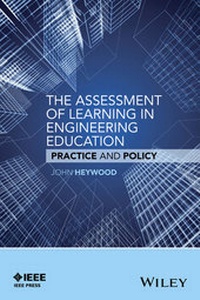
The Assessment of Learning in Engineering Education
Practice and Policy
Published on 23. February 2016
364 pages
978-1-119-17553-7 (ISBN)
Description

Explores how we judge engineering education in order to effectively redesign courses and programs that will prepare new engineers for various professional and academic careers
* Shows how present approaches to assessment were shaped and what the future holds
* Analyzes the validity of teaching and judging engineering education
* Shows the integral role that assessment plays in curriculum design and implementation
* Examines the sociotechnical system's impact on engineering curricula
Reviews / Votes
Once again, Dr. John Heywood assembles and synthesizes a vast amount of data and literature into a readable and thoughtful discussion of an important issue, assessment. Given current debates on what should be assessed and what should be included in accreditation of engineering programs, this is a timely book that will be an invaluable resource for engineering educators and all who care about preparing effective engineers. Dr. Heywood's holistic approach challenges readers to reexamine their assumptions about learning, teaching, and assessment. Dr. Susan M. Lord, Professor and Chair of Electrical Engineering, University of San Diego, San Diego CA 921102009-2010 IEEE Education Society President Fellow, IEEE and ASEEMore details
Other editions
Additional editions
Book
05/2016
Wiley-IEEE Press
€78.50
Shipment within 15-20 days
Software
03/2016
Wiley
€68.96
No shipping information available
Person
John Heywood is a Professorial Fellow Emeritus of Trinity College Dublin, the University of Dublin. He was awarded the best research publication award of the Division for the Professions of the American Educational Research Association in 2006 for his book "Engineering Education: Research and Development in Curriculum and Instruction" published by Wiley/IEEE. He is co-author of Analysing Jobs- a study of engineers at work. His other publications include three books on Assessment in Higher Education. He is a Fellow of the American Society for Engineering Education and a Life Senior Member of the Institute of Electrical and Electronic Engineers.
Content
- Intro
- The Assessment of Learning in Engineering Education
- Contents
- Preface
- References
- Acknowledgments
- 1 Prologue
- 1.1 General Introduction: The Functions of Assessment
- 1.2 Health Warning: Ambiguities in the Use of the Term "Assessment"
- 1.3 The Assessment of Persons for the Professions
- 1.4 The Engineering Profession
- 1.5 The Development of Higher and Engineering Education as Areas of Academic Study in the 1960s
- 1.6 Assumptions About Examinations: Reliability
- 1.7 Myths Surrounding Examinations
- 1.8 The Introduction of Coursework Assessment
- 1.9 Rethinking Validity
- 1.10 Wastage (Dropout): The Predictive Value of School Examinations for Satisfactory Performance in Higher Education
- 1.11 Factors Influencing Performance in College Courses
- 1.12 Assessment: Results and Accountability
- 1.13 Assessing the Learner
- Notes
- References
- 2 Assessment and the Preparation of Engineers for Work
- 2.1 Engineers at Work
- 2.2 An Alternative Approach to the Education and Training of Engineers for Industry
- 2.3 Toward an Alternative Curriculum for Engineering
- 2.4 Creativity in Engineering and Design
- 2.5 Furneauxs Study of a Universitys Examinations in First-Year Mechanical Engineering: The Argument for "Objectives"
- 2.6 Discussion
- Notes
- References
- 3 The Development of a Multiple-Objective (Strategy) Examination and Multidimensional Assessment and Evaluation
- 3.1 The Development of an Advanced Level Examination in Engineering Science (For 1718-Year-Old High School Students): The Assessment of Achievement and Competency
- 3.2 Skills Involved in Writing Design Proposals and Practical Laboratory Work
- 3.3 A Balanced System of Assessment
- 3.4 Pictures of the Curriculum Process
- 3.5 Multidimensional Assessment and Evaluation: A Case Study
- 3.6 Discussion
- Notes
- References
- 4 Categorizing the Work Done by Engineers: Implications for Assessment and Training
- 4.1 Introduction
- 4.2 A Study of Engineers at Work in a Firm in the Aircraft Industry
- 4.3 The Application of The Taxonomy of Educational Objectives to the Task Analysis of Managers in a Steel Plant
- 4.4 The Significance of Interpersonal Competence
- 4.5 A Comparative Study of British and German Production Engineers (Managers)
- 4.6 Engineering Knowledge
- 4.7 Discussion
- Notes
- References
- 5 Competency-Based Qualifications in the United Kingdom and United States and Other Developments
- 5.1 The Development of Competency-Based Vocational Qualifications in the United Kingdom
- 5.2 Outcomes Approaches in High Schools in the United Kingdom
- 5.3 Standards in Schools in the United States
- 5.4 Education for Capability: Capability vs. Competence
- 5.5 Ability (Assessment)-Led Curricula: The Alverno College Model
- 5.6 The Enterprise in Higher Education Initiative in the United Kingdom and the SCANS Report in the United States
- 5.7 The College Outcome Measures Program
- 5.8 Discussion
- Notes
- References
- 6 The Impact of Accreditation
- 6.1 ABET, European Higher Education Area (Bologna Process), and the Regulation of the Curriculum
- 6.2 Taxonomies
- 6.3 Outcomes-Based Engineering Education
- 6.4 Mastery Learning and Personalized Systems of Instruction
- 6.5 Discussion
- References
- 7 Student Variability
- 7.1 Introduction
- 7.2 Learning and Teaching Styles
- 7.3 Study Habits/Strategies
- 7.4 Intellectual Development
- 7.5 Critical Thinking
- 7.6 The Assessment of Development
- 7.7 The Reflective Practitioner
- 7.8 Adaptive Expertise
- 7.9 Discussion
- Notes
- References
- 8 Emotional Intelligence, Peer and Self-Assessment, Journals and Portfolios, and Learning-How-to-Learn
- 8.1 Introduction
- 8.2 Emotional Intelligence
- 8.3 Self- and Peer Assessment
- 8.4 Learning Journals and Portfolios
- 8.5 Learning-How-to-Learn
- 8.6 Discussion
- Note
- References
- 9 Experiential Learning, Interdisciplinarity, Projects, and Teamwork
- 9.1 Introduction
- 9.2 Project Work as a Vehicle for Integrated Learning and Interdisciplinarity
- 9.3 Learning to Collaborate
- 9.4 Constructive Controversy
- 9.5 Communication, Teamwork, and Collegial Impediments to the Development of Good Engineering Practice
- 9.6 The Demand for Skill in Innovation: Can It Be Taught?
- 9.7 Creativity, Teamwork, and Reflective Practice (See Also Section 2.4)
- 9.8 Can Teamwork Be Taught?
- 9.9 Discussion
- References
- 10 Competencies
- 10.1 Introduction
- 10.2 The Iowa Studies (ISU)
- 10.3 The Outcomes Approach in Australia, Europe, and Elsewhere
- 10.4 The CDIO Initiative
- 10.5 A Standards-Based Approach to the Curriculum
- 10.6 Recent European Studies
- 10.7 Impact of Subjects (Courses) on Person-Centered Interventions
- 10.8 The Potential for Comparative Studies: Choosing Competencies
- 10.9 Expressive Outcomes
- 10.10 Discussion
- References
- 11 "Outside" Competency
- 11.1 Introduction
- 11.2 Accidental Competencies
- 11.3 Understanding Competence at Work
- 11.4 Contextual Competence
- 11.5 A Post-Technician Cooperative Apprenticeship
- 11.6 Theories of Competence Development in Adult Life
- 11.7 Discussion
- Notes
- References
- 12 Assessment, Moral Purpose, and Social Responsibility
- 12.1 Introduction
- 12.2 Moral Purpose and the Power of Grading
- 12.3 From Reliability to Validity: Toward a Philosophy of Engineering Education
- 12.4 Screening the Aims of Engineering Education
- 12.5 The Role of Educational Institutions in the Preparation for Industry (the Development of Professional Skills)
- 12.6 The Role of Industry in Professional Development
- 12.7 Assessment and the Curriculum
- 12.8 Changing Patterns in the Workforce, the Structure of Higher Education
- 12.9 Lifelong Education and Credentialing
- 12.10 Conclusion
- Notes
- References
- A A Quick Guide to the Changing Terminology in the Area of ``Assessment''
- A.1 Objectives and Outcomes
- A.2 Assessment and Evaluation
- References
- B Extracts from the Syllabus and Notes for the Guidance of Schools for GCE Engineering Science (Advanced) 1972 Joint Matriculation Board, Manchester
- B.1 Extract 1 (pp. 2-6)
- Introduction
- The aims of the syllabus
- The objectives of the written examination and coursework
- The form of the examination
- Allocation of marks between papers and sections
- Subject matter to be tested in the examination
- B.2 Extract 2 (p. 9)
- Coursework
- B.3 Extract 3 (pp. 13-16)
- Author Index
- Subject Index
- EULA
