

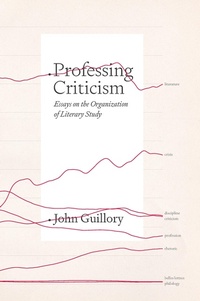
Professing Criticism
Essays on the Organization of Literary Study
Published on 30. December 2022
456 pages
978-0-226-82131-3 (ISBN)
Description

A sociological history of literary study-both as a discipline and as a profession.
As the humanities in higher education struggle with a labor crisis and with declining enrollments, the travails of literary study are especially profound. No scholar has analyzed the discipline's contradictions as authoritatively as John Guillory. In this much-anticipated new book, Guillory shows how the study of literature has been organized, both historically and in the modern era, both before and after its professionalization. The traces of this volatile history, he reveals, have solidified into permanent features of the university. Literary study continues to be troubled by the relation between discipline and profession, both in its ambivalence about the literary object and in its anxious embrace of a professionalism that betrays the discipline's relation to its amateur precursor: criticism.
In a series of timely essays, Professing Criticism offers an incisive explanation for the perennial churn in literary study, the constant revolutionizing of its methods and objects, and the permanent crisis of its professional identification. It closes with a robust outline of five key rationales for literary study, offering a credible account of the aims of the discipline and a reminder to the professoriate of what they already do, and often do well.
As the humanities in higher education struggle with a labor crisis and with declining enrollments, the travails of literary study are especially profound. No scholar has analyzed the discipline's contradictions as authoritatively as John Guillory. In this much-anticipated new book, Guillory shows how the study of literature has been organized, both historically and in the modern era, both before and after its professionalization. The traces of this volatile history, he reveals, have solidified into permanent features of the university. Literary study continues to be troubled by the relation between discipline and profession, both in its ambivalence about the literary object and in its anxious embrace of a professionalism that betrays the discipline's relation to its amateur precursor: criticism.
In a series of timely essays, Professing Criticism offers an incisive explanation for the perennial churn in literary study, the constant revolutionizing of its methods and objects, and the permanent crisis of its professional identification. It closes with a robust outline of five key rationales for literary study, offering a credible account of the aims of the discipline and a reminder to the professoriate of what they already do, and often do well.
More details
Other editions
Additional editions
Book
12/2022
University of Chicago Press
€27.50
Shipment within 10-20 days
Book
12/2022
University of Chicago Press
€123.50
Shipment within 10-20 days
Person
John Guillory is the Julius Silver Professor of English at New York University. He is coeditor of
What's Left of Theory? New Work on the Politics of Theoryand the author of
Cultural Capital: The Problem of Literary Canon Formation and
Poetic Authority: Spenser, Milton, and Literary History.
Content
- Intro
- Contents
- Preface
- Part One: The Formation and Deformation of Literary Study
- Chapter 1. The Institution of Professions
- Chapter 2. Professing Criticism
- Chapter 3. Critique of Critical Criticism
- Part Two: Organizing Literature: Foundations, Antecedents, Consequences
- Chapter 4. Monuments and Documents: On the Object of Study in the Humanities
- Chapter 5. The Postrhetorical Condition
- Chapter 6. Two Failed Disciplines: Belles Lettres and Philology
- Chapter 7. The Location of Literature
- Chapter 8. The Contradictions of Global English
- Part Three: Professionalization and Its Discontents
- Chapter 9. On the Permanent Crisis of Graduate Education
- Chapter 10. Evaluating Scholarship in the Humanities
- Chapter 11. Composition and the Demand for Writing
- Chapter 12. The Question of Lay Reading
- Conclusion: Ratio Studiorum
- Acknowledgments
- Index
