

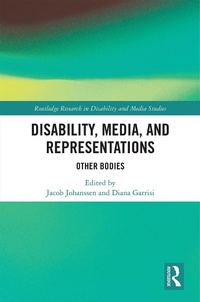
Disability, Media, and Representations
Other Bodies
1st Edition
Published on 27. February 2020
196 pages
978-0-429-89018-5 (ISBN)
Description

Bringing together scholars from around the world to research the intersection between media and disability, this edited collection aims to offer an interdisciplinary exploration and critique of print, broadcast and online representations of physical and mental impairments.
Drawing on a wide range of case studies addressing how people can be 'othered' in contemporary media, the chapters focus on analyses of hateful discourses about disability on Reddit, news coverage of disability and education, media access of individuals with disabilities, the logic of memes and brain tumour on Twitter, celebrity and Down Syndrome on Instagram, disability in TV drama, the metaphor of disability for the nation; as well as an autoethnography of treatment of breast cancer. Providing a much-needed global perspective, Disability, Media, and Representations examines the relationship between self-representation and representations in either reinforcing or debunking myths around disability, and ways in which academic discourse can be differently articulated to study the relationship between media and disability.
This book will be of interest to students and researchers of disability studies and media studies as well as activists and readers engaged in debates on diversity, inclusivity and the media.
Drawing on a wide range of case studies addressing how people can be 'othered' in contemporary media, the chapters focus on analyses of hateful discourses about disability on Reddit, news coverage of disability and education, media access of individuals with disabilities, the logic of memes and brain tumour on Twitter, celebrity and Down Syndrome on Instagram, disability in TV drama, the metaphor of disability for the nation; as well as an autoethnography of treatment of breast cancer. Providing a much-needed global perspective, Disability, Media, and Representations examines the relationship between self-representation and representations in either reinforcing or debunking myths around disability, and ways in which academic discourse can be differently articulated to study the relationship between media and disability.
This book will be of interest to students and researchers of disability studies and media studies as well as activists and readers engaged in debates on diversity, inclusivity and the media.
Reviews / Votes
The international scope (spanning the US, Japan, North Korea, Germany, South Africa, and the UK) and intersectional approach to representation (i.e., representations of people with disabilities and self-representation) make this volume an important contribution to disability studies. It will be very useful in introductory disability studies classes, while it is also sophisticated enough to advance scholarship and clarify thought in the field.Summing Up: Highly recommended. Lower- and upper-division undergraduates. Graduate students and faculty.
J. L. Croissant, University of Arizona, USA
Representations of disability in media are densely layered phenomena, extending far beyond a screen. This collection gives nuanced attention to the accessibility, contexts, and tropes of disability representations around the world. It enriches what we think we know, and points to areas in which students and scholars of disability and media alike could-and should-know more.
Assistant Professor Elizabeth Ellcessor, Department of Media Studies, University of Virginia, USA
This exciting, timely and readable text brings together established and emerging scholars to seek connections and, as importantly, reveal tensions between media and disability studies. The centrality of the body as a subject and object of analysis means that this book will be of interest to readers from a myriad of disciplines across the human and social sciences, arts and humanities.
Professor Dan Goodley, iHuman, University of Sheffield, UK
More details
Series
Edition
1. Auflage
Language
English
Place of publication
London
United Kingdom
Publishing group
Taylor & Francis Ltd
Target group
College/higher education
Illustrations
4 Tables, black and white
ISBN-13
978-0-429-89018-5 (9780429890185)
Copyright in bibliographic data and cover images is held by Nielsen Book Services Limited or by the publishers or by their respective licensors: all rights reserved.
Schweitzer Classification
Other editions
Additional editions
Book
08/2022
1st Edition
Routledge
€65.00
Shipment within 10-20 days
Book
03/2020
1st Edition
Routledge
€206.10
Shipment within 10-20 days
Persons
Jacob Johanssen is Senior Lecturer in Communications, St. Mary's University (London, UK). His research interests include audience research, social media, media and the body, psychoanalysis and the media, affect theory, as well as digital culture.
Diana Garrisi is lecturer in journalism, Xi'An Jiaotong-Liverpool University (Suzhou, China). Her research interests include: body image and the media, rhetorical theory, cultural history and science communication.
Diana Garrisi is lecturer in journalism, Xi'An Jiaotong-Liverpool University (Suzhou, China). Her research interests include: body image and the media, rhetorical theory, cultural history and science communication.
Content
1. Introduction
Diana Garrisi and Jacob Johanssen
2. 'The Stuff of Nightmares': Representations of Disability on the Online Bulletin Board Reddit
Leah Burch
3. Madeline Stuart as Disability Advocate and Brand: Exploring the Affective Economies of Social Media
Maria Bee Christensen-Stryno and Camilla Bruun Eriksen
4. Losing Someone Like Us: Memetic Logics and Coping with Brain Tumors on Social Media
Samira Rajabi
5. Re-inscribing the Feminine in Breast Cancer: Dis/Ability, Autoethnography and Black Humour
Rachel Velody
6. Knowing North Korea through Photographing Abled/Disabled Bodies for the Western News
Micky Lee
7. Disabled Heroines: Representations of Female Disability in Japanese Television Dramas
Anne-Lise Mithout
8. The Education of Children with Disabilities in South African Online News Reports
Elizabeth Walton and Judith McKenzie
9. Mass Media Use by Persons with Disabilities in Germany and Comparison with the United Kingdom
Ingo Bosse and Annegret Haage
Diana Garrisi and Jacob Johanssen
2. 'The Stuff of Nightmares': Representations of Disability on the Online Bulletin Board Reddit
Leah Burch
3. Madeline Stuart as Disability Advocate and Brand: Exploring the Affective Economies of Social Media
Maria Bee Christensen-Stryno and Camilla Bruun Eriksen
4. Losing Someone Like Us: Memetic Logics and Coping with Brain Tumors on Social Media
Samira Rajabi
5. Re-inscribing the Feminine in Breast Cancer: Dis/Ability, Autoethnography and Black Humour
Rachel Velody
6. Knowing North Korea through Photographing Abled/Disabled Bodies for the Western News
Micky Lee
7. Disabled Heroines: Representations of Female Disability in Japanese Television Dramas
Anne-Lise Mithout
8. The Education of Children with Disabilities in South African Online News Reports
Elizabeth Walton and Judith McKenzie
9. Mass Media Use by Persons with Disabilities in Germany and Comparison with the United Kingdom
Ingo Bosse and Annegret Haage
