

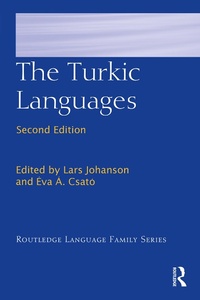
The Turkic Languages
2nd Edition
Published on 27. December 2021
512 pages
978-1-000-48818-0 (ISBN)
Description

The Turkic languages are spoken today in a vast geographical area stretching from southern Iran to the Arctic Ocean and from the Balkans to the great wall of China. There are currently 20 literary languages in the group, the most important among them being Turkish with over 70 million speakers; other major languages covered include Azeri, Bashkir, Chuvash, Gagauz, Karakalpak, Kazakh, Kirghiz, Noghay, Tatar, Turkmen, Uyghur, Uzbek, Yakut, Yellow Uyghur and languages of Iran and South Siberia.
The Turkic Languages is a reference book which brings together detailed discussions of the historical development and specialized linguistic structures and features of the languages in the Turkic family. Seen from a linguistic typology point of view, Turkic languages are particularly interesting because of their astonishing morphosyntactic regularity, their vast geographical distribution, and their great stability over time.
This volume builds upon a work which has already become a defining classic of Turkic language study. The present, thoroughly revised edition updates and augments those authoritative accounts and reflects recent and ongoing developments in the languages themselves, as well as our further enhanced understanding of the relations and patterns of influence between them. The result is the fruit of decades-long experience in the teaching of the Turkic languages, their philology and literature, and also of a wealth of new insights into the linguistic phenomena and cultural interactions defining their development and use, both historically and in the present day.
Each chapter combines modern linguistic analysis with traditional historical linguistics; a uniform structure allows for easy typological comparison between the individual languages. Written by an international team of experts, The Turkic Languages will be invaluable to students and researchers within linguistics, Turcology, and Near Eastern and Oriental Studies.
The Turkic Languages is a reference book which brings together detailed discussions of the historical development and specialized linguistic structures and features of the languages in the Turkic family. Seen from a linguistic typology point of view, Turkic languages are particularly interesting because of their astonishing morphosyntactic regularity, their vast geographical distribution, and their great stability over time.
This volume builds upon a work which has already become a defining classic of Turkic language study. The present, thoroughly revised edition updates and augments those authoritative accounts and reflects recent and ongoing developments in the languages themselves, as well as our further enhanced understanding of the relations and patterns of influence between them. The result is the fruit of decades-long experience in the teaching of the Turkic languages, their philology and literature, and also of a wealth of new insights into the linguistic phenomena and cultural interactions defining their development and use, both historically and in the present day.
Each chapter combines modern linguistic analysis with traditional historical linguistics; a uniform structure allows for easy typological comparison between the individual languages. Written by an international team of experts, The Turkic Languages will be invaluable to students and researchers within linguistics, Turcology, and Near Eastern and Oriental Studies.
More details
Series
Edition
2nd edition
Language
English
Place of publication
London
United Kingdom
Publishing group
Taylor & Francis Ltd
Target group
College/higher education
Professional and scholarly
Illustrations
128 Tables, black and white; 2 Halftones, black and white; 2 Illustrations, black and white
ISBN-13
978-1-000-48818-0 (9781000488180)
Copyright in bibliographic data and cover images is held by Nielsen Book Services Limited or by the publishers or by their respective licensors: all rights reserved.
Schweitzer Classification
Other editions
Additional editions
Lars Johanson | Eva A. Csato
The Turkic Languages
Book
10/2024
2nd Edition
Routledge
€109.40
Shipment within 10-20 days
Lars Johanson | Eva A. Csato
The Turkic Languages
Book
12/2021
2nd Edition
Routledge
€517.20
Shipment within 15-20 days
Lars Johanson | Eva A. Csato
The Turkic Languages
Book
12/2021
Routledge
Unfortunately, price unknown
Available (delivery time upon request)
Persons
Lars Johanson, one of the world's leading Turcologists, was born and educated at Uppsala University in Sweden. He is professor of Turcology at the University of Mainz, Germany. He has published widely on descriptive and historical linguistics, mostly focusing on the Turkic language family. His book Turkic (2021) presents his pioneering contributions to Turkic linguistics and language typology. He edits the journal Turkic Languages and the monograph series Turcologica.
Eva A. Csato, born in Hungary, is professor emeritus in Turkic languages at Uppsala University, Sweden. She studied linguistics and Turcology at the University of Oslo. Her research interests include Turkic linguistics, syntactic typology, contact linguistics, documentation, and revitalization of endangered Turkic languages. She has published over 100 articles and edited more than 10 volumes on different Turkic linguistic topics. She is on the editorial board of the journal Turkic Languages.
Eva A. Csato, born in Hungary, is professor emeritus in Turkic languages at Uppsala University, Sweden. She studied linguistics and Turcology at the University of Oslo. Her research interests include Turkic linguistics, syntactic typology, contact linguistics, documentation, and revitalization of endangered Turkic languages. She has published over 100 articles and edited more than 10 volumes on different Turkic linguistic topics. She is on the editorial board of the journal Turkic Languages.
Content
Contents
List of Tables and Figures
List of Contributors
Preface
A General Introduction to the Turkic Family
The Structure of the Volume
Changes
Limitations
Diversity and Harmonization
Acknowledgements
Transcription and Notations
Actants
Name Forms
Transcription
Vowels
Basic Vowels
Non-prime Vowels
Consonants
Suffix Notations
Parentheses
Other Signs
Abbreviations in Glosses
1 The Speakers of Turkic Languages Hendrik Boeschoten
2 The Turkic Peoples: A Historical Sketch Peter B. Golden
3 The Structure of Turkic Lars Johanson
4 The Reconstruction of Proto-Turkic and the Genealogical Question Andras Rona-Tas
5 Transeurasian Martine Robbeets
6 The History of Turkic Lars Johanson
7 Turkic Writing Systems Andras Rona-Tas
8 East Old Turkic Lars Johanson
9 West Old Turkic Laszlo Karoly
10 Middle Kipchak Arpad Berta and Eva A. Csato
11 Chaghatay Hendrik Boeschoten
12 Ottoman Turkish Celia Kerslake
13 Turkish Eva A. Csato and Lars Johanson
14 Turkish Dialects Bernt Brendemoen
15 The Turkish Language Reform Bernt Brendemoen
16 Gagauz Astrid Menz
17 Azeri Elisabetta Ragagnin
18 Turkmen Birsel Karakoc
19 Turkic Languages of Iran Christiane Bulut
20 Tatar and Bashkir Arpad Berta
21 West Kipchak Languages Arpad Berta & Eva A. Csato
22 Kazakh and Karakalpak Aynur Abish
23 Noghay Birsel Karakoc
24 Kirghiz Birsel Karakoc and Kenjeguel Kalieva
25 Uzbek Hendrik Boeschoten
26 Uyghur Abdurishid Yakup
27 Yellow Uyghur and Salar Abdurishid Yakup
28 South Siberian Turkic Claus Schoenig and Irina Nevskaya
29 Yakut Astrid Menz and Vladimir Monastyrev
30 Chuvash Klara Agyagasi
Index
List of Tables and Figures
List of Contributors
Preface
A General Introduction to the Turkic Family
The Structure of the Volume
Changes
Limitations
Diversity and Harmonization
Acknowledgements
Transcription and Notations
Actants
Name Forms
Transcription
Vowels
Basic Vowels
Non-prime Vowels
Consonants
Suffix Notations
Parentheses
Other Signs
Abbreviations in Glosses
1 The Speakers of Turkic Languages Hendrik Boeschoten
2 The Turkic Peoples: A Historical Sketch Peter B. Golden
3 The Structure of Turkic Lars Johanson
4 The Reconstruction of Proto-Turkic and the Genealogical Question Andras Rona-Tas
5 Transeurasian Martine Robbeets
6 The History of Turkic Lars Johanson
7 Turkic Writing Systems Andras Rona-Tas
8 East Old Turkic Lars Johanson
9 West Old Turkic Laszlo Karoly
10 Middle Kipchak Arpad Berta and Eva A. Csato
11 Chaghatay Hendrik Boeschoten
12 Ottoman Turkish Celia Kerslake
13 Turkish Eva A. Csato and Lars Johanson
14 Turkish Dialects Bernt Brendemoen
15 The Turkish Language Reform Bernt Brendemoen
16 Gagauz Astrid Menz
17 Azeri Elisabetta Ragagnin
18 Turkmen Birsel Karakoc
19 Turkic Languages of Iran Christiane Bulut
20 Tatar and Bashkir Arpad Berta
21 West Kipchak Languages Arpad Berta & Eva A. Csato
22 Kazakh and Karakalpak Aynur Abish
23 Noghay Birsel Karakoc
24 Kirghiz Birsel Karakoc and Kenjeguel Kalieva
25 Uzbek Hendrik Boeschoten
26 Uyghur Abdurishid Yakup
27 Yellow Uyghur and Salar Abdurishid Yakup
28 South Siberian Turkic Claus Schoenig and Irina Nevskaya
29 Yakut Astrid Menz and Vladimir Monastyrev
30 Chuvash Klara Agyagasi
Index
