

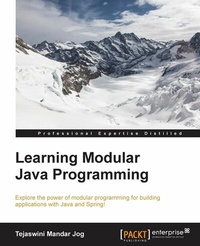
Learning Modular Java Programming
Explore the power of modular programming for building applications with Java and Spring!
Published on 8. July 2025
226 pages
978-1-78588-320-0 (ISBN)
Description

Explore the power of modular programming for building applications with Java and Spring!
Key Features
[*] Understand the basic concepts of Modular Programming to build enterprise applications with Java
[*] Create short and precise code and eliminate recursion
[*] The book follows a step-by-step approach that makes implementing Modular Programming easy
Book DescriptionModular programming means dividing an application into small parts and then developing it. It is an approach taken by developers to build applications and helps them add efficiency in their development process, thus making it more effective. The book starts with the fundamentals of Modular Programming. Then we move on to the actual implementation, where we teach developers how to divide an application into different modules or layers (such as presentation, execution, security, lifecycle, services, and so on) for better management. Once readers are well-versed in these modules and their development, the book shows how to create bindings in order to join these different modules and form a complete application. Next, the readers will learn how to manage these modules through dependency injection. Later, we move on to testing; readers will learn how to test the different modules of an application. The book ends by teaching readers how to maintain different versions of their application and how to modify it. By the end of the book, readers will have a good understanding of modular programming and will be able to use it to build applications with Java.What you will learn
[*] Learn about Modular Programming and what modules an enterprise application can be divided into.
[*] Set up a development environment and create a "Hello World" application.
[*] Start implementing a sample application from the presentation layer.
[*] Implement the persistence layer.
[*] Implement the business layer, wrapping up all of the modules with Contexts and Dependency Injection (CDI).
[*] Manage an application s life cycle.
[*] Learn how to secure Web applications.
[*] Test enterprise applications and their automation.
[*] Understand how to version source code using Source Code Management (SCM) systems such as GIT and SVN.
Who this book is forThis book targets Java developers who have a basic knowledge of application development with Java and are interested in learning the Modular Programming approach for building reusable applications that are easy to test, and thus improve overall project management.
Key Features
[*] Understand the basic concepts of Modular Programming to build enterprise applications with Java
[*] Create short and precise code and eliminate recursion
[*] The book follows a step-by-step approach that makes implementing Modular Programming easy
Book DescriptionModular programming means dividing an application into small parts and then developing it. It is an approach taken by developers to build applications and helps them add efficiency in their development process, thus making it more effective. The book starts with the fundamentals of Modular Programming. Then we move on to the actual implementation, where we teach developers how to divide an application into different modules or layers (such as presentation, execution, security, lifecycle, services, and so on) for better management. Once readers are well-versed in these modules and their development, the book shows how to create bindings in order to join these different modules and form a complete application. Next, the readers will learn how to manage these modules through dependency injection. Later, we move on to testing; readers will learn how to test the different modules of an application. The book ends by teaching readers how to maintain different versions of their application and how to modify it. By the end of the book, readers will have a good understanding of modular programming and will be able to use it to build applications with Java.What you will learn
[*] Learn about Modular Programming and what modules an enterprise application can be divided into.
[*] Set up a development environment and create a "Hello World" application.
[*] Start implementing a sample application from the presentation layer.
[*] Implement the persistence layer.
[*] Implement the business layer, wrapping up all of the modules with Contexts and Dependency Injection (CDI).
[*] Manage an application s life cycle.
[*] Learn how to secure Web applications.
[*] Test enterprise applications and their automation.
[*] Understand how to version source code using Source Code Management (SCM) systems such as GIT and SVN.
Who this book is forThis book targets Java developers who have a basic knowledge of application development with Java and are interested in learning the Modular Programming approach for building reusable applications that are easy to test, and thus improve overall project management.
All prices
More details
Edition
Digital original
Language
English
Place of publication
Birmingham
United Kingdom
Target group
Professional and scholarly
US School Grade: College Graduate Student
Edition type
Digital original
File size
6,55 MB
ISBN-13
978-1-78588-320-0 (9781785883200)
Copyright in bibliographic data and cover images is held by Nielsen Book Services Limited or by the publishers or by their respective licensors: all rights reserved.
Schweitzer Classification
Other editions
Additional editions
Tejaswini Mandar Jog
Learning Modular Java Programming
Explore the power of modular programming for building applications with Java and Spring!
Book
06/2016
Packt Publishing
€45.50
Shipment within 3-4 weeks
Person
Jog Tejaswini Mandar :
Tejaswini Mandar Jog is a passionate and enthusiastic Java trainer. She has more than nine years of experience in the IT training field, specializing in Java, J2EE, Spring, and relevant technologies. She has worked with many renowned corporate companies on training and skill enhancement programs. She is also involved in the development of projects using Java, Spring, and Hibernate. Tejaswini has written two books. In her first book, Learning Modular Java Programming, the reader explores the power of modular programming to build applications with Java and Spring. The second book, Learning Spring 5.0, explores building an application using the Spring 5.0 framework with the latest modules such as WebFlux for dealing with reactive programming.
Tejaswini Mandar Jog is a passionate and enthusiastic Java trainer. She has more than nine years of experience in the IT training field, specializing in Java, J2EE, Spring, and relevant technologies. She has worked with many renowned corporate companies on training and skill enhancement programs. She is also involved in the development of projects using Java, Spring, and Hibernate. Tejaswini has written two books. In her first book, Learning Modular Java Programming, the reader explores the power of modular programming to build applications with Java and Spring. The second book, Learning Spring 5.0, explores building an application using the Spring 5.0 framework with the latest modules such as WebFlux for dealing with reactive programming.
Content
Table of Contents
Introduction to Modular Programming
Saying Hello to Java EE
Working on the Presentation Layer
Implementing the Persistence Layer
Developing the Business Layer
Testing
Application Security
Managing and Deploying
Introduction to Modular Programming
Saying Hello to Java EE
Working on the Presentation Layer
Implementing the Persistence Layer
Developing the Business Layer
Testing
Application Security
Managing and Deploying

