

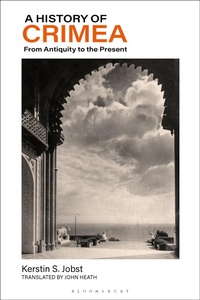
A History of Crimea
From Antiquity to the Present
1st Edition
Published on 12. December 2024
384 pages
978-1-350-32802-0 (ISBN)
Description

Since the Russian Federation's illegal annexation of Crimea from Ukraine in March 2014 - 160 years after the Crimean War - the peninsula has returned to the fore on the global geopolitical stage. This book provides a comprehensive history of the peninsula that was previously lacking, one that stretches from ancient times to the present and explores various aspects and inhabitants through the ages.
Kerstin S. Jobst examines the complex history of multi-ethnic and pluri-religious Crimea - not only from a political perspective, but also considering the manifold cultural and historical interdependencies that are central to the territory. The book examines myths and legends about Crimea, as well as the various peoples for whom it has been a settlement and transit area and who have shaped the fate of the peninsula: Greek, Genoese and Venetian colonists, Eurasian nomads, Crimean Tatars, Germans, Russians, Ukrainians and others. A History of Crimea shows the importance of Crimea as a site of early Christianity, but also as a contact zone between different religions - Judaism, Christianity and Islam. It also emphasizes the role of the peninsula as a peripheral space of various great powers - the Roman Empire, Byzantium, the Golden Horde, the "Third Reich" and the Ottoman, Russian and Soviet empires.
With this detailed overview of 2,000 years of Crimea's history, Kerstin S. Jobst debunks the narratives around the most recent explosive events in the peninsula by examining the full historical context. In doing so, she de-mythologizes simplified claims to historical legitimacy that, rooted in Russian emotional attachment and geopolitical ambitions, ignore the cultural complexities of the previous centuries. This important work thus rebalances skewed narratives that continue to prevail even among seasoned observers of developments in Crimea.
Kerstin S. Jobst examines the complex history of multi-ethnic and pluri-religious Crimea - not only from a political perspective, but also considering the manifold cultural and historical interdependencies that are central to the territory. The book examines myths and legends about Crimea, as well as the various peoples for whom it has been a settlement and transit area and who have shaped the fate of the peninsula: Greek, Genoese and Venetian colonists, Eurasian nomads, Crimean Tatars, Germans, Russians, Ukrainians and others. A History of Crimea shows the importance of Crimea as a site of early Christianity, but also as a contact zone between different religions - Judaism, Christianity and Islam. It also emphasizes the role of the peninsula as a peripheral space of various great powers - the Roman Empire, Byzantium, the Golden Horde, the "Third Reich" and the Ottoman, Russian and Soviet empires.
With this detailed overview of 2,000 years of Crimea's history, Kerstin S. Jobst debunks the narratives around the most recent explosive events in the peninsula by examining the full historical context. In doing so, she de-mythologizes simplified claims to historical legitimacy that, rooted in Russian emotional attachment and geopolitical ambitions, ignore the cultural complexities of the previous centuries. This important work thus rebalances skewed narratives that continue to prevail even among seasoned observers of developments in Crimea.
More details
Edition
1. Auflage
Language
English
Place of publication
London
United Kingdom
Publishing group
Bloomsbury Publishing PLC
Target group
College/higher education
Professional and scholarly
Illustrations
16 bw illus
ISBN-13
978-1-350-32802-0 (9781350328020)
Copyright in bibliographic data and cover images is held by Nielsen Book Services Limited or by the publishers or by their respective licensors: all rights reserved.
Schweitzer Classification
Other editions
Additional editions
Book
01/2025
Bloomsbury Academic
€31.50
Shipment within 15-20 days
Person
Kerstin S. Jobst is Professor for the Societies and Memory Cultures of Eastern Europe at the Institute for East European History at the University of Vienna, Austria. Her research interests include the History of East Central and Eastern Europe, the Black Sea region, the Caucasus, the Russian Empire and the Habsburg Monarchy, as well as comparative empires and colonialism studies.
Content
Preface
1. Introduction
2. Crimea as a Space of Myths and Legends
3. On Greeks, Scythians, and Others
4. New Actors: Sarmatians and Others
5. The Mithridatic Wars: Crimea under the Rule of Rome
6. On Goths, Huns, the 'Migration Period' and Its Impacts on Crimea
7. Crimea as a Place of Early Christianity
8. Crimea between the Eastern Roman Empire, the Crimean Gothia, and the Khazar Empire
9. Crimea between the Kievan Rus', Byzantium, and Semi-Nomadic Groups from Eurasia
10. On Cumans, Polovtsians, and Kipchaks
11. The Fourth Crusade (1202-1204) and its Impact on Crimea
12. Pax Mongolica, Trade, Slavery, and the 'Black Death'
13. The Principality of Theodoro and a Lithuanian Intermezzo
14. The Crimean Khanate: The Beginnings
15. The Establishment of the Crimean Khanate
16. The Crimean Khanate: Ottoman Suzerainty and an Eastern European Equilibrium
17. Slavery and the Topos of the Crimean Tatar Warrior
18. The Nogays as a Factor in the Early Modern Crimean History
19. The Cossacks as a Factor in the Early Modern Crimean History
20. Internal Conditions in the Crimean Khanate
21. In the Run-Up to the Annexation: The Strengthening of the Russian Empire, the 'Greek Plan', and the Treaty of Küçük Kaynarca of 1774
22. An 'Independent' Crimean Khanate and the Russian Annexation, 1774-1783
23. The First Decades of Russian Rule in Crimea
24. The Multi-Ethnic and Multi-Religious Crimea under Tsarist Rule: The Tatar Population and Gender Relations
25. The Multi-Ethnic and Multi-Religious Crimea under Tsarist Rule: 'Old' and 'New' Inhabitants
26. The Crimean War: A 'Modern' War?
27. The Crimean War: The Developments on the Peninsula
28. After the War: Crimea Between 1856 and 1905
29. The Crimean Tatar Population after the Crimean War
30. The Revolution 1905 and Its Consequences in Crimea
31. World War I and the Revolution in the Periphery: The Crimean Peninsula, 1917-1920
32. The Crimean Peninsula, 1920-1941
33. Crimea during World War II
34. The Deportations 1944/45 and Their Background
35. Crimea after World War II
36. The Dissolution of the Soviet Union: Crimea as Part of Independent Ukraine
37. Russian Again?! Crimea after the Second Annexation of 2014
Bibliography
Index
