

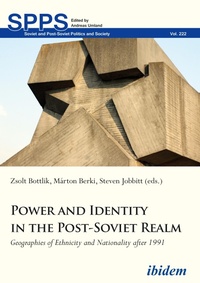
Power and Identity in the Post-Soviet Realm
Geographies of Ethnicity and Nationality after 1991
Published on 16. February 2021
320 pages
978-3-8382-9178-9 (ISBN)
Description

With the dissolution of the Soviet Union and the demise of the Cold War's bipolar world order, Soviet successor states on the Russian periphery found themselves in a geopolitical vacuum, and gradually evolved into a specific buffer zone throughout the 1990s. The establishment of a new system of relations became evident in the wake of the Baltic States' accession to the European Union in 2004, resulting in the fragmentation of this buffer zone. In addition to the nations that are more directly connected to Zwischeneuropa (i.e. 'In-Between Europe') historically and culturally (Belarus, Moldova, Ukraine), countries beyond the Caucasus (Azerbaijan, Georgia, Armenia), as well as the states of former Soviet Central Asia (Kazakhstan, Uzbekistan, Kyrgyzstan, Turkmenistan, Tajikistan) have also become characterized by particular developmental pathways.
Focusing on these areas of the post-Soviet realm, this collected volume examines how they have faced multidimensional challenges while pursuing both geopolitics and their place in the world economy. From a conceptual point of view, the chapters pay close attention not only to issues of ethnicity (which are literally intertwined with a number of social problems in these regions), but also to the various socio-spatial contexts of ethnic processes. Having emerged after the collapse of Soviet authority, the so-called 'post-Soviet realm' might serve as a crucial testing ground for such studies, as the specific social and regional patterns of ethnicity are widely recognized here. Accordingly, the phenomena covered in the volume are rather diverse.
The first section reviews the fundamental elements of the formation of national identity in light of the geopolitical situation both past and present. This includes an examination of the relative strength and shifting dynamics of statehood, the impacts of imperial nationalism, and the changes in language use from the early-modern period onwards. The second section examines the (trans)formation of the identities of small nations living at the forefront of Tsarist Russian geopolitical expansion, in particular in Central Asia, the Caucasus, and the Southern Steppe. Finally, in the third section, the contributors discuss the fate of groups whose settlement space was divided by the external boundaries of the Soviet Union, a reality that resulted in the diverging developmental trajectories of the otherwise culturally similar communities on both sides of the border. In these imperial peripheries, Soviet authority gave rise to specifically Soviet national identities amongst groups such as the Azeris, Tajiks, Karelians, Moldavians, and others.
The book also includes more than 30 primarily original maps, graphs, and tables and will be of great use not only for human geographers (particularly political and cultural geographers) and historians, but also for those interested in contemporary issues in social science.
Focusing on these areas of the post-Soviet realm, this collected volume examines how they have faced multidimensional challenges while pursuing both geopolitics and their place in the world economy. From a conceptual point of view, the chapters pay close attention not only to issues of ethnicity (which are literally intertwined with a number of social problems in these regions), but also to the various socio-spatial contexts of ethnic processes. Having emerged after the collapse of Soviet authority, the so-called 'post-Soviet realm' might serve as a crucial testing ground for such studies, as the specific social and regional patterns of ethnicity are widely recognized here. Accordingly, the phenomena covered in the volume are rather diverse.
The first section reviews the fundamental elements of the formation of national identity in light of the geopolitical situation both past and present. This includes an examination of the relative strength and shifting dynamics of statehood, the impacts of imperial nationalism, and the changes in language use from the early-modern period onwards. The second section examines the (trans)formation of the identities of small nations living at the forefront of Tsarist Russian geopolitical expansion, in particular in Central Asia, the Caucasus, and the Southern Steppe. Finally, in the third section, the contributors discuss the fate of groups whose settlement space was divided by the external boundaries of the Soviet Union, a reality that resulted in the diverging developmental trajectories of the otherwise culturally similar communities on both sides of the border. In these imperial peripheries, Soviet authority gave rise to specifically Soviet national identities amongst groups such as the Azeris, Tajiks, Karelians, Moldavians, and others.
The book also includes more than 30 primarily original maps, graphs, and tables and will be of great use not only for human geographers (particularly political and cultural geographers) and historians, but also for those interested in contemporary issues in social science.
More details
Series
Edition
New edition
Language
English
Place of publication
Hannover
Germany
Target group
Professional and scholarly
Edition type
New edition
Product notice
Reflowable
Illustrations
Illustrations
File size
5,26 MB
ISBN-13
978-3-8382-9178-9 (9783838291789)
Copyright in bibliographic data and cover images is held by Nielsen Book Services Limited or by the publishers or by their respective licensors: all rights reserved.
Schweitzer Classification
Other editions
Additional editions
Steven Jobbitt | Zsolt Bottlik | Marton Berki
Power and Identity in the Post-Soviet Realm
Geographies of Ethnicity and Nationality after 1991
Book
02/2021
ibidem
€34.90
Shipment within 10-15 days
Persons
Dr. Zsolt Bottlik is Associate Professor at the Institute of Geography and Earth Sciences of Eötvös Loránd University, Budapest. His research focuses on the ethnic background of social conflicts in the Central and Eastern European region.
Dr. Márton Berki is Senior Lecturer at the Department of Social and Economic Geography of Eötvös Loránd University, Budapest. His main fields of research include cultural geography, urban geography, socialist and post-socialist urbanism, critical social and spatial theory.
Dr. Steven Jobbitt is Associate Professor of History at Lakehead University in Thunder Bay, Ontario. His research focuses primarily on identity and the history of geography in twentieth-century Hungary.
Dr. Márton Berki is Senior Lecturer at the Department of Social and Economic Geography of Eötvös Loránd University, Budapest. His main fields of research include cultural geography, urban geography, socialist and post-socialist urbanism, critical social and spatial theory.
Dr. Steven Jobbitt is Associate Professor of History at Lakehead University in Thunder Bay, Ontario. His research focuses primarily on identity and the history of geography in twentieth-century Hungary.
