

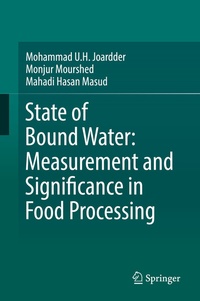
State of Bound Water: Measurement and Significance in Food Processing
Description

This book presents a comprehensive review of the characteristics of bound water and its use in food processing. The significance of bound water in food is discussed in terms of quality, energy consumption and cost. Also included is a thorough discussion on the emerging and appropriate measuring techniques of bound water in food materials. The challenges involved with bound water measurement and strategies for bound water removal during processing are covered in order to establish the appropriate conditions for food preservation. This work presents researchers with a clear, up-to-date concept of bound water and its significance in food processing and preservation.
Despite the importance of bound water in food processing, there are limited resources for researchers seeking an in-depth understanding of bound water in food materials. This is the first reference work dedicated to discussing the details of bound water in food materials and its significance in food processes and preservation, from its special characteristics to its energy consumption to its measurement and techniques. State of Bound Water: Measurement and significance in food processing is a singular work in the field of food preservation and processing arena.
More details
Other editions
Additional editions
Persons
Dr. Mohammad U. H. Joardder received his bachelor degree in Mechanical Engineering from Rajshahi University of Engineering and Technology (RUET), and PhD from QUT, Australia. He is now serving as a faculty member in Mechanical Engineering of RUET. His research interests include biotransport, Innovative food drying, modeling of novel food processing, food microstructure, food quality, Multiscale transport phenomena modelling as well as Renewable energy. He authored one popular book, three books chapter and more than 40 refereed journal publications. Most of his publications are in highly ranked journals and have been well cited. He is a regular reviewer of several high ranked journals of prominent publishers including Nature, Springer, Elsevier, Willey, and Taylor and Francis.
Mr. Monjur Mourshed works as an Assistant Professor at the Department of Mechanical engineering, Rajshahi University of Engineering & Technology (RUET), Rajshahi, Bangladesh. Healso graduated from this very institute. Monjur's research focus is on clean and alternative energy processing technologies, heat and mass transfer analysis of plant based materials.
Mr. Mahadi Hasan Masud works as an Assistant Professor at the Department of Mechanical engineering, Rajshahi University of Engineering & Technology (RUET), Rajshahi, Bangladesh. He also graduated from the same Department. Masud's research focus is on the advanced food preservation techniques, simultaneous heat and mass transfer, and renewable energy resources.
