

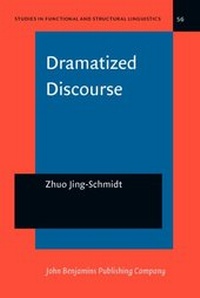
Dramatized Discourse
The Mandarin Chinese ba-construction
1st Edition
Published on 31. August 2005
XXII, 337 pages
978-90-272-9428-9 (ISBN)
Description

Language is a symbolic system of meanings evoked by linguistic forms. The choice of forms in communication is non-arbitrary. Rather, speakers pick those forms whose meanings best convey their discourse intention. The meaning of the Mandarin ba-construction, argues Jing-Schmidt, is discourse dramaticity, a concept that includes high conceptual salience and subjectivity. The ba-construction and its "syntactic variations" are never interchangeable because contrast in their meanings determines difference in their functions. Quantitative analyses based on authentic data validate the postulation of discourse dramaticity. By taking discourse pragmatics seriously, the dramaticity hypothesis enables a unitary explanation that transcends sentence grammar. The diachronic treatment reveals the syntactic change of the ba-construction as an adaptive process of pragmatization, which raises the issue of linguistic evolution as a result of socio-cultural development.
This book will be of particular value to readers interested in the interaction between grammar and pragmatics and to teachers confronting the controversy of the ba-construction in foreign language pedagogy.
This book will be of particular value to readers interested in the interaction between grammar and pragmatics and to teachers confronting the controversy of the ba-construction in foreign language pedagogy.
More details
Other editions
Additional editions
Book
08/2005
John Benjamins Publishing Co
€137.80
Shipment within 10-15 days
Person
Content
- Dramatized Discourse
- Editorial page
- Title page
- LCC data
- Dedication
- Table of contents
- Preface
- Acknowledgments
- List of figures and tables
- Notational conventions
- Abbreviations
- Introduction
- Database
- The syntax of the ba-construction
- 3.1. Compositional properties of the ba-construction
- 3.2. The ba-construction and mood
- 3.2.1. Indicative
- 3.2.2. Imperative
- 3.2.3. Interrogative
- 3.2.4. Subjunctive
- 3.3. The ba-construction and modality
- 3.4. The ba-construction and negation
- 3.5. The ba-construction in passive sentences
- 3.6. The ba-construction in causative sentences
- 3.7. The ba-construction as subordinate
- 3.8. Mandarin word order and the ba-construction
- Previous approaches
- 4.1. Disposal
- 4.2. Transitivity
- 4.2.1. Overview
- 4.2.2. What is transitivity?
- 4.3. The causativity approach
- 4.4. The problem
- The hypothesis of discourse dramaticity
- 5.1. The system of discourse dramaticity
- 5.2. The human factor
- 5.2.1. Cognitive salience
- 5.2.2. Subjectivity and emotionality
- 5.3. Redundancy
- Cognitive salience as discourse dramaticity
- 6.1. Cognitive salience at the clause level
- 6.1.1. Cognitive salience and the number of participants
- 6.1.2. Cognitive salience and verbal dynamism
- 6.1.3. Cognitive salience and verbal modification
- 6.1.4. Cognitive salience of event and salient participants
- 6.1.5. Cognitive salience and information structure
- 6.2. Cognitive salience at the trans-clause level
- 6.2.1. Foregrounding properties
- 6.2.2. Textual linking
- Subjectivity and emotionality as discourse dramaticity
- 7.1. The nature of linguistic subjectivity and emotionality
- 7.2. Conceptual metaphors
- 7.3. Intensifiers
- 7.3.1. Intensifying adverbs
- 7.3.2. Intensifying quantifiers
- 7.4. Mood and modality
- 7.4.1. Mood
- 7.4.2. Modality
- 7.4.3. The potential construction versus the modal verb neng
- 7.5. Frequency variation across discourse types as additional evidence
- An interim conclusion
- The pragmatization of the ba-construction
- 9.1. Evolution and a functional view of syntactic change
- 9.2. Serial verb construction as source of change
- 9.2.1. Formal pressure towards change
- 9.2.2. Functional re-adaptation and its formal repercussions
- 9.3. Regulation and systemization
- 9.3.1. Data
- 9.3.2. Results
- 9.3.3. Discussion
- 9.4. Inadequacies of the OM postulation
- 9.5. Subjectification
- Final remarks
- Notes
- -24pt
- References
- Text material
- Author index
- Subject index
- The series Studies In Functional And Structural Linguistics
