

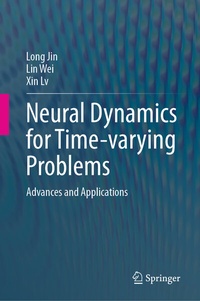
Neural Dynamics for Time-varying Problems
Description

This book mainly presents methods based on neural dynamics for the time-varying problems with applications, together with the corresponding theoretical analysis, simulative examples, and physical experiments. Based on these methods, their applications include motion planning of redundant manipulators, filter design, winner-take-all operation, multiple-input multiple-output system configuration, multi-linear tensor equation solving, and manipulability optimization are also presented. In this book, we present the design, proposal, development, analysis, modeling, and simulation of various neural dynamic models, along with their respective applications including motion planning of redundant manipulators, filter design, winner-take-all operation, multiple-input multiple-output system configuration, multi-linear tensor equation solving, and manipulability optimization. Specifically, starting from the top-level considerations of hardware implementation, we integrate computational intelligence methods and control theory to design a series of dynamic and noise-resistant discrete neural dynamic methods. The research work not only owns the theoretical guarantee on its convergence, noise resistance, and accuracy, but demonstrate the effectiveness and robustness in solving various optimization and equation solving problems, particularly in handling time-varying problems and noise perturbations. Moreover, by reducing complexity and avoiding matrix inversion operations, the models' feasibility and practicality are further enhanced.
More details
Other editions
Additional editions
Persons
Long Jin (Senior Member, IEEE) received the B.E. degree in automation and the Ph.D. degree in information and communication engineering from Sun Yat-sen University, Guangzhou, China, in 2011 and 2016, respectively. He underwent postdoctoral training with the Department of Computing, The Hong Kong Polytechnic University, Hong Kong, from 2016 to 2017. In 2017, he was a Professor of Computer Science and Engineering with the School of Information Science and Engineering, Lanzhou University, Lanzhou, China. From 2023 to 2024, he is serving as a Visiting Professor with The City University of Hong Kong, Hong Kong. He has published more than 90 papers in IEEE TRANSACTIONS journals. His current research interests include neural networks, optimization, intelligent computing, and robotics. Prof. Jin currently serves as an Associate Editor for IEEE TRANSACTIONS ON INTELLIGENT VEHICLES and IEEE TRANSACTIONS ON INDUSTRIAL ELECTRONICS. Besides, he holds the position of Outstanding Young Editorial Board Member for the IEEE/CAA JOURNAL OF AUTOMATICA SINICA.
Lin Wei received the B.E. degree in electronic and information engineering from the Beijing Institute of Technology, Beijing, China, in 2018; and her Ph.D. degree in computer application technology from Lanzhou University in Lanzhou University. Her research interests include neural networks and robotics. She has published more than 12 scientific papers as author or co-author (including 7 IEEE-transaction papers).
Xin Lv received her B.S. degree in electronic information science and technology from Lanzhou University, Lanzhou, China, in 2003; and her M.S. degree in information and communication engineering and Ph.D. degree in radio physics from Lanzhou University, in 2006 and 2015, respectively. Currently, she is a lecturer in the School of Information Science and Engineering at Lanzhou University. Her research interests include machine learning, neural networks and optimization.
Content
1. Neural Dynamics Based on Control Theoretical Techniques.- 2. Complex-Valued Discrete-Time Neural Dynamics.- 3. Noise-Tolerant Neural Dynamics.- 4. Computational Neural Dynamics.- 5. Discrete Computational Neural Dynamics.- 6. High-Order Robust Discrete-Time Neural Dynamics.- 7. Collaborative Neural Dynamics.
