

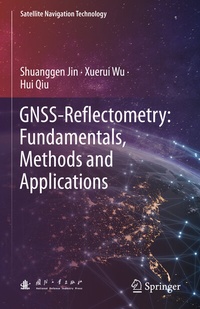
GNSS-Reflectometry: Fundamentals, Methods and Applications
Description

This book gives comprehensive introduction to the fundamentals, methods and applications of GNSS-Reflectometry (GNSS-R), including GNSS-R history, GNSS reflection signal characteristics, ground-based GNSS multipath reflectometry, interference pattern technology, delay Doppler map, space-based GNSS-R theory, ocean altimetry, hydrological remote sensing, vegetation monitoring and cryosphere remote sensing, etc. It well presents the current status and the latest application progress in this field. The authors have been engaged in the research and application of GNSS-R for many years with achieving lots of original theoretical and application progress, such as GNSS-R scattering mechanism and new applications, which reflect the forefront trends and cutting-edge dynamics in this discipline. It has important reference value and application prospect for marine monitoring, environment remote sensing, global change monitoring, glacier and permafrost monitoring, meteorological and agricultural application and so on.
This book is suitable for professionals, graduate students, and researchers engaged in satellite navigation, remote sensing, space geodesy, marine environment, meteorological services, and global change, and as well as technical support for engineers and transformation applications, especially those engaged in satellite navigation development and environmental remote sensing applications.
The basis of English translation of this book, originally in Chinese, was facilitated by artificial intelligence. The content was later revised completely by the authors for accuracy.
More details
Other editions
Additional editions
Persons
Prof. Dr. Shuanggen Jin (AE/EAS/RANS/TUBA Members & IUGG Fellow)
Presidents of IAPS (2015-19), CPGPS (2016-17) & AOGS PS (2018-20)
Head of Satellite Navigation and Remote Sensing Group
Content
Chapter 1 Introduction.- Chapter 2 Basics of GNSS Signals.- Chapter 3 Characteristics of GNSS Reflected Signals.- Chapter 4 Ground-based GNSS Multipath Reflectometry.- Chapter 5 Interference Technology and Delay Doppler Map.- Chapter 6 GNSS Altimetry Theory and Methods.- Chapter 7 Space-based GNSS Reflectometry Theory.- Chapter 8 Sea Surface Height and Significant Wave Height Estimation.- Chapter 9 Sea Surface Wind Estimation.- Chapter 10 Soil Moisture Remote Sensing.- Chapter 11 Vegetation Remote Sensing.- Chapter 12 Snow and Ice Remote Sensing.- Chapter 13 Monitoring Surface Freeze-Thaw Status.- Chapter 14 Conclusion and Prospects.
