

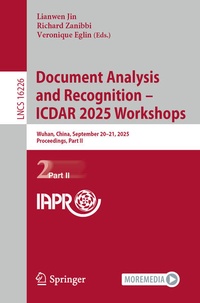
Document Analysis and Recognition - ICDAR 2025 Workshops
Description

The two-volume set LNCS 16225 + 16226 constitutes the proceedings of International Workshops co-located with the 19th International Conference on Document Analysis and Recognition, ICDAR 2025, held in Wuhan, China, during September 2025.
The 46 full papers included in these proceedings were carefully reviewed and selected from a total of 74 submissions. The contributions stem from the following workshops:
Part I: The Fifth ICDAR International Workshop on Machine Learning (WML 2025); ICDAR 2025 Workshop on Multi-Modal Mathematical Reasoning in Documents (M3RD 2025);
Part II: The 16th IAPR International Workshop on Graphics Recognition (GREC 2025); ICDAR 2025 Workshop on Visual Text Generation and Text Image Processing(VT-TIP 2025); ICDAR 2025 Workshop on Documents Analysis of Low-resource Languages (DALL 2025)
More details
Other editions
Additional editions
Content
.- The 16th IAPR International Workshop on Graphics Recognition (GREC 2025)
.- Hierarchical structure understanding in complex tables with VLLMs: a benchmark and experiments.
.- Archival Faces: Detection of Faces in Digitized Historical Documents.
.- AnonED: Complex Region Anonymisation in Electrical Diagrams using Hybrid Density-Based Spatial Clustering.
.- AnnoPage Dataset: Dataset of Non-Textual Elements in Documents with Fine-Grained Categorization.
.- GAN-based Content-Conditioned Generation of Handwritten Musical Symbols.
.-
ICDAR 2025 Workshop on Visual Text Generation and Text Image Processing (VT-TIP 2025)
.- SynFinTabs: A Dataset of Synthetic Financial Tables for Information and Table Extraction.
.- BengaliDiff: Diffusion Model for Few-Shot Bengali Font Generation.
.- DAA-Net: Dynamic Adaptive Aggregation Network for Document Image Rectification.
.- Visual Text Generation in Khmer Language: Challenges and Trends with Diffusion Models.
.- EroPT: Benchmarking Robustness of OCR Methods on Eroded Printed Text.
.- BiNet: A Deep Encoder-Decoder Network for Binarizing Degraded Ancient Manuscripts.
.- Modular OCR Using Web Scraping Data.
.- Semi-Supervised Writing Style Classification in Medieval Hebrew Manuscripts.
.-
ICDAR 2025 Workshop on Documents Analysis of Low-resource Languages (DALL 2025)
.- Enhancing Khmer-English Machine Translation via Document Analysis Techniques.
.- PALM-LAY: A Multi-Script Cross-Regional Dataset for Layout Analysis of Palm Leaf Manuscripts.
.- Open Set Oracle Character Recognition via Adaptive Decision Boundary.
.- TMAWS: A Manchu Archives Word Spotting Method Supporting Both Image and String Query Modes.
.- The Research on End-to-End Tibetan Text Detection and Recognition in Natural Scenes.
.- Multi-Type Tibetan Ancient Book Text Line Recognition Based on Adapter Fine-Tuning.
.- ClapperText: A Benchmark for Text Recognition in Low-Resource Archival Documents.
.- Cross-Lingual Learning for Low-Resource Khmer Scene Text Detection and Recognition.
.- Text Enhancement of Degraded Historical Documents.
.- HePU: Hebrew Paleography Understanding Dataset For Semantic Script Segmentation.
