

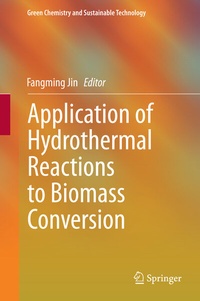
Application of Hydrothermal Reactions to Biomass Conversion
Description

This book reviews the recent advances in hydrothermal conversion of biomass into chemicals and fuels, and consists of 15 chapters. It introduces the properties of high-temperature water, the merits of hydrothermal conversion of biomass, and some novel hydrothermal conversion processes, mainly including hydrothermal production of value-added products, hydrothermal gasification, hydrothermal liquefaction and hydrothermal carbonization. This book introduces a new concept for counteracting the imbalance in the carbon cycle, which is caused by the rapid consumption of fossil fuels in anthropogenic activities in combination with the slow formation of fossil fuels. Accordingly, the book is useful in conveying a fundamental understanding of hydrothermal conversion of biomass in the carbon cycle so that a contribution can be made to achieving sustainable energy and environment. It is also interesting to a wide readership in various fields including chemical, geologic and environmental science andengineering.
Fangming Jin is a Distinguished Professor at the School of Environmental Science & Engineering, Shanghai Jiao Tong University, China
More details
Other editions
Additional editions
Person
Fangming Jin is a distinguished professor at the School of Environmental Science & Engineering, Shanghai Jiao Tong University, China. She received her Ph.D. from Tohoku University, Japan. She was an associate professor at Tohoku University before returning to China in 2007. She became a professor at Tongji University and a chair professor sponsored by Chang-Jiang Scholar Program (administered by Ministry of Education of the People's Republic of China) in 2007. In 2010, she moved to Tohoku University as a professor, and then in July 2011, she moved to Shanghai Jiao Tong University and received the honor of "Recruitment Program of Global Experts" in Shanghai. Her research focuses on the application of hydrothermal reactions for the conversion of biomass and carbon dioxide into fuels and chemicals, with the aim of exploring a potentially useful technology to improve the carbon cycle by mimicking nature. She has authored more than 200 research articles and book chapters and holds more than 20 patents. Prof. Jin is also a visiting professor at Tohoku University and a fellow of the Graduate School of Environmental Studies at Tohoku University.
Content
Part I Characters of High Temperature Water and Hydrothermal Reactions.- Water under High Temperature and Pressure Conditions and Its Applications to Develop Green Technologies for Biomass Conversion.- Part II Hydrothermal Conversion of Biomass into Chemicals.- Hydrothermal Conversion of Cellulose into Organic Acids with a CuO Oxidant.- Hydrothermal Conversion of Lignin and Its Model Compounds into Formic Acid and Acetic Acid.- Production of Lactic Acid from Sugars by Homogeneous and Heterogeneous Catalysts.- Catalytic Conversion of Lignocellulosic Biomass to Value-Added Organic Acids in Aqueous Media.- Catalytic Hydrothermal Conversion of Biomass-Derived Carbohydrates to High Value-Added Chemicals.- Part III Hydrothermal Conversion of Biomass into Fuels.- Effective Utilization of Moso-Bamboo (Phyllostachys Heterocycla) with Hot Compressed Water.- Hydrothermal Liquefaction of Biomass in Hot-Compressed Water, Alcohols and Alcohol-Water Co-Solvents for Bio-Crude Production.- Hydrothermal Liquefaction of Biomass.- Hydrothermal Gasification of Biomass for Hydrogen Production.- Part IV Hydrothermal Conversion of Biomass into Other Useful Products.- Review of Biomass Conversion in High Pressure High Temperature Water (HHW) including Recent Experimental Results (Isomerization and Carbonizaiton).- Hydrothermal Carbonization of Lignocellulosic Biomass.- Part V Hydrothermal Conversion of Biomass Waste into Fuels.- Organic Waste Gasification in Near- and Super-Critical Water.- Hydrothermal Treatment of Municipal Solid Waste for Producing Solid Fuel.- Sewage Sludge Treatment by Hydrothermal Process for Producing Solid Fuel.
