

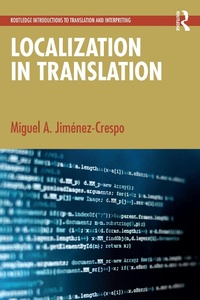
Localization in Translation
1st Edition
Published on 31. May 2024
336 pages
978-1-040-01658-9 (ISBN)
Description

Localization is everywhere in our digital world, from apps to websites or games. Our interconnected digital world functions in part thanks to invisible localization processes that allow global users to engage with all sorts of digital content and products. This textbook presents a comprehensive overview of the main theoretical, practical, and methodological issues related to localization, the technological, textual, communicative, and cognitive process by which interactive digital texts are prepared to be used in contexts other than those of production.
Localization in Translation provides an interdisciplinary introduction to the main practical and theoretical issues involved in localizing software, web, video games, and apps. It discusses the many technological, cultural, linguistic, quality, economic, accessibility, and user-reception issues related to the different localization types. It also provides an updated overview of localization in an ever-changing technological landscape marked by advances in neural machine translation and AI. Each chapter includes a basic summary, key questions, a final section with discussion and assignments, as well as additional readings. Online resources with additional questions and assignments are included on the Routledge Translation Studies portal.
This is the essential textbook for advanced undergraduates and graduates in translation studies and translation professionals engaged in localization practice.
Localization in Translation provides an interdisciplinary introduction to the main practical and theoretical issues involved in localizing software, web, video games, and apps. It discusses the many technological, cultural, linguistic, quality, economic, accessibility, and user-reception issues related to the different localization types. It also provides an updated overview of localization in an ever-changing technological landscape marked by advances in neural machine translation and AI. Each chapter includes a basic summary, key questions, a final section with discussion and assignments, as well as additional readings. Online resources with additional questions and assignments are included on the Routledge Translation Studies portal.
This is the essential textbook for advanced undergraduates and graduates in translation studies and translation professionals engaged in localization practice.
Reviews / Votes
Miguel Jimenez-Crespo has already established himself as the go-to expert for web localization, but with this new book, he offers insights into localization on a broader scale, taking in not only the web but also software, video games and apps. What's more, he does not shy away from exploring the complex relationships between localization and pressing issues such as accessibility, sustainability, and generative large language models (LLMs). No other resource offers such a comprehensive and up-to-date investigation of the theory and practice of localization in all its forms, making this a must-read for translation students or professionals seeking to add localization work to their repertoire. - Lynne Bowker, University of Ottawa, CanadaThis book by Miguel Jimenez-Crespo updates and builds on his previous writings that have become standard resources on localization. Not only is this an in-depth and timely volume, the layout and format are ideal for a university module. The comprehensive overview, breadth of research cited, and novel content combine to make this a key reading on localization for novice and expert readers. - Joss Moorkens, Dublin City University, Ireland
In this book, Miguel Angel Jimenez-Crespo unravels the concept of localization, masterfully exploring the nuances of adapting content for diverse media, be it software, websites, mobile apps, or video games. The author also provides insight into the latest developments in the field, such as Large Language Models (LLMs), Artificial Intelligence and Green Localization, and proposes future research avenues. Theoretical and practical insights, real-world examples, and expert tips make this a comprehensive companion for translation students and researchers, as well as novice and seasoned professionals in the realm of localization - Carme Mangiron, Universitat Autonoma de Barcelona, Spain
More details
Series
Edition
1. Auflage
Language
English
Place of publication
London
United Kingdom
Publishing group
Taylor & Francis Ltd
Target group
College/higher education
Professional and scholarly
Illustrations
12 Tables, black and white; 31 Line drawings, black and white; 8 Halftones, black and white; 39 Illustrations, black and white
ISBN-13
978-1-040-01658-9 (9781040016589)
Copyright in bibliographic data and cover images is held by Nielsen Book Services Limited or by the publishers or by their respective licensors: all rights reserved.
Schweitzer Classification
Other editions
Additional editions
Miguel A. Jimenez-Crespo
Localization in Translation
Book
05/2024
1st Edition
Routledge
€60.90
Shipment within 10-20 days
Miguel A. Jimenez-Crespo
Localization in Translation
Book
05/2024
1st Edition
Routledge
€207.10
Shipment within 10-20 days

Miguel A. Jimaenez-Crespo
Localization in Translation
Book
03/2024
Taylor & Francis
Unfortunately, price unknown
Available (delivery time upon request)
Person
Miguel A. Jimenez-Crespo is a Professor at the Department of Spanish and Portuguese, Rutgers University, NJ, USA, where he directs the graduate and undergraduate programs in Spanish < > English translation and interpreting.
Content
List of Figures
List of Tables
Acknowledgements
List of Abbreviations
Chapter 1 - Introduction
Chapter 2 - Defining localization: Main Concepts
Chapter 3 - Localization: minding the process
Chapter 4 - Quality in localization
Chapter 5 - Culture in localization
Chapter 6 - Localization and digital interaction: interactivity, multimodality, usability, and accessibility
Chapter 7 - Localization: texts and digital genres
Chapter 8 - Software localization
Chapter 9 - Web localization
Chapter 10 - Video Game localization
Chapter 11 - Mobile app localization
Chapter 12 - Perspectives in localization: from MT to AI
Chapter 13 - Researching localization
Bibliography
Index
List of Tables
Acknowledgements
List of Abbreviations
Chapter 1 - Introduction
Chapter 2 - Defining localization: Main Concepts
Chapter 3 - Localization: minding the process
Chapter 4 - Quality in localization
Chapter 5 - Culture in localization
Chapter 6 - Localization and digital interaction: interactivity, multimodality, usability, and accessibility
Chapter 7 - Localization: texts and digital genres
Chapter 8 - Software localization
Chapter 9 - Web localization
Chapter 10 - Video Game localization
Chapter 11 - Mobile app localization
Chapter 12 - Perspectives in localization: from MT to AI
Chapter 13 - Researching localization
Bibliography
Index
