

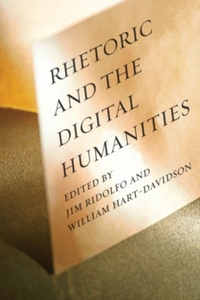
Rhetoric and the Digital Humanities
Published on 19. January 2015
320 pages
978-0-226-17672-7 (ISBN)
Description

The digital humanities is a rapidly growing field that is transforming humanities research through digital tools and resources. Researchers can now quickly trace every one of Issac Newton's annotations, use social media to engage academic and public audiences in the interpretation of cultural texts, and visualize travel via ox cart in third-century Rome or camel caravan in ancient Egypt. Rhetorical scholars are leading the revolution by fully utilizing the digital toolbox, finding themselves at the nexus of digital innovation.
Rhetoric and the Digital Humanities is a timely, multidisciplinary collection that is the first to bridge scholarship in rhetorical studies and the digital humanities. It offers much-needed guidance on how the theories and methodologies of rhetorical studies can enhance all work in digital humanities, and vice versa. Twenty-three essays over three sections delve into connections, research methodology, and future directions in this field. Jim Ridolfo and William Hart-Davidson have assembled a broad group of more than thirty accomplished scholars. Read together, these essays represent the cutting edge of research, offering guidance that will energize and inspire future collaborations.
More details
Other editions
Additional editions
Jim Ridolfo | William Hart-Davidson
Rhetoric and the Digital Humanities
Book
01/2015
University of Chicago Press
€99.04
Shipment within 10-20 days
Jim Ridolfo | William Hart-Davidson
Rhetoric and the Digital Humanities
Book
12/2014
University of Chicago Press
€32.50
Shipment within 10-20 days
Persons
Jim Ridolfo is assistant professor of writing, rhetoric, and digital studies at the University of Kentucky and associate researcher at Matrix, the Center for Digital Humanities and Social Sciences at Michigan State University.
William Hart-Davidson is associate dean of graduate studies in the College of Arts and Letters at Michigan State University and senior researcher at Matrix.
Content
- Intro
- Contents
- Introduction - Jim Ridolfo and William Hart-Davidson
- Part One. Interdisciplinary Connections
- 1. Digital Humanities Now and the Possibilities of a Speculative Digital Rhetoric - Alexander Reid
- 2. Crossing State Lines: Rhetoric and Software Studies - James J. Brown, Jr.
- 3. Beyond Territorial Disputes: Toward a "Disciplined Interdisciplinarity" in the Digital Humanities - Shannon Carter, Jennifer Jones, Sunchai Hamcumpai
- 4. Cultural Rhetorics and the Digital Humanities: Toward Cultural Reflexivity in Digital Making - Jennifer Sano-Franchini
- 5. Digital Humanities Scholarship and Electronic Publication - Douglas Eyman and Cheryl Ball
- 6. The Metaphor and Materiality of Layers - Daniel Anderson and Jentery Sayers
- 7. Modeling Rhetorical Disciplinarity: Mapping the Digital Network - Nathan Johnson
- Part Two. Research Methods and Methodology
- 8. Tactical and Strategic: Qualitative Approaches to the Digital Humanities - Brian McNely and Christa Teston
- 9. Low Fidelity in High Definition: Speculations on Rhetorical Editions - Casey Boyle
- 10. The Trees within the Forest: Extracting, Coding, and Visualizing Subjective Data in Authorship Studies - Krista Kennedy and Seth Long
- 11. Genre and Automated Text Analysis: A Demonstration - Roderick P. Hart
- 12. At the Digital Frontier of Rhetoric Studies: An Overview of Tools and Methods for Computer-Aided Textual Analysis - David Hoffman and Don Waisanen
- 13. Corpus-Assisted Analysis of Internet-Based Discourses: From Patterns to Rhetoric - Nelya Koteyko
- Part Three. Future Trajectories
- 14. Digitizing English - Jennifer Glaser and Laura R. Micciche
- 15. In/Between Programs: Forging a Curriculum between Rhetoric and the Digital Humanities - Douglas Walls
- 16. Tackling a Fundamental Problem: Using Digital Labs to Build Smarter Computing Cultures - Kevin Brooks, Chris Lindgren and Matthew Warner
- 17. In, Through, and About the Archive: What Digitization (Dis)Allows - Tarez Samra Graban, Alexis Ramsey-Tobienne and Whitney Myers
- 18. Pop-Up Archives - Jenny Rice and Jeff Rice
- 19. Archive Experiences: A Vision for User-Centered Design in the Digital Humanities - Liza Potts
- 20. MVC, Materiality, and the Magus: The Rhetoric of Source-Level Production - Karl Stolley
- 21. Procedural Literacy and the Future of the Digital Humanities - Brian Ballentine
- 22. Nowcasting/Futurecasting: Big Data, Prognostication, and the Rhetorics of Scale - Elizabeth Losh
- 23. New Materialism and a Rhetoric of Scientific Practice in the Digital Humanities - David Gruber
- List of Contributors
- Index
