

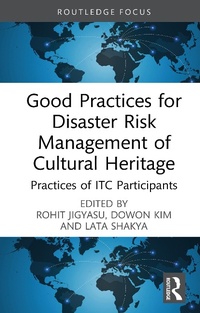
Good Practices for Disaster Risk Management of Cultural Heritage
Practices of ITC Participants
1st Edition
Published on 27. June 2023
170 pages
978-1-000-92650-7 (ISBN)
Description

This book is a selection of case studies undertaken by cultural heritage and disaster risk management professionals across the world demonstrating good practices for disaster risk management of cultural heritage.
The readers will learn about the practical application of various methodologies, tools, and techniques for disaster risk assessment, mitigation, preparedness, response, and recovery of cultural heritage. They will also learn about the application of traditional knowledge and engagement of communities for disaster risk management of cultural heritage. This will help relevant organisations and professionals to develop and implement projects in this field.
The intended audience for this book are Practitioners or site managers of cultural heritage sites and museums. Also, researchers and students studying disaster risk management of cultural heritage. The book will also be of interest to disaster risk management institutions at the urban, regional or national level/cultural heritage management institutions at the urban, regional or national level/city administration, municipalities, urban local bodies and planning departments/educational and research institutions which have specialised programmes in engineering, planning, disaster risk management, and conservation of cultural heritage.
The readers will learn about the practical application of various methodologies, tools, and techniques for disaster risk assessment, mitigation, preparedness, response, and recovery of cultural heritage. They will also learn about the application of traditional knowledge and engagement of communities for disaster risk management of cultural heritage. This will help relevant organisations and professionals to develop and implement projects in this field.
The intended audience for this book are Practitioners or site managers of cultural heritage sites and museums. Also, researchers and students studying disaster risk management of cultural heritage. The book will also be of interest to disaster risk management institutions at the urban, regional or national level/cultural heritage management institutions at the urban, regional or national level/city administration, municipalities, urban local bodies and planning departments/educational and research institutions which have specialised programmes in engineering, planning, disaster risk management, and conservation of cultural heritage.
More details
Series
Edition
1. Auflage
Language
English
Place of publication
London
United Kingdom
Publishing group
Taylor & Francis Ltd
Target group
College/higher education
Product notice
Reflowable
Illustrations
1 Tables, black and white; 10 Line drawings, black and white; 24 Halftones, black and white; 34 Illustrations, black and white
ISBN-13
978-1-000-92650-7 (9781000926507)
Copyright in bibliographic data and cover images is held by Nielsen Book Services Limited or by the publishers or by their respective licensors: all rights reserved.
Schweitzer Classification
Other editions
Additional editions
Rohit Jigyasu | Dowon Kim | Lata Shakya
Good Practices for Disaster Risk Management of Cultural Heritage
Practices of ITC Participants
Book
12/2024
1st Edition
Routledge
€33.10
Shipment within 10-20 days
Rohit Jigyasu | Dowon Kim | Lata Shakya
Good Practices for Disaster Risk Management of Cultural Heritage
Practices of ITC Participants
Book
06/2023
1st Edition
Routledge
€78.00
Shipment within 10-20 days
Persons
Rohit Jigyasu is a conservation architect and risk management professional from India, currently working at ICCROM as a Project Manager on Urban Heritage, Climate Change and Disaster Risk Management. He is also the Vice President of ICOMOS International Scientific Committee on Risk Preparedness (ICORP). Rohit served as UNESCO Chair holder professor at the Institute for Disaster Mitigation of Urban Cultural Heritage at Ritsumeikan University, Kyoto, Japan, where he was instrumental in developing and teaching the International Training Course on Disaster Risk Management of Cultural Heritage. He was the elected President of ICOMOS India from 2014 to 2018 and president of the ICOMOS International Scientific Committee on Risk Preparedness (ICORP) from 2010 to 2019. Rohit served as the Elected Member of the Executive Committee of ICOMOS since 2011 and was its Vice President from 2017 to 2020. Before joining ICCROM, Rohit worked with several national and international organisations such as UNESCO, UNISDR, Getty Conservation Institute, and World Bank for consultancy, research, and training on Disaster Risk Management of Cultural Heritage.
Dowon Kim is an associate professor at the Department of Civil and Environmental Engineering, Ritsumeikan University and a UNESCO Co-Chair holder professor at the Institute of Disaster Mitigation for Urban Cultural Heritage, Ritsumeikan University (R-DMUCH). Since 2014, he has been conducting and organising the International Training Course (ITC) on Disaster Risk Management of Cultural Heritage. His current research focuses on community design of disaster risk management in historical districts nationally and internationally. As for international contribution, he works for the International Scientific Committee on Risk Preparedness (ICORP) of ICOMOS. The main objective of his research is sharing the best practices of the urban and local communities' sustainability and cultural/social identity, with the method of analytics, field investigation, and communication tools development, and theorising these practices to transfer to the global context. Moreover, he is interested in disaster mitigation planning to balance heritage conservation, using traditional knowledge and community practices in urban heritage.
Lata Shakya is an associate professor at the Institute of Disaster Mitigation for Urban Cultural Heritage R-DMUCH, Ritsumeikan University. She has been serving as a coordinator of the International Training Course on Disaster Risk Management of Cultural Heritage since 2020. She received her doctoral degree in Urban and Environmental Engineering from Kyoto University and pursued postdoctoral research at the University of Tokyo, Department of Architecture, as a Japan Society for the Promotion of Science postdoctoral fellow and project researcher from 2013 to 2017. Her research focuses on community resilience to disasters and the sustainability of historic cities. She has conducted research in various urban and rural areas of Nepal and Japan. Her primary field area is the historic city of Patan in Nepal, a courtyard-style settlement that originated from Buddhist monasteries. She is currently involved in disaster mitigation planning of different communities in Patan through workshops with the local community. She is the co-author and coordinator of the book 'The Memory of 2015 Nepal Earthquake, the Experience of Local Residents Utilizing Traditional Resources in UNESCO World Heritage Site' (2019) and a co-author of the book 'Rural and Urban Sustainability Governance' (2014). She was awarded 'The Encouragement Prize of AIJ (Architectural Institute of Japan)', the Doctoral Dissertation Award from Association of Urban Housing Sciences in 2014, and the first JUSOKEN Doctoral Dissertation Award in 2016.
Dowon Kim is an associate professor at the Department of Civil and Environmental Engineering, Ritsumeikan University and a UNESCO Co-Chair holder professor at the Institute of Disaster Mitigation for Urban Cultural Heritage, Ritsumeikan University (R-DMUCH). Since 2014, he has been conducting and organising the International Training Course (ITC) on Disaster Risk Management of Cultural Heritage. His current research focuses on community design of disaster risk management in historical districts nationally and internationally. As for international contribution, he works for the International Scientific Committee on Risk Preparedness (ICORP) of ICOMOS. The main objective of his research is sharing the best practices of the urban and local communities' sustainability and cultural/social identity, with the method of analytics, field investigation, and communication tools development, and theorising these practices to transfer to the global context. Moreover, he is interested in disaster mitigation planning to balance heritage conservation, using traditional knowledge and community practices in urban heritage.
Lata Shakya is an associate professor at the Institute of Disaster Mitigation for Urban Cultural Heritage R-DMUCH, Ritsumeikan University. She has been serving as a coordinator of the International Training Course on Disaster Risk Management of Cultural Heritage since 2020. She received her doctoral degree in Urban and Environmental Engineering from Kyoto University and pursued postdoctoral research at the University of Tokyo, Department of Architecture, as a Japan Society for the Promotion of Science postdoctoral fellow and project researcher from 2013 to 2017. Her research focuses on community resilience to disasters and the sustainability of historic cities. She has conducted research in various urban and rural areas of Nepal and Japan. Her primary field area is the historic city of Patan in Nepal, a courtyard-style settlement that originated from Buddhist monasteries. She is currently involved in disaster mitigation planning of different communities in Patan through workshops with the local community. She is the co-author and coordinator of the book 'The Memory of 2015 Nepal Earthquake, the Experience of Local Residents Utilizing Traditional Resources in UNESCO World Heritage Site' (2019) and a co-author of the book 'Rural and Urban Sustainability Governance' (2014). She was awarded 'The Encouragement Prize of AIJ (Architectural Institute of Japan)', the Doctoral Dissertation Award from Association of Urban Housing Sciences in 2014, and the first JUSOKEN Doctoral Dissertation Award in 2016.
Content
Introduction
PART 1 - DRM Frameworks and Risk Assessment
Developing a Guideline for Preparing Risk Management Plans for Heritage Places in New Zealand
Implementation of Fire Risk Mitigation Strategies at Urban Heritage Site - A Case Study on al-Azhar and al-Ghuri District
Ancient Town Walls at Risk: Methods, Technologies and Tools for Multi-hazard Risk Analysis, Monitoring, and Governance
A Cultural Heritage Risk Index - The STORM Project Perspective
PART 2 - DRM plan implementation- workshops/community engagement/traditional knowledge
Mapping Risk for Cultural Heritage: A Project on Archaeological Decorative Elements in Mexico
Disaster Risk Management of Cultural Heritage in George Town World Heritage City, Malaysia
Historic Water Cisterns - An Effective Fire Preventive System
The Dominican Convent of Santo Domingo Tehuantepec- A Disaster Risk Management Plan for Local Cultural Heritage
PART 3 - DRM plan implementation- stakeholders participation/decision making
Disaster Risk Management Plan for a World Heritage Site - Humberstone and Santa Laura Saltpetre Works, Chile
Disaster Risk Management Plan for Punakha Dzong, Bhutan
PART 4 - DRM plan implementation- capacity building/others
From Theory to Practice: Insights from the Pathway to Implement DRM Measures for Cultural Heritage Sites
Specialised Civil Protection Volunteering for Cultural Heritage Rescue - A Rescue Project During Earthquake in Central Italy
Future Approach
PART 1 - DRM Frameworks and Risk Assessment
Developing a Guideline for Preparing Risk Management Plans for Heritage Places in New Zealand
Implementation of Fire Risk Mitigation Strategies at Urban Heritage Site - A Case Study on al-Azhar and al-Ghuri District
Ancient Town Walls at Risk: Methods, Technologies and Tools for Multi-hazard Risk Analysis, Monitoring, and Governance
A Cultural Heritage Risk Index - The STORM Project Perspective
PART 2 - DRM plan implementation- workshops/community engagement/traditional knowledge
Mapping Risk for Cultural Heritage: A Project on Archaeological Decorative Elements in Mexico
Disaster Risk Management of Cultural Heritage in George Town World Heritage City, Malaysia
Historic Water Cisterns - An Effective Fire Preventive System
The Dominican Convent of Santo Domingo Tehuantepec- A Disaster Risk Management Plan for Local Cultural Heritage
PART 3 - DRM plan implementation- stakeholders participation/decision making
Disaster Risk Management Plan for a World Heritage Site - Humberstone and Santa Laura Saltpetre Works, Chile
Disaster Risk Management Plan for Punakha Dzong, Bhutan
PART 4 - DRM plan implementation- capacity building/others
From Theory to Practice: Insights from the Pathway to Implement DRM Measures for Cultural Heritage Sites
Specialised Civil Protection Volunteering for Cultural Heritage Rescue - A Rescue Project During Earthquake in Central Italy
Future Approach
