

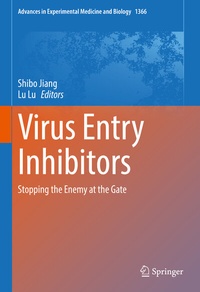
Virus Entry Inhibitors
Description

This book focuses on the important discoveries of the small molecule-, peptide-, and protein-based virus entry inhibitors and discusses advance of the development of different type of virus entry inhibitors as a novel class of antiviral drugs for treatment and prevention of viral infection. It includes entry inhibitors of HIV,HeV, NiV, RSV, EBOV, HCoV, HBV, HCV, HDV, HPV, flavivirus and influenza virus, so on. This book aims at providing an updated knowledge on virus entry inhibitors.
More details
Other editions
Additional editions
Persons
Dr. Shibo Jiang is a professor of School of Basic Medical Sciences, Shanghai Institute of Infectious Diseases and Biosecurity, Fudan University, China. He has served as an Editorial Consultant for The Lancet, Editorial Board Member for Emerging Microbes and Infection, Antiviral Research, Viruses, Retrovirology, BiochimBiophys Acta, Biomedical Journal, and Microbes and Infection. Dr. Jiang's research interest is to develop antiviral therapeutics and vaccines against HIV, RSV, HPV, SARS-CoV, MERS-CoV, SARS-CoV-2, EBOV, ZIKV, NiV, LASV and influenza viruses. He has published 523 peer-reviewed papers in international journals, including Cell, Nature, Science, Lancet, etc. with more than 33,500 citations and h-index of 93 (Google Scholar).
Dr. Lu Lu is a professor of School of Basic Medical Sciences, Shanghai Institute of Infectious Diseases and Biosecurity, Fudan University, China. He serves as the committee member of Zoonoses Etiology Branch of the Chinese Society for Microbiology (CSM) and Associate director of Youth Committee of Medical Microbiology and Immunology branch of CSM. Dr. Lu's research focuses on development of novel antiviral drugs and vaccines. He has published more than 118 articles in peer-reviewed international journals in this field, including Cell, Science, etc.
Content
Peptide virus entry inhibitors: past, present and future.- Small-molecule virus entry inhibitors.- Human endogenous virus entry inhibitors.- Lipopeptide HIV entry inhibitors.- Peptide HIV entry inhibitors targeting gp41 NHR.- Small-molecule HIV entry inhibitors targeting gp41 MPER.- Small-molecule HIV entry inhibitors targeting CD4-binding site in gp120.- Small-molecule HIV entry inhibitors targeting gp120.- SARS-CoV, MERS-CoV, and pan-coronavirus entry inhibitors.- Hendra virus (HeV) and Nipah virus (NiV) entry inhibitors.- Ebola virus entry inhibitors.- Cyclo-peptide-based Ebola virus entry inhibitors.- Influenza virus entry inhibitors.- Parainfluenza virus entry inhibitors.- Zika virus entry inhibitors.- HBV entry inhibitors.- HBV and HDV entry inhibitors.- HCV entry inhibitors.- Protein-based HPV entry inhibitors.
