

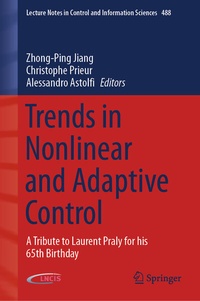
Trends in Nonlinear and Adaptive Control
Description

This book, published in honor of Professor Laurent Praly on the occasion of his 65th birthday, explores the responses of some leading international authorities to new challenges in nonlinear and adaptive control. The mitigation of the effects of uncertainty and nonlinearity - ubiquitous features of real-world engineering and natural systems - on closed-loop stability and robustness being of crucial importance, the contributions report the latest research into overcoming these difficulties in:
- autonomous systems;
- reset control systems;
- multiple-input-multiple-output nonlinear systems;
- input delays;
- partial differential equations;
- population games; and
- data-driven control.
Trends in Nonlinear and Adaptive Control presents research inspired by and related to Professor Praly's lifetime of contributions to control theory and is a valuable additionto the literature of advanced control.
More details
Other editions
Additional editions
Persons
Zhong-Ping Jiang is Professor of Electrical and Computer Engineering at New York University. His main research interests include stability theory, robust/adaptive/distributed nonlinear control, robust adaptive dynamic programming, reinforcement learning and its applications to information, and mechanical and biological systems. In these fields, he has written six research monographs and is the author or co-author of over 500 peer-reviewed journal and conference papers. Professor Jiang has served as Deputy Editor-in-Chief, Senior Editor, and Associate Editor for numerous journals. He is a Fellow of the IEEE, a Fellow of the IFAC and a Fellow of the CAA, and is among Clarivate Analytics' Highly Cited Researchers.
Dr
Christophe Prieur
is a CNRS Senior Researcher at University Grenoble Alpes. His current research interests include nonlinear control theory, hybrid systems and control of partial differential equations. He was the Program Chair of the 9th IFAC Symposium on Nonlinear Control Systems (NOLCOS 2013) and the 14th European Control Conference (ECC 2015), and Publication Chair for the Conference on Decision and Control (CDC) in 2016. He served as Vice IPC Chair for CDC2019 and CDC2020, and will serve a IPC Chair for CDC2022. His editorial services include the following: member of the IEEE-CSS Conference Editorial Board (2009-2013) and associate editor for the
IEEE Trans. on Automatic Control
(2011-2017). He is currently an associate editor of the IEEE Trans. on Control Systems Technology (since 2015) and a senior editor of the
IEEE Control Systems Letters
(since 2017). He is an IMA Fellow (since 2011) and an IEEE Senior Member (since 2016).
Professor Alessandro Astolfi is Professor of Nonlinear Control Theory and the Head of the Control and Power Group at Imperial College London and Professor at the University of Rome Tor Vergata. His research interests include mathematical control theory and control applications, with special emphasis on the problems of discontinuous stabilization, robust and adaptive control, observer design, and model reduction. Prof. Astolfi was the recipient of the IEEE Control Systems Society (CSS) A. Ruberti Young Researcher Prize (2007), the IEEE Robotics and Automation Society Googol Best New Application Paper Award (2009), the IEEE CSS George S. Axelby Outstanding Paper Award (2012), and the Automatica Best Paper Award (2017). He was also the recipient of the 2015 Sir Harold Hartley Medal, for outstanding contribution to the technology of measurement and control, from the Institute of Measurement and Control. He is a Distinguished Member of the IEEE CSS, and a Fellow of IEEE, IFAC and IET. He is currently the Editor-in-Chief for the IEEE Transactions on Automatic Control .
