

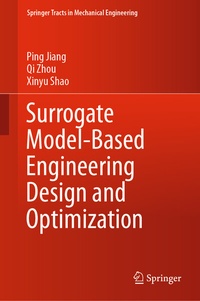
Surrogate Model-Based Engineering Design and Optimization
Description

This book covers some of the most popular methods in design space sampling, ensembling surrogate models, multi-fidelity surrogate model construction, surrogate model selection and validation, surrogate-based robust design optimization, and surrogate-based evolutionary optimization.
Surrogate or metamodels are now frequently used in complex engineering product design to replace expensive simulations or physical experiments. They are constructed from available input parameter values and the corresponding output performance or quantities of interest (QOIs) to provide predictions based on the fitted or interpolated mathematical relationships.
The book highlights a range of methods for ensembling surrogate and multi-fidelity models, which offer a good balance between surrogate modeling accuracy and building cost. A number of real-world engineering design problems, such as three-dimensional aircraft design, are also provided to illustrate the ability of surrogates for supporting complex engineering design. Lastly, illustrative examples are included throughout to help explain the approaches in a more "hands-on" manner.
More details
Other editions
Additional editions
Persons
Dr. Ping Jiang is a Professor at the School of Mechanical Science and Engineering, Huazhong University of Science and Technology (HUST), Wuhan, China. His research areas include metamodel-based robust design optimization, laser welding and simulation-based design. He is the associate editor of 'Mathematical Biosciences and Engineering'. He has published over 80 peer-reviewed, international journal and conference papers.
Dr. Qi Zhou is an Assistant Professor at the School of Aerospace Engineering, Huazhong University of Science and Technology (HUST), Wuhan, China. His research areas include multi-fidelity surrogate model and design optimization under uncertainty. He was the session chair of the International Conference on System Modeling and Optimization committee. He has published over 60 peer-reviewed, international journal and conference papers.
Dr. Xinyu Shao is a Professor at the School of Mechanical Science and Engineering, Huazhong University of Science and Technology (HUST), Wuhan, China. His research areas include advanced manufacturing processes and equipment, laser welding, and precision grinding. He is a Distinguished Professor in the Yangtze River Scholars Award Program, a recipient of the National Science Fund for Distinguished Young Scholars, and a Chief Scientist of the National 973 Program. He has served as the convener of the "Experts of Major Equipment and Process Technology" in the advanced manufacturing technology field of the National 863 Program, and the leader of the expert group supporting the "Numerical Generation Machinery Product Innovation Application Demonstration Project". He has published over a hundred peer-reviewed international journal and conference papers.
