

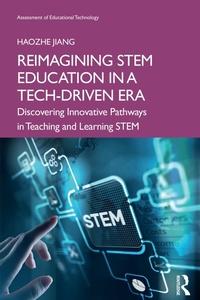
Reimagining STEM Education in a Tech-Driven Era
Discovering Innovative Pathways in Teaching and Learning STEM
Published on 1. June 2026
244 pages
978-1-040-55784-6 (ISBN)
Description

This book explores the fields of science, technology, engineering, and mathematics (STEM) through the lens of psychological, motivational, and technological forces that shape teaching and learning in a rapidly evolving educational landscape. The author discusses new and creative approaches to STEM education, offering valuable insights and practical solutions for fostering student engagement, building academic confidence, and preparing learners for technology-driven careers.
Drawing on rigorous empirical research, including quantitative studies employing structural equation modeling and in-depth longitudinal case studies, the book illuminates the complex mechanisms that underlie STEM learning outcomes. Key findings reveal how student interest in mathematics influences coding motivation, how intrinsic coding interest shapes STEM career aspirations, and how emerging technologies such as virtual and augmented reality can transform science learning. The author also synthesizes insights from the literature to examine how technology can be leveraged to enhance educational delivery and student engagement, fostering more dynamic and interactive learning environments across STEM disciplines.
One of the key highlights of this book is its unique blend of perspectives from teacher development, student motivation, and educational technology, providing a holistic understanding of the challenges and opportunities in contemporary STEM education. The inclusion of evidence-based strategies makes this book an invaluable resource for educators seeking to implement innovative approaches in their classrooms immediately. By bridging the gap between theory and practice, as well as between research and application, the author offers a comprehensive perspective for readers who need to understand the full spectrum of factors that drive successful STEM education.
This book targets a key group in the education sector, including STEM educators, researchers, educational psychologists, and policymakers, with the aim of advancing STEM teaching and learning in a tech-driven era.
Drawing on rigorous empirical research, including quantitative studies employing structural equation modeling and in-depth longitudinal case studies, the book illuminates the complex mechanisms that underlie STEM learning outcomes. Key findings reveal how student interest in mathematics influences coding motivation, how intrinsic coding interest shapes STEM career aspirations, and how emerging technologies such as virtual and augmented reality can transform science learning. The author also synthesizes insights from the literature to examine how technology can be leveraged to enhance educational delivery and student engagement, fostering more dynamic and interactive learning environments across STEM disciplines.
One of the key highlights of this book is its unique blend of perspectives from teacher development, student motivation, and educational technology, providing a holistic understanding of the challenges and opportunities in contemporary STEM education. The inclusion of evidence-based strategies makes this book an invaluable resource for educators seeking to implement innovative approaches in their classrooms immediately. By bridging the gap between theory and practice, as well as between research and application, the author offers a comprehensive perspective for readers who need to understand the full spectrum of factors that drive successful STEM education.
This book targets a key group in the education sector, including STEM educators, researchers, educational psychologists, and policymakers, with the aim of advancing STEM teaching and learning in a tech-driven era.
More details
Series
Language
English
Place of publication
London
United Kingdom
Publishing group
Taylor & Francis Ltd
Target group
Professional and scholarly
Illustrations
23 Tables, black and white; 24 Line drawings, black and white; 24 Illustrations, black and white
File size
117,39 MB
ISBN-13
978-1-040-55784-6 (9781040557846)
Copyright in bibliographic data and cover images is held by Nielsen Book Services Limited or by the publishers or by their respective licensors: all rights reserved.
Schweitzer Classification
Other editions
Additional editions
Haozhe Jiang
Reimagining STEM Education in a Tech-Driven Era
Discovering Innovative Pathways in Teaching and Learning STEM
Book
06/2026
1st Edition
Routledge
€90.00
Shipment within 15-20 days
Haozhe Jiang
Reimagining STEM Education in a Tech-Driven Era
Discovering Innovative Pathways in Teaching and Learning STEM
Book
06/2026
1st Edition
Routledge
€68.00
Shipment within 15-20 days
Person
Haozhe Jiang is a ZJU100 Young Professor and doctoral supervisor at College of Education, Zhejiang University. He leads research in STEM education with a focus on technology-enhanced STEM teaching and learning. His work has been published in many prestigious education journals, including the International Journal of STEM Education, Journal of Research in Science Teaching, Teaching and Teacher Education, International Journal of Science and Mathematics Education, Interactive Learning Environments, Education and Information Technologies, European Journal of Education, and International Journal of Educational Research. Notably, three of his papers are recognised as ESI Highly Cited Papers by Web of Science, with one additionally recognised as an ESI Hot Paper.
Content
1. Understanding a STEM Teacher's Emotions and Professional Identities: A Three-Year Longitudinal Case Study. 2. Longitudinal Analysis of Teacher Self-Efficacy Evolution during a STEAM Professional Development Program: A Qualitative Case Study. 3. Virtual Reality and Augmented Reality-Supported K-12 STEM Learning: Trends, Advantages, and Challenges. 4. Modeling the Impact of Intrinsic Coding Interest on STEM Career Interest: Evidence from Senior High School Students in Two Large Chinese Cities. 5. Bridging Disciplines: A Structural Equation Model of How Mathematics Motivations Shape Coding Motivations. 6. Exploring the Effects of Technology-Related Informal Mathematics Learning Activities: A Structural Equation Modeling Analysis. 7. Exploring the Influence of Problematic Mobile Phone Use on Mathematics Anxiety and Mathematics Self-Efficacy: An Empirical Study during the COVID-19 Pandemic.
