

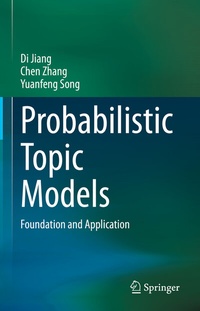
Probabilistic Topic Models
Description

This book introduces readers to the theoretical foundation and application of topic models. It provides readers with efficient means to learn about the technical principles underlying topic models. More concretely, it covers topics such as fundamental concepts, topic model structures, approximate inference algorithms, and a range of methods used to create high-quality topic models. In addition, this book illustrates the applications of topic models applied in real-world scenarios. Readers will be instructed on the means to select and apply suitable models for specific real-world tasks, providing this book with greater use for the industry. Finally, the book presents a catalog of the most important topic models from the literature over the past decades, which can be referenced and indexed by researchers and engineers in related fields. We hope this book can bridge the gap between academic research and industrial application and help topic models play an increasingly effective role inboth academia and industry.
This book offers a valuable reference guide for senior undergraduate students, graduate students, and researchers, covering the latest advances in topic models, and for industrial practitioners, sharing state-of-the-art solutions for topic-related applications. The book can also serve as a reference for job seekers preparing for interviews.
More details
Other editions
Additional editions
Persons
Di Jiang works as principal scientist and engineering manager at WeBank AI. His research interests include text mining, speech processing, and the broader topics of artificial intelligence. He obtained his PhD degree from the Hong Kong University of Science and Technology. He has served on the technical program committee of various international conferences, including KDD, AAAI, IJCAI, DASFAA, CIKM, and COLING. He is serving as a reviewer of international journals including TIST, TKDE, TWEB, etc. His work won DASFAA 2013 Best Student Paper Runner-up, Yahoo TechPulse 2014 Best Paper Award, and CCF Science and Technology Award.
Chen Zhang is currently a research assistant professor in the Department of Computing, PolyU. Before joining the Department, he worked as a senior manager of the Big Data Institute at The Hong Kong University of Science and Technology (HKUST). He received his PhD in Computer Science and Engineering from HKUST in 2015, supervised by Prof. Lei CHEN. Dr.Zhang has served on the Technical Program Committee of various international conferences, including ICDE and CIKM. He won the Outstanding Demonstration Award at VLDB 2014. He has published various papers at top-tier conferences and journals such as ICDE, VLDB, SIGMOD, and TKDE. He is broadly interested in crowdsourcing, fintech, NLP, and interdisciplinary research.
Yuanfeng Song works as a research engineer at AI Group, WeBank. He has more than ten years of working experience in leading Internet institutions such as Tencent and Baidu. His research interests include natural language processing and speech recognition. He received an MPhil degree in computer science from the Hong Kong University of Science and Technology in 2012. He has served as a reviewer of international conferences and journals, including AAAI, EMNLP, and KBS. He has published various papers in top conferences and journals such as KDD, MM, ICDM, TOIS, and TOIST.
