

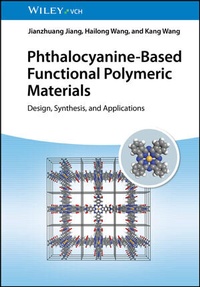
Phthalocyanine-Based Functional Polymeric Materials
Design, Synthesis, and Applications
1st Edition
Published on 10. February 2025
384 pages
978-3-527-84008-3 (ISBN)
Description

A carefully curated collection of resources covering the concepts, perspectives, and applications of phthalocyanine chemistry
In Phthalocyanine-Based Functional Polymeric Materials: Design, Synthesis, and Applications, a team of distinguished researchers delivers a comprehensive discussion of phthalocyanine-involving hybrids, molecular cages, coordination polymers, covalent organic frameworks, and organic polymers. The book also explains a diverse array of the applications of these novel materials in chemical sensors, organic catalysts, electrocatalysis, photocatalysis, energy storage, and more.
The authors have included material designed to help you improve the design of monomers to synthesize polymers with desired functionalities. A valuable reference in the development of phthalocyanine chemistry, readers will also find:
* A thorough introduction to phthalocyanine-based polymers and their uses in sensors, catalysis, energy storage, and other applications
* Comprehensive explorations of the extended molecular systems of phthalocyanines, filling the gap between monomeric phthalocyanine compounds and polymers
* Practical discussions of a variety of phthalocyanine-based polymer systems, their potential applications, and major design and synthesis challenges
* Complete treatments of these novel materials appropriate for readers in academia and industry
Perfect for polymer, organic, inorganic, catalytic, complex, and structural chemists, Phthalocyanine-Based Functional Polymeric Materials will also benefit materials scientists and chemists working in industry.
In Phthalocyanine-Based Functional Polymeric Materials: Design, Synthesis, and Applications, a team of distinguished researchers delivers a comprehensive discussion of phthalocyanine-involving hybrids, molecular cages, coordination polymers, covalent organic frameworks, and organic polymers. The book also explains a diverse array of the applications of these novel materials in chemical sensors, organic catalysts, electrocatalysis, photocatalysis, energy storage, and more.
The authors have included material designed to help you improve the design of monomers to synthesize polymers with desired functionalities. A valuable reference in the development of phthalocyanine chemistry, readers will also find:
* A thorough introduction to phthalocyanine-based polymers and their uses in sensors, catalysis, energy storage, and other applications
* Comprehensive explorations of the extended molecular systems of phthalocyanines, filling the gap between monomeric phthalocyanine compounds and polymers
* Practical discussions of a variety of phthalocyanine-based polymer systems, their potential applications, and major design and synthesis challenges
* Complete treatments of these novel materials appropriate for readers in academia and industry
Perfect for polymer, organic, inorganic, catalytic, complex, and structural chemists, Phthalocyanine-Based Functional Polymeric Materials will also benefit materials scientists and chemists working in industry.
More details
Other editions
Additional editions
Jianzhuang Jiang | Hailong Wang | Kang Wang
Phthalocyanine-Based Functional Polymeric Materials
Design, Synthesis, and Applications
Book
03/2025
1st Edition
Wiley-VCH
€155.00
Available immediately
Persons
Prof. Jianzhuang Jiang received his BSc (1985), MSc (1988), and PhD (1993) (with Tsinglien Chang) from the Peking University. During his doctoral study (1990-1992), he obtained a Fellowship from the Ministry of Culture, Science, and Sport of Japan and carried out his PhD work at the Osaka University under the guidance of Kenichi Machida and Ginya Adachi. He became a Postdoctoral Fellow at the Peking University with Tsinglien Chang (1993-1994), a Visiting Scholar at The Chinese University of Hong Kong with Dennis. K. P. Ng and Thomas C. W. Mak (1995-1996), and a Postdoctoral Fellow at the Queensland University of Technology with Dennis P. Arnold (1998-2000). He joined the Shandong University and University of Science and Technology Beijing in 1996 and 2008, respectively. Due to his outstanding contributions on single-molecule magnets, organic field-effect transistors, linear and nonlinear optical materials, new energy materials, etc., he was awarded the titles of Distinguished Young Scholar (2003), Cheung Kong Prof. (2005), State Class Person of National Talents Engineering (2013), and Leading Scientist of the National Special Support Program for High Level Talents (2015).
Hailong Wang was born in Jilin, China. He received BSc (2007), MSc (2010), and PhD (2013) degrees from Northeast Normal University, Shandong University, and University of Science and Technology Beijing (USTB), respectively, under the supervision of Prof. Jianzhuang Jiang. During 2013-2018, as a postdoctoral fellow, he worked with Prof. Banglin Chen at the University of Texas at San Antonio and with Prof. Qiang Xu at the National Institute of Advanced Industrial Science and Technology. Now, he is full-professor at USTB, focusing on porous molecular crystals and tetrapyrrole-based crystalline materials.
Dr. Kang Wang received his PhD in Chemistry from University of Science and Technology Beijing (USTB) in 2013 under supervision of Prof. Jianzhuang Jiang. He became a Postdoctoral Fellow at USTB (2013-2015) and a Visiting Scholar at Griffith University (2017-2018). Dr. Kang Wang joined USTB in 2015 and is currently an associate professor in Department of Chemistry and Chemical Engineering. Dr. Wang's research focuses on 1) synthesis of conjugate extended tetrapyrrole and tetrapyrrole-fused oligomer skeletons and 2) synthesis and application of tetrapyrrole based conjugated mesoporous organic frameworks.
Hailong Wang was born in Jilin, China. He received BSc (2007), MSc (2010), and PhD (2013) degrees from Northeast Normal University, Shandong University, and University of Science and Technology Beijing (USTB), respectively, under the supervision of Prof. Jianzhuang Jiang. During 2013-2018, as a postdoctoral fellow, he worked with Prof. Banglin Chen at the University of Texas at San Antonio and with Prof. Qiang Xu at the National Institute of Advanced Industrial Science and Technology. Now, he is full-professor at USTB, focusing on porous molecular crystals and tetrapyrrole-based crystalline materials.
Dr. Kang Wang received his PhD in Chemistry from University of Science and Technology Beijing (USTB) in 2013 under supervision of Prof. Jianzhuang Jiang. He became a Postdoctoral Fellow at USTB (2013-2015) and a Visiting Scholar at Griffith University (2017-2018). Dr. Kang Wang joined USTB in 2015 and is currently an associate professor in Department of Chemistry and Chemical Engineering. Dr. Wang's research focuses on 1) synthesis of conjugate extended tetrapyrrole and tetrapyrrole-fused oligomer skeletons and 2) synthesis and application of tetrapyrrole based conjugated mesoporous organic frameworks.
Content
Journey from Molecular Phthalocyanines to Polymeric Materials
Phthalocyanine-based Cages
Phthalocyanine-based Coordination Polymers
Porous Phthalocyanine-based Organic Polymers
Sensors based on Phthalocyanine Polymers and COFs
Application of phthalocyanine in electrocatalysis
Application of phthalocyanine in photocatalysis
Applications of Phthalocyanine-based Polymeric Materials for Energy Storage
Phthalocyanine-based Cages
Phthalocyanine-based Coordination Polymers
Porous Phthalocyanine-based Organic Polymers
Sensors based on Phthalocyanine Polymers and COFs
Application of phthalocyanine in electrocatalysis
Application of phthalocyanine in photocatalysis
Applications of Phthalocyanine-based Polymeric Materials for Energy Storage
