

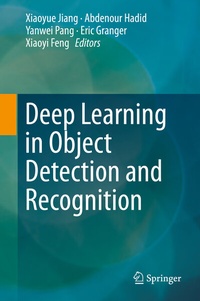
Deep Learning in Object Detection and Recognition
Description

This book discusses recent advances in object detection and recognition using deep learning methods, which have achieved great success in the field of computer vision and image processing. It provides a systematic and methodical overview of the latest developments in deep learning theory and its applications to computer vision, illustrating them using key topics, including object detection, face analysis, 3D object recognition, and image retrieval.
The book offers a rich blend of theory and practice. It is suitable for students, researchers and practitioners interested in deep learning, computer vision and beyond and can also be used as a reference book. The comprehensive comparison of various deep-learning applications helps readers with a basic understanding of machine learning and calculus grasp the theories and inspires applications in other computer vision tasks.
More details
Other editions
Additional editions
Persons
Abdenour Hadid is an adjunct professor at the Center for Machine Vision and Signal Analysis at University of Oulu. He is the chairman of the Pattern Recognition Society of Finland. His research interests include biometrics and facial image analysis, local descriptors, machine learning and human-machine interaction. He has authored over 140< articles in different forums and coauthored a very popular Springer Book on Computer Vision Using Local Binary Patterns in 2011.
Yanwei Pang received his Ph.D. degree in Electronic Engineering from the University of Science and Technology of China (USTC) in 2004. Currently, he is a professor at the School of Electronic Information Engineering, Tianjin University, China. He is also the founding director of the Visual Pattern Analysis Laboratory of Tianjin University. His research interests include deep convolutional neural networks, pattern recognition, machine learning, computer vision and digital image processing. He has authored more than 100 scientific papers, 24 of which were published in IEEE Transactions.
Eric Granger earned his Ph.D. in EE from the Poly-technique Montréalin 2001, and worked as a defense scientist at DRDC-Ottawa (1999-2001), and in R&D with Mitel Networks (2001-04). He joined the École de Technologie Supérieure (Université du Québec), Montreal, in 2004, where he is presently full professor and director of LIVIA, a research laboratory on computer vision and artificial intelligence. His research focuses on adaptive pattern recognition, machine learning, computer vision and computational intelligence.
Xiaoyi Feng received her Ph.D. degree in Electronics and Information from Northwestern Polytechnical University in 2001. She is currently a professor and vice dean of the School of Electronics and Information, Northwestern Polytechnical University, and the vice director of the key laboratory of Ministry of Education "Aerospace electronics information perception and photoelectric control". Her research interests include image processing, pattern recognition, computer vision, radar imaging, embedded system design and applications. She is the executive director of Shaanxi Society of Image and Graphics, and senior member of the China Society of Electronics.
