

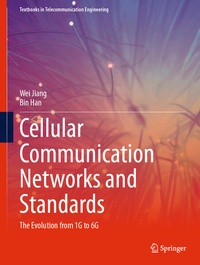
Cellular Communication Networks and Standards
Description

This textbook provides a comprehensive review of the evolution of mobile communications and networking from the birth of cellular networks to the forthcoming sixth-generation mobile communications, which is envisioned to be commercially deployed first in 2030. New students who are coming to wireless communications/electrical engineering/computer networking/telecommunications and network engineering can benefit from this book by quickly grasping the whole history of cellular networks, understanding its trends. This tutorial styled textbook provides a comprehensive overview, but also provides details of the system design aspects of the various cellular generations up to 6G and how they build on each other. The book also gives the student an overview of different cellular generations' motivations, core technologies, architecture, key performance indicators, killer applications, market drivers, and the general/main features of each. The authors capture the big picture and fundamental drivers of wireless communication technologies, and then motivate students to understand the importance of learning related subjects such as electromagnetics theory, antenna design, analog and digital circuits, signal processing, Internet protocols, artificial intelligence, etc. The book features homework questions and case studies throughout.
More details
Other editions
Additional editions
Persons
Wei Jiang, Ph.D., is a Senior Researcher with the German Research Center for Artificial Intelligence (DFKI), Germany. He has served as the leader of many EU or German research projects on 5G, 6G, AI, and Industry 4.0, and has extensive experiences in developing new technology and international standards related to wireless communications and networking by publishing 100 articles and holding 30 patents. He has published the book "6G Key Technologies: A Comprehensive Guide " (IEEE Press & Wiley, 2023), and co-authored three books: "Signal processing for 5G: algorithms and implementations" (IEEE Press & Wiley, 2016), "5G System Design: Architectural and Functional Considerations and Long Term Research" (Wiley 2018), and "Machine learning for future wireless communications" (IEEE Press & Wiley, 2020).
Bin Han, Ph.D., is a Privatdozent (Senior Lecturer with Habilitation) with University of Kaiserslautern (RPTU), Germany. His research interests lie in the vast fields of wireless communications, networking, and signal processing. He has authored a book, six book chapters, and over 65 research papers. He has been a part of multiple EU FP7, Horizon 2020, and Horizon Europe research projects. He is an Editorial Board Member for Network and Guest Editor for Electronics. He is actively involved in the IEEE Standards Association Working Groups P2303 and P3106 and is a Senior Member of IEEE.
Content
Introduction.- Standards History of Mobile Systems.- First-Generation Mobile Communication.- Evolution to Second-Generation Mobile Communication, 2G.- The Global System for Mobile Communications (GSM).- Evolution to Third-Generation Mobile Communication, 3G.- Wideband Code-Division Multiple Access.- Evolution to Fourth-Generation Mobile Communication, 4G.- Long-Term Evolution (LTE).- Evolution to Fifth-Generation Mobile Communication, 5G.- 5G New Radio.- Evolution Towards Sixth-Generation Mobile Communication, 6G.- Key Technologies for Sixth-Generation Mobile Communication.- Conclusion.
