

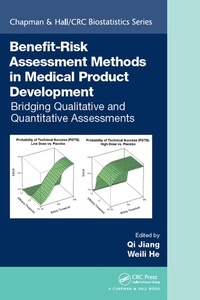
Benefit-Risk Assessment Methods in Medical Product Development
Bridging Qualitative and Quantitative Assessments
Published on 19. December 2017
312 pages
978-1-4822-5937-7 (ISBN)
Description

Guides You on the Development and Implementation of B-R Evaluations
Benefit-Risk Assessment Methods in Medical Product Development: Bridging Qualitative and Quantitative Assessments provides general guidance and case studies to aid practitioners in selecting specific benefit-risk (B-R) frameworks and quantitative methods. Leading experts from industry, regulatory agencies, and academia present practical examples, lessons learned, and best practices that illustrate how to conduct structured B-R assessment in clinical development and regulatory submission.
The first section of the book discusses the role of B-R assessments in medicine development and regulation, the need for both a common B-R framework and patient input into B-R decisions, and future directions. The second section focuses on legislative and regulatory policy initiatives as well as decisions made at the U.S. FDA's Center for Devices and Radiological Health. The third section examines key elements of B-R evaluations in a product's life cycle, such as uncertainty evaluation and quantification, quantifying patient B-R trade-off preferences, ways to identify subgroups with the best B-R profiles, and data sources used to assist B-R assessment. The fourth section equips practitioners with tools to conduct B-R evaluations, including assessment methodologies, a quantitative joint modeling and joint evaluation framework, and several visualization tools. The final section presents a rich collection of case studies.
With top specialists sharing their in-depth knowledge, thought-provoking considerations, and practical advice, this book offers comprehensive coverage of B-R evaluation methods, tools, and case studies. It gives practitioners a much-needed toolkit to develop and conduct their own B-R evaluations.
Benefit-Risk Assessment Methods in Medical Product Development: Bridging Qualitative and Quantitative Assessments provides general guidance and case studies to aid practitioners in selecting specific benefit-risk (B-R) frameworks and quantitative methods. Leading experts from industry, regulatory agencies, and academia present practical examples, lessons learned, and best practices that illustrate how to conduct structured B-R assessment in clinical development and regulatory submission.
The first section of the book discusses the role of B-R assessments in medicine development and regulation, the need for both a common B-R framework and patient input into B-R decisions, and future directions. The second section focuses on legislative and regulatory policy initiatives as well as decisions made at the U.S. FDA's Center for Devices and Radiological Health. The third section examines key elements of B-R evaluations in a product's life cycle, such as uncertainty evaluation and quantification, quantifying patient B-R trade-off preferences, ways to identify subgroups with the best B-R profiles, and data sources used to assist B-R assessment. The fourth section equips practitioners with tools to conduct B-R evaluations, including assessment methodologies, a quantitative joint modeling and joint evaluation framework, and several visualization tools. The final section presents a rich collection of case studies.
With top specialists sharing their in-depth knowledge, thought-provoking considerations, and practical advice, this book offers comprehensive coverage of B-R evaluation methods, tools, and case studies. It gives practitioners a much-needed toolkit to develop and conduct their own B-R evaluations.
Reviews / Votes
"This is one of the few books fully dedicated to the benefit-risk (BR) evaluation of pharmaceutical product. . . This book was edited by two leading experts who not only have done extensive research on the topics but also have established and led the society of clinical trial BR working group. The contributing authors in each chapter are experienced researchers and/or thought-leaders in the field. We think this book gives practitioners a much needed job aid to perform their BR evaluation."~ Journal of Biopharmaceutical Statistics
More details
Series
Language
English
Place of publication
Philadelphia, PA
United States
Publishing group
Taylor & Francis Inc
Target group
College/higher education
Professional and scholarly
This book is intended for statisticians, epidemiologists, clinicians, drug safety professionals, and medical scientists who are involved in the benefit-risk assessment of drug products. It also would be useful to regulators who face complex benefit-risk decisions, and to regulatory and drug development policymakers.
Illustrations
63 farbige Abbildungen, 24 s/w Tabellen
24 Tables, black and white; 63 Illustrations, color
File size
15,13 MB
ISBN-13
978-1-4822-5937-7 (9781482259377)
Copyright in bibliographic data and cover images is held by Nielsen Book Services Limited or by the publishers or by their respective licensors: all rights reserved.
Schweitzer Classification
Other editions
Additional editions
Qi Jiang | Weili He
Benefit-Risk Assessment Methods in Medical Product Development
Bridging Qualitative and Quantitative Assessments
Book
12/2020
1st Edition
Chapman & Hall/CRC
€64.36
Shipment within 15-20 days
Qi Jiang | Weili He
Benefit-Risk Assessment Methods in Medical Product Development
Bridging Qualitative and Quantitative Assessments
Book
05/2016
1st Edition
Chapman & Hall/CRC
€155.99
Article not available for order
Persons
Dr. Qi Jiang is an executive director of Global Biostatistical Science at Amgen. In this role, she is the biostatistical therapeutic area head for oncology and hematology and the lead of the Center of Excellence for Safety and Benefit-Risk. In addition, Dr. Jiang provides oversight to Amgen's biostatistical efforts in the Asia-Pacific region. Before joining Amgen, she worked at the Harvard School of Public Health, Merck, and Novartis. Dr. Jiang is the co-editor of the Chapman & Hall/CRC book Quantitative Evaluation of Safety in Drug Development: Design, Analysis and Reporting and the author of more than 60 peer-reviewed publications on method development, study design, and data analysis and reporting. She is a fellow of the American Statistical Association, a co-lead of the American Statistical Association Biopharmaceutical Section Safety Working Group, a co-lead of the Quantitative Sciences in the Pharmaceutical Industry (QSPI) Benefit-Risk Working Group, and an associate editor for Statistics in Biopharmaceutical Research.
Dr. Weili He is a director of clinical biostatistics at Merck & Co., Inc. Her research interests include survival and longitudinal data modeling, missing data imputation, cancer Phase I and II designs, repeated categorical data modeling, surrogate marker evaluations, adaptive design methodologies and implementations, and methods for benefit-risk assessment. Dr. He has published extensively in the areas of adaptive designs and benefit-risk evaluations and is the author of more than 50 peer-reviewed publications in statistical and medical journals. She is also a lead editor of the book Practical Considerations for Adaptive Trial Design and Implementation. She has been actively involved in many professional activities and services, including serving as co-chair of the Quantitative Sciences in the Pharmaceutical Industry (QSPI) Benefit-Risk Working Group, co-chair of the DIA Adaptive Design Scientific Working Group (ADSWG) KOL lecture series, associate editor for Statistics in Biopharmaceutical Research, and a referee for other statistical journals.
Dr. Weili He is a director of clinical biostatistics at Merck & Co., Inc. Her research interests include survival and longitudinal data modeling, missing data imputation, cancer Phase I and II designs, repeated categorical data modeling, surrogate marker evaluations, adaptive design methodologies and implementations, and methods for benefit-risk assessment. Dr. He has published extensively in the areas of adaptive designs and benefit-risk evaluations and is the author of more than 50 peer-reviewed publications in statistical and medical journals. She is also a lead editor of the book Practical Considerations for Adaptive Trial Design and Implementation. She has been actively involved in many professional activities and services, including serving as co-chair of the Quantitative Sciences in the Pharmaceutical Industry (QSPI) Benefit-Risk Working Group, co-chair of the DIA Adaptive Design Scientific Working Group (ADSWG) KOL lecture series, associate editor for Statistics in Biopharmaceutical Research, and a referee for other statistical journals.
Content
The Need for Benefit-Risk Assessment and Future Directions. Overview of Benefit-Risk Assessment and Regulatory Environment. Considerations of Benefit-Risk Assessment Development in Products' Life Cycle Management. Benefit-Risk Assessment Methods and Visual Tools. Benefit-Risk Assessment Case Studies and Lessons Learned. Glossary. Index.
