

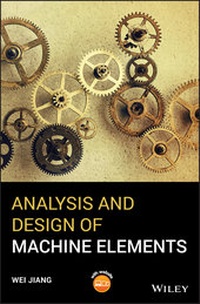
Analysis and Design of Machine Elements
Description

* Presents a consistent approach to the design of different machine elements from failure analysis through strength analysis and structural design, which facilitates students' understanding, learning, and integration of analysis with design
* Fundamental theoretical topics such as mechanics, friction, wear and lubrication, and fluid mechanics are embedded in each chapter to illustrate design in practice
* Includes examples, exercises, review questions, design and practice problems, and CAD examples in each self-contained chapter to enhance learning
Analysis and Design of Machine Elements is a design-centric textbook for advanced undergraduates majoring in Mechanical Engineering. Advanced students and engineers specializing in product design, vehicle engineering, power machinery, and engineering will also find it a useful reference and practical guide.
More details
Other editions
Additional editions
Person
WEI JIANG, PHD, is a senior member of the Chinese Mechanical Engineering Society, and a Registered Professional Engineer in China, with extensive industrial experience in design and manufacturing. She has taught Mechanical Design, Computer Aided Design, and advised Mechanical Design Projects, capstone design projects for over ten years at Dalian University of Technology. She also teaches a graduate course on Mechanical Strength with emphasis on stress analysis, fracture and fatigue analysis of machine elements.
Content
Preface xvii
About the Companion Website xix
Part I Fundamentals of Design and Strength Analysis 1
1 An Overview of Machine Design 3
1.1 Introduction 3
1.2 Machine Design 5
1.3 Machine Element Design 9
1.4 Materials and Their Properties 15
1.5 Unit Systems 21
1.6 Standards and Codes 22
References 23
Problems 23
2 Strength of Machine Elements 25
2.1 Fluctuating Loads and Stresses 26
2.2 Static Strength 29
2.3 Fatigue Strength 32
2.4 Contact Strength 50
References 52
Problems 53
Part II Design Applications 57
3 Detachable Joints and Fastening Methods 59
3.1 Introduction 60
3.2 Screw Threads 61
3.3 Threaded Fastening Methods 64
3.4 Force Analysis of Multiply Bolted Joints 67
3.5 Strength Analysis 71
3.6 Design of Bolted Joints 76
References 83
Problems 84
4 Detachable Fastenings for Shaft and Hub 91
4.1 Keys 91
4.2 Splines 96
4.3 Pins 97
References 98
Problems 99
5 Permanent Connections 105
5.1 Riveting 105
5.2 Welding 109
5.3 Brazing, Soldering and Adhesive Bonding 113
References 115
Problems 115
6 Belt Drives 119
6.1 Introduction 120
6.2 Working Condition Analysis 124
6.3 Power Transmission Capacities 131
6.4 Design of Belt Drives 135
6.5 Installation and Maintenance 140
References 141
Problems 141
7 Chain Drives 147
7.1 Introduction 148
7.2 Working Condition Analysis 151
7.3 Power Transmission Capacities 155
7.4 Design of Chain Drives 157
7.5 Drive Layout, Tension and Lubrication 163
References 165
Problems 165
8 Gear Drives 171
8.1 Introduction 173
8.2 Working Condition Analysis 178
8.3 Strength Analysis for Spur Gears 182
8.4 Strength Analysis for Helical Gears 188
8.5 Strength Analysis for Bevel Gears 196
8.6 Design of Gear Drives 202
8.7 Structural Design of Gears 224
8.8 Lubrication and Efficiency 225
References 225
Problems 226
9 Wormgear Drives 233
9.1 Introduction 234
9.2 Working Condition Analysis 239
9.3 Load Carrying Capacities 242
9.4 Design of Wormgear Drives 246
9.5 Structural Design of Wormgear Drives 253
9.6 Lubrication of Wormgear Drives 253
References 254
Problems 254
10 Shafts 259
10.1 Introduction 260
10.2 Working Condition Analysis 262
10.3 Load Carrying Capacities 264
10.4 Design of Shafts 271
References 284
Problems 284
11 Rolling Contact Bearings 291
11.1 Introduction 292
11.2 Working Condition Analysis 298
11.3 Life Expectancy and Load Carrying Capacities 305
11.4 Design of Bearing Support Systems 310
References 321
Problems 322
12 Sliding Bearings 329
12.1 Introduction 330
12.2 Working Condition Analysis 332
12.3 Load Carrying Capacities 340
12.4 Design of Sliding Bearings 349
References 360
Problems 360
13 Couplings and Clutches 365
13.1 Introduction to Couplings 366
13.2 Design and Selection of Couplings 375
13.3 Introduction to Clutches 377
References 382
Problems 382
14 Springs 387
14.1 Introduction 388
14.2 Working Condition Analysis 392
14.3 Loading Carrying Capacities 396
14.4 Design of Springs 406
References 415
Problems 416
Index 419
1
An Overview of Machine Design
1.1 Introduction
1.1.1 Machines and Machine Elements
A machine is a device that employs power to accomplish a desired function to benefit humankind. It is generally composed of a power source to provide power and movement, and an executive device to fulfil intended function. In between is a transmission system and controller. Power sources can be prime movers, that is, a machine utilizes a natural source of energy to produce power, like an internal combustion engine; or a secondary mover, like an electric motor, which receives energy directly or indirectly from a generator driven by a prime mover [1]. Take a car as an example; power sources, either engines in motor vehicles or batteries in electrical vehicles, provide power to executive devices; for example, wheels, through a transmission system (including couplings, clutches, shafts, powertrain etc.). The control system, that is, steering systems and brakes, control car movement. Lights, meters and windscreen wipers are accessories that facilitate a car running properly.
Machines involve a vast variety of mechanical products in various fields of manufacturing, transportation, aerospace, construction, agricultural, energy and many others. 'Products' covers industrial robots, machine tools and automated assembly systems in manufacturing systems; automobiles, trains, ships and aircraft in transportation vehicles; mobile cranes, dump trucks and concrete mixers in construction equipment. Household appliances, like vacuum cleaners, washing machines and air-conditioning systems are also machines.
A similar concept, that is, mechanism, is a combination of elements formed and connected to transmit motion in a predetermined fashion. Typical mechanisms include linkages, cams and follower systems, gears and gear trains and so on. There is no clear division between mechanisms and machines. If the transmitted forces or power are significant, it is considered a machine; otherwise, it is considered a mechanism [2]. Machinery is a derived term and refers to a grouping of mechanisms and machines [1].
A machine composes individual machine elements properly designed and arranged to work together. Machine elements are the fundamental components of a machine, and are broadly classified as universal elements, such as bolts, keys, splines, pins, belts, chains, gears, bearings and springs that are widely used in different kinds of machines, and special elements such as turbine blades, crankshafts and aircraft propellers, which perform specific functions [3]. This book focuses on the analysis and design of universal machine elements.
1.1.2 The Scope of Machine Design
Design is widely considered to be the central or distinguishing activity of engineering [4]. It aims to create and execute a purposeful plan to meet commercial, industrial and social needs. When design is discussed in mechanical engineering domain, especially about mechanical products or machines, it is termed mechanical or machine design.
Machine design is the art of envisioning, creating and developing a brand new or improving on an existing mechanical device for the fulfilment of human needs, with due regard for resource conservation and environmental impact [ 1,5]. It is an innovative, iterative, decision making and problem-solving process involving comprehensive utilization of scientific knowledge and creative capability. Designers are required to generate concepts and decide deterministic dimensions for devices or products from limited information, ambiguous and sometimes even partially contradictory requirements to achieve users' objectives while satisfying a set of specified constraints. Therefore, the initial design is usually tentative. With more variables gradually determined, material, geometry, as well as manufacturing and tolerance details are fine-tuned during iteration until final optimum design is achieved [5].
Machine design generally has more than one solution. Since design is a rational process of choosing among design alternatives [6], it greatly depends on the designer's knowledge, previous experience, design method and design philosophies to solve a specific problem. Consider, for example, the design of an automobile. A large number of models are available on the market, and all of them can fulfil the function of transportation. The differences among them are the operation convenience, comfort, aesthetic appearance, cost and so on. These features decide the competitiveness and sales of products.
Analysis and design are indispensable aspects in the process of machine design. Analysis is concerned with predicting the response of an existing or a tentatively designed machine under specified inputs, which is especially important in creative design process; while design attempts to decide the dimensions and shapes of machines to meet performance requirements. Integrating analysis and design skills during the design process distinguishes an outstanding design engineer from a good one [7]. Since design is an evolutionary process, a tentative design is firstly proposed and then analysed to see if it satisfies the given specifications. If not, which is the usual case; the tentative design is revised with changes involving geometry, material and loads, and is analysed again until it satisfies the specified design requirements.
Extensive multidisciplinary skills and knowledge are employed in the design process to convert inadequate, vague requirements into a product that is functional, safe, reliable, manufacturable, competitive and marketable. Engineering science includes mechanics of solids and fluids, materials science, manufacturing processes and so on. Designers are required to use computers and graphics tools to visualize design plans. Since designers often work collaboratively on teams, communication skills, teamwork ability and presentation skills are equally important.
To design a machine or machine element successfully, design engineers not only need to develop competence in understanding and applying scientific knowledge, empirical information, professional judgement and ingenuity in solving practical problems, but also cultivate a strong sense of responsibility and professional work ethic. Mechanical design involves almost all the disciplines of mechanical engineering [8-10]. The extensive knowledge and skills required for a mechanical designer are briefly summarized as:
- Competence in mathematics, statics, dynamics, mechanics of materials, kinematics and mechanisms to facilitate load, stress and strength analyses; an advanced CAD/CAE (computer-aided design or engineering) or FEM (finite element method) technique is preferred;
- Familiar with engineering materials and their properties, materials processing, heat treatments and manufacturing processes;
- Knowledge of tribology, fluid mechanics, heat transfer, electrical and information technology and controls;
- Creativity, complex problem-solving capability and project management skills;
- Competence in graphical representation by sketches, engineering drawing, CAD tools and 3D visualization to convert mental design concepts into technical drawings;
- Both verbal and written communication skills and presentation skills to articulate design projects, describe constraints and limitations and present proposals and technical reports;
- Teamwork and collaboration capability, and a sense of social and ethical responsibilities.
Students are expected to appreciate that machine design is an integration of physical and engineering considerations with social concerns, with an aim to design machines with satisfactory lives and high reliabilities. With the globalization of business world, future design engineers are expected to feel comfortable to work in a vibrant and multicultural environment, learn to satisfy the needs of customers in a competent, responsible, ethical and professional manner and able to communicate complex aspects of design verbally and graphically to other members in both national and international concurrent design teams.
1.2 Machine Design
1.2.1 Machine Design Considerations
An important assessment of design quality is machine's safe and reliable performance of its intended function for the prescribed design life without serious breakdown. Besides, machine design involves a multitude of considerations, as summarized in Table 1.1. It is unrealistic to satisfy all these considerations, as some are seemingly incompatible. Designers are challenged to recognize incongruities and find compromises between these discrepancies. During the design process, the total life cycle of a product, from initial ideation, design, manufacturing, assembly to service and final disposal, should be reviewed, and situations that may practically occur during manufacturing, transporting, storing, installing, servicing and disposal be evaluated. The main concerns selected from Table 1.1 are discussed next and will be addressed throughout the book.
Table 1.1 Machine design considerations.
Functional considerations Safety and reliability considerations Manufacturing considerations Form considerations Economic, ecological, societal considerations Functionality Load/stress/...