

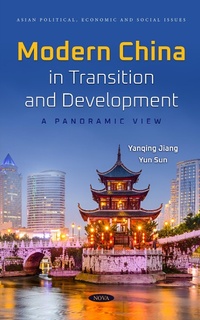
Modern China in Transition and Development: A Panoramic View
Published on 25. October 2022
247 pages
979-8-88697-394-5 (ISBN)
Description

This is a book discussing China's economic transition and development since the beginning of modern times. The book is chronologically divided into eight connected chapters that collectively provide a comprehensive and coherent discussion of the book's focus - China's economic transition and development in modern and contemporary times. However, each one of the eight chapters is sufficiently self-contained and can be read on its own, which potentially enhances the usefulness of the book. Chapter 1 provides an introduction and overview. All the subsequent chapters go into detail with each one of them pertaining to a specific historical time period as the corresponding chapter title properly implies. Chapter 2 focuses on the period of transformational development of the Late Qing Dynasty and the socio-economic situation after the founding of the Republic of China. Chapter 3 is about the Chinese economy in wars and covers the period of the Anti-Japanese War and China's War of Liberation. Chapter 4 is concerned with the economy under the early governance of the People's Republic of China while Chapter 5 focuses on the subsequent twists and turns of the socialist economic construction. The longest chapter, Chapter 6 is devoted to the great turning point in the history of China's socialist construction - the reform and opening up. The last two chapters, Chapters 7 and 8, stride into the 21st Century. Chapter 7 is about the new stage of China's economy, new development strategies, completion and prospect, and the achievements of the first 12 years into the new century, while Chapter 8 discusses the economic new normal and the socialism with Chinese characteristics for a new era.
More details
Other editions
Additional editions

Yanqing Jiang | Yun Sun
Modern China in Transition and Development: A Panoramic View
Book
12/2022
Nova Science Publishers Inc
€210.94
Shipment within 10-20 days
Content
- Intro
- Contents
- Preface
- Chapter 1
- Introduction and Overview
- 1.1. A Brief Introduction to the History
- 1.2. The Economic History of Modern China
- 1.3. Economic Transition of Contemporary China
- Chapter 2
- The Economic Situation of the Early Stage
- 2.1. The Early Stage of Foreign Trade
- 2.2. The Background of the Opium War
- 2.3. The Influences of the Opium War
- 2.4. Transformational Development of Late Qing Dynasty
- 2.5. The Society of the Republic of China
- Chapter 3
- The Chinese Economy in Wars
- Part I: The Economic Situation during the Anti-Japanese War (1937-1945)
- 3.1. A Social Background of the Anti-Japanese War
- 3.2. The General Economic Conditions
- 3.3. The Economic Situation in Kuomintang Ruling Areas
- 3.4. The Economy under the Leadership of the Communist Party of China
- Part II: The Economic Situation during China's War of Liberation (1945-1949)
- 3.5. The Social Background of China's War of Liberation
- 3.6. The American Influence in Kuomintang Ruling Areas
- 3.7. The Collapse of Kuomintang Areas
- 3.8. The Victory of the New Democratic Economy
- Chapter 4
- Early Governance of the People's Republic of China
- Part I: The Period of Economic Recovery (1949-1952)
- 4.1. Elimination of Residual Forces
- 4.2. The Agrarian Reform
- 4.3. Unified Financial Management
- Part II: The Second Transition Stage and the First Five-Year Plan (1953-1957)
- 4.4. Industrialization
- 4.5. The Transformation of Agriculture
- 4.6. Transformation of Handicraft Industry
- 4.7. Transformation of Capitalist Industry and Commerce
- Chapter 5
- Twists and Turns of the Socialist Economic Construction
- 5.1. The Movement of Great Leap Forward and People's Commune
- 5.2. The Adjustment Policies Attempting to Recover the Economy
- 5.3. The Great Cultural Revolution
- Chapter 6
- A Great Turning Point: The Reform and Opening Up
- Part I: The Great Transition
- 6.1. Reform and Opening Up
- 6.2. The Household Contract Responsibility System
- 6.3. Township and Village Enterprises
- 6.4. A Reform of Urban Economic Systems
- 6.5. The Opening-Up Policy
- Part II: Initial Success of the Reform and Opening up
- 6.6. The Theory of the Primary Stage of Socialism
- 6.6.1. Ownership of the Means of Production and Economic System
- 6.6.2. Mode of Business Operation and Distribution System
- 6.6.3. Foreign Relations
- 6.6.4. The Relationship between National Economic Construction and People's Living
- 6.7. The Sixth Five-Year Plan
- 6.7.1. Agriculture and Industry
- 6.7.2. Transportation Industry
- 6.7.3. Government Revenue and Expenditure
- 6.7.4. Domestic and Foreign Trade
- 6.7.5. People's Living
- 6.7.6. Expenditure and Investment on Scientific Research and Education
- 6.8. The Seventh Five-Year Plan
- Part III. Progress in the 1990s
- 6.9. The Socialist Market Economy System
- 6.10. Reform of State-Owned Enterprises
- 6.10.1. The Overall National Economy
- 6.10.2. The Distribution of State-Owned Economy
- 6.10.3. Enterprise Management
- 6.10.4. Optimizing the Layout and Structure of State-owned Economy
- 6.10.5. Transforming the Operating System
- 6.10.6. Developing High and New Technologies
- 6.10.7. Properly Using Non-Renewable Resources
- 6.11. The Return of Hongkong to China
- 6.11.1. Further Promoting the Construction and Development of Socialist Market Economy of Mainland China
- 6.11.2. Strengthening the Development and Opening Up of the Central and Western Regions and Shanghai
- 6.11.3. The Formation of Economic Circle of South China
- 6.12. Achievements in the 1990s
- Chapter 7
- Developments in the 21st Century
- 7.1. The New Stage of China's Economy
- 7.1.1. Accession to the WTO
- 7.1.2. The Transformation of Guiding Thoughts
- 7.1.3. The Tenth and Eleventh Five-Year Plans
- 7.2. New Development Strategies
- 7.2.1. Coordinated Development between Urban and Rural Areas and Different Regions
- 7.2.2. Mechanisms and Institutions for the Integrated Development of Urban and Rural Areas
- 7.2.3. 'Bringing In' and 'Going Out' Strategy
- 7.3. Experiences from the Tenth and Eleventh Five-Year Plans
- 7.4. Major Achievements
- Chapter 8
- The Breakthroughs of the New Stage
- 8.1. The New Normal of China's Economy
- 8.1.1. The Decisive Role of the Market
- 8.1.2. The Role of Government Functions
- 8.2. The New Vision on Development
- 8.2.1. The Completion of the Twelfth Five-Year Plan
- 8.2.2. The Thirteenth Five-Year Plan
- 8.3. A New Era of Socialism with Chinese Characteristics
- 8.3.1. The 19th National Congress of Communist Party of China
- 8.3.2. The Achievements of the First Centenary Goal and the Future Prospects
- Bibliography
- About the Authors
- Index
- Blank Page
