

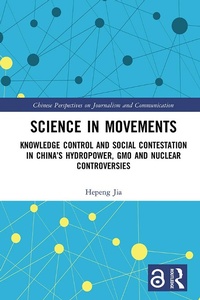
Science in Movements
Knowledge Control and Social Contestation in China's Hydropower, GMO and Nuclear Controversies
1st Edition
Published on 5. July 2021
250 pages
978-1-000-41838-5 (ISBN)
Description

This book analyses and compares the origins, evolutionary patterns and consequences of different science and technology controversies in China, including hydropower resistance, disputes surrounding genetically modified organisms and the nuclear power debate.
The examination combines social movement theories, communication studies, and science and technology studies. Taking a multidisciplinary approach, the book provides an insight into the interwoven relationship between social and political controls and knowledge monopoly, and looks into a central issue neglected by previous science communication studies: why have different controversies shown divergent patterns despite similar social and political contexts? It is revealed that the media environment, political opportunity structures, knowledge-control regimes and activists' strategies have jointly triggered, nurtured and sustained these controversies and led to the development of different patterns. Based on these observations, the author also discusses the significance of science communication studies in promoting China's social transformation and further explores the feasible approach to a more generic framework to understand science controversies across the world.
The book will be of value to the academics of science communication, science and technology studies, political science studies and sociology, as well as general readers interested in China's science controversies and social movements.
The Open Access version of this book, available at http://www.taylorfrancis.com/books/e/9781003160212, has been made available under a Creative Commons Attribution-Non Commercial-No Derivatives 4.0 license.
The examination combines social movement theories, communication studies, and science and technology studies. Taking a multidisciplinary approach, the book provides an insight into the interwoven relationship between social and political controls and knowledge monopoly, and looks into a central issue neglected by previous science communication studies: why have different controversies shown divergent patterns despite similar social and political contexts? It is revealed that the media environment, political opportunity structures, knowledge-control regimes and activists' strategies have jointly triggered, nurtured and sustained these controversies and led to the development of different patterns. Based on these observations, the author also discusses the significance of science communication studies in promoting China's social transformation and further explores the feasible approach to a more generic framework to understand science controversies across the world.
The book will be of value to the academics of science communication, science and technology studies, political science studies and sociology, as well as general readers interested in China's science controversies and social movements.
The Open Access version of this book, available at http://www.taylorfrancis.com/books/e/9781003160212, has been made available under a Creative Commons Attribution-Non Commercial-No Derivatives 4.0 license.
More details
Series
Edition
1. Auflage
Language
English
Place of publication
London
United Kingdom
Publishing group
Taylor & Francis Ltd
Target group
College/higher education
Professional and scholarly
Illustrations
21 Tables, black and white; 20 Line drawings, black and white; 20 Illustrations, black and white
File size
5,10 MB
ISBN-13
978-1-000-41838-5 (9781000418385)
Copyright in bibliographic data and cover images is held by Nielsen Book Services Limited or by the publishers or by their respective licensors: all rights reserved.
Schweitzer Classification
Other editions
Additional editions
Hepeng Jia
Science in Movements
Knowledge Control and Social Contestation in China's Hydropower, GMO and Nuclear Controversies
Book
01/2023
1st Edition
Routledge
€61.30
Shipment within 15-20 days
Hepeng Jia
Science in Movements
Knowledge Control and Social Contestation in China's Hydropower, GMO and Nuclear Controversies
Book
07/2021
1st Edition
Routledge
€233.20
Shipment within 15-20 days
Hepeng Jia
Science in Movements
Knowledge Control and Social Contestation in China's Hydropower, Gmo and Nuclear Controversies
Book
07/2021
Routledge
Unfortunately, price unknown
Available (delivery time upon request)
Person
Hepeng Jia is a professor of communication at Soochow University, Suzhou, China. He has worked as a leading science journalist for 20 years and is also a pioneering researcher in the field of science journalism and communication in China.
Content
1. Science Controversies Encounter Political Opportunities 2. Research Method and Data 3. Science Controversies in Transitional China 4. Hydropower, Fragmentation and Knowledge-Making 5. GMO Controversy: How Orthodox Science Lost Control 6. The Nuclear Power Debate in a Narrow Political Opportunity Structure 7. Why are Science Controversies So Different? 8. Synergy of Different Theoretical Traditions in a Comparative Lens 9. Conclusion
