

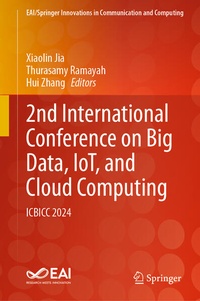
2nd International Conference on Big Data, IoT, and Cloud Computing
Description

This book presents contributions selected from 2nd International Conference on Big Data, IoT, and Cloud Computing (ICBICC 2024), held in Xishuangbanna, China, on December 30, 2024 to January 1, 2025. The book covers topics including Big Data Application, Internet of Things and 5G Networks,Artificial Intelligence and Machine Learning. The contributions from leading experts in the field highlight innovative solutions and strategies developed to address pressing global challenges. The main benefit readers will derive from the book is valuable insights into the latest technologies and future directions within the Big Data, IoT, and Cloud Computing field. This knowledge will be useful for researchers, practitioners, policymakers, and students interested in these areas.
- Presents the proceedings of the 2nd International Conference on Big Data, IoT, and Cloud Computing (ICBICC 2024);
- Covers topics including big data application, IoT and Cloud Computing;
- Highlights innovative solutions and strategies developed to address pressing global challenges.
More details
Other editions
Additional editions
Persons
Xiaolin Jia , Ph.D., professor, doctoral supervisor, deputy dean of the School of Computer Science and Technology, director of the Radio Frequency Identification and Internet of Things (RFID&IOT) Laboratory, director of Mianyang Key Laboratory of Mobile Internet of Things Radio Frequency Identification Technology (MIOT&RFID); IEEE Senior Member, senior member of CCF, IEEE journal, journal and conference paper review expert, National Natural Science Foundation of China project review expert; Winner of the Sichuan Province Science and Technology Progress Award, and a visiting scholar at the University of Ottawa in Canada. He makes a breakthrough progress in the research on anti-collision technology for RFID multi-tag identification, and the core results have become one of the three tree-type (query tree, binary tree, collision tree) search algorithm branch systems in the field of RFID multi-tag identification.
T. Ramayah , is currently a Professor of Technology Management, School of Management, Universiti Sains Malaysia. He has an h-index of 113 and citation of 49,164 in Google Scholar and i-10 index of 531, his h-index in SCOPUS is 64, with 15,123 citations while his h-index in ISI/Clarivate is 50 with 10,100 citations. He has published more than 500 Journal Articles, 30 Books and 300 Proceedings. He serves as the Journal Editor of JASEM, JASEM, IJBI, JMI, etc.
Zhang Hui , Ph.D., professor, master's tutor. He is currently the dean of the School of Computer Science and Technology of Southwest University of Science and Technology, a member of the Computer Society of China, and the deputy director of the Natural Language Processing Committee of the Sichuan Computer Society. Obtained a PhD from Japan Advanced Institute of Science and Technology, Hokuriku, Japan. Currently, he is mainly engaged in teaching and research related to artificial intelligence, with his main research directions being data mining, knowledge engineering, etc. He has published more than50 papers in many important international conferences and journals such as IEEE Transaction on Big Data, PRICAI, and ACML, and has 3 authorized invention patents and 12 registered software copyrights.
