

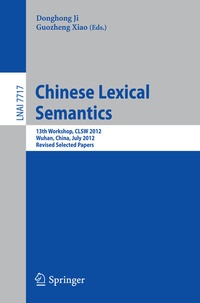
Chinese Lexical Semantics
13th Workshop, CLSW 2012, Wuhan, China, July 6-8, 2012, Revised Selected Papers
Published on 15. February 2013
XVI, 838 pages
978-3-642-36337-5 (ISBN)
Description

This book constitutes carefully reviewed and revised selected papers from the 13th Chinese Lexical Semantics Workshop, CLSW 2012, held in Wuhan, China, in July 2012. The 67 full papers and 17 short papers presented in this volume were carefully reviewed and selected from 169 submissions. They are organized in topical sections named: applications on natural language processing; corpus linguistics; lexical computation; lexical resources; lexical semantics; new methods for lexical semantics; and other topics.
More details
Other editions
Additional editions
Donghong Ji | Guozheng Xiao
Chinese Lexical Semantics
13th Workshop, CLSW 2012, Wuhan, China, July 6-8, 2012, Revised Selected Papers
Book
01/2013
Springer
€53.49
Shipment within 7-9 days
Content
MT-Oriented and Computer-Based Subject Restoration for Chinese
Empty-Subject Sentences.- Incorporating Lexical Semantic Similarity to Tree Kernel-Based Chinese Relation Extraction.- Research on Chinese Sentence Compression for the Title Generation.- Event Argument Extraction Based on CRF.- Fuzzy Matching for N-Gram-Based MT Evaluation.- Active Learning on Sentiment Classification by Selecting Both Words and Documents.- Research on Intrinsic Plagiarism Detection Resolution: A Supervised Learning Approach.- Employing Emotion Keywords to Improve Cross-Domain Sentiment Classification.- Extracting Chinese Product Features: Representing a Sequence by a Set of Skip-Bigrams.- Ensemble Learning for Sentiment Classification.- Social Relation Extraction Based on Chinese Wikipedia Articles.- Event Recognition Based on Co-occurrence Concept Analysis.- Atomic Event Semantic Roles and Chinese Instances Analysis.- Construction and Application of Chinese Emotional Corpus.- Termhood-Based Comparability Metrics of Comparable Corpus
in Special Domain.- Corpus-Based Statistics of Pre-Q in Chinese.- Automatic Acquisition of Chinese Words' Property of Times.- A Study of English Word Sense Disambiguation Base on WordNet.- The Unified Platform for Language Monitoring Based on the Temporal-Spatial Model of Vocabulary Movement.- Elementary Discourse Unit in Chinese Discourse Structure Analysis.- A Corpus-Based Study of Epistemic Modality Markers in Chinese Research Articles.- Rule-Based Computation of Semantic Orientation for Chinese Sentence.- Studies on Automatic Recognition of Contemporary Chinese Common Preposition Usage.- Automatic Extraction of Chinese V-N Collocations.- Identification on Semantic Orientation of Adjectives in Nominal Compound Phrases AN1N2.- Measuring the Semantic Relevance between Term and Short Text: Using the Concepts of Shortest Path Length and Relatively Important Community.- Rapid Increase of the Weighted Shortest Path Length in Key Term Concurrence Network andIts Origin.- VO Verbal Compounds and the Realization of Their Objects.- Specification for Segmentation and Named Entity Annotation of
Chinese Classics in the Ming and Qing Dynasties.- A Survey on the Adjective in Learner's Dictionary.- Chinese Idiom Knowledge Base for Chinese Information Processing.- Developing Mongolian Phrase Information Resources.- Constructing Chinese Sentiment Lexicon Using Bilingual Information.- Constructing Chinese Opinion-Element Collocation Dataset Using Search Engine and Ontology.- Automatic Tagging of Interchangeable Characters in Pre-Qin Literature.- A Management Structures of Concepts Based on Ontology.- A Tentative Study on the Annotation of Evidentiality.- The Semantic Category Restriction on Agent and Patient Syntactic
Realization.- Towards an Event-Based Classification System for Non-natural Kind Nouns.- A Form of Verb + Object Displaced Separable Slots: "N's+B+Ax".- Innovative Use of Xi¯a in Modern Taiwan Mandarin: A Witness to Pragmaticalization.- Study on "shi" as a Demonstrative Pronoun in Modern Chinese.- On the Transferred Designation of "Subject 1 + Subject 2 + Predicate" Structures in Modern Chinese.- The Research on Sequential Meaning Extension: A Case Study on the Polysemy of (kan).- The Semantic Feature Analysis and Formalization of the "Appearance"
Attribute Nouns.- Semantic Derivation Patterns of the Chinese Character "SHENG"- A Perspective from Metaphor.- Study of Semantic Features of Dimensional Adjective Cu 'Thick' in Mandarin Chinese.- Paradigmatic Semantic Network Construction of Psychological
Adjectives in Mandarin Chinese-With a Case of Semantic Metadata
Network Denoting Congming "Smart".- Semantic Derivation of the Lexical Item Yan/Mu in Mandarin: A Cognitive Study.- A Study on Homophonic Puns from the Perspective of Semantic Field Theory.- The Semantic Relations of Internal Construction in NN Modifier-Head Compounds.- The Generation of Syntactic Structure Based on theSpherical Structure of Lexical Meaning.- Cross-Linguistic Perspectives on Event Structure in Chinese xia qu(down-go) and Its English Equivalents.- YONG as a Pro-verb in Taiwan Mandarin.- On Computing Multi-predicate Sentences in Mandarin.- The Description of You in Mandarin Based on the Concept-Semantic Approach of the WordGroup Model.- The Study of the Structure "Verb+Numeral+Measure(le)" from the Perspective of Information Conveying Grammar.- Description of the Lexical Meaning Structure of Evaluated Speech Act Verb and Its Synset Construction.- The Insights of Primitive-Primitive Structure into ELT through Task and Activity.- Verbal Empty Categories and Their Types in Mandarin.- On the Core Elements in Sememic Description from the Perspective of Lexicographical Definition.- New Exploration into the Word Semantic Generation Mechanism Based on Word Representation.- A Study on the Modal Particle "ne"and "ne" Interrogative Sentence from Information-Parsing Perspective.- A Metonymic Approach to the Cognitive Mechanism of Chinese Lexical Meaning.- A Study on Measure Adjectives from the Perspective of Semantics.- The Systematic Characters of Synonymous Paradigm in Chinese.- The Fluid Food Feeding Verbs in Jin Ping Mei: (he), (yin), (chi).- Three Directional Systems Involved in Verbs.- A Semantic Study of Mandarin Cai as a Focus Adverb in Simple Sentences.- Research of Contemporary Use of the Cultural Revolution Vocabulary.- Measuring the Semantic Distance of the Near-Synonyms of Touch Verbs in Chinese.- Features, Improvements and Applications of Ontology in the Field of Sports Events during the Era of the Semantic Web.- The Ordering of Mandarin Chinese Light Verbs.- Negation and Double-Negation of Chinese Oppositeness.- A Hanzi Radical Ontology Based Approach towards Teaching Chinese Characters.- Discourse Coherence: Lexical Chain, Complex Network and Semantic Field.- The Nature of Semantic Primitive and Its Role in Synset Construction.- The Text Deductionand Model Realization of the Lexical Meanings in Dictionaries Based on "Synset-Lexeme Anamorphosis" and "Basic Semantic Elements and Their Structures".- Semantic Labeling of Chinese Serial Verb Sentences Based on Feature Structure.- Study on Predicate-Only Lexical Items in Mandarin Chinese.- A Chinese-English Comparative Study on Non-conventional Verb-Object Collocations in Chinese.- A Chinese Sentence Segmentation Approach Based on Comma.- An Ontology-Based Approach for Topic-Based Interpretation Training.- The Construction of Music Domain Ontology.
