

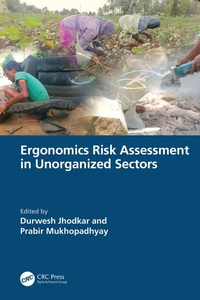
Ergonomics Risk Assessment in Unorganized Sectors
Published on 29. May 2026
154 pages
978-1-040-53816-6 (ISBN)
Description

The unorganized sector-encompassing agriculture, construction, small-scale manufacturing, healthcare, vending, and service-oriented workforces-remains the backbone of many economies worldwide. Yet, workers in this sector often operate in hazardous conditions with little or no social security, occupational safety measures, or ergonomic considerations. Repetitive tasks, awkward postures, poorly designed tools, and physically demanding work contribute to a high prevalence of work-related musculoskeletal disorders (WMSDs) and other health risks.
Ergonomics Risk Assessment in Unorganized Sectors is a comprehensive volume that sheds light on these pressing issues and presents practical solutions. It combines theoretical frameworks, research-based methodologies, and real-world case studies to offer a balanced and applied perspective.
This book:
Explores the challenges of ergonomics in unorganized sectors across agriculture, manufacturing, healthcare, construction, and service industries
Introduces and applies methodologies such as RULA, REBA, and other postural risk evaluation techniques
Includes case studies ranging from ergonomic analyses of cotton harvesting and forklift operation to healthcare tasks, cricket postures, and hawker workforces and practices from India, Indonesia, and beyond to illustrate cross-cultural dimensions of ergonomics
Highlights causes, impacts, and innovative preventive measures against musculoskeletal disorders
Addresses the ergonomic risks faced by women in workplaces and their unique occupational health concerns and discusses innovative ergonomic interventions, workplace design improvements, and policy recommendations to enhance worker safety and productivity
This book serves as a vital resource for students, researchers, ergonomists, industrial engineers, healthcare professionals, and policymakers.
Ergonomics Risk Assessment in Unorganized Sectors is a comprehensive volume that sheds light on these pressing issues and presents practical solutions. It combines theoretical frameworks, research-based methodologies, and real-world case studies to offer a balanced and applied perspective.
This book:
Explores the challenges of ergonomics in unorganized sectors across agriculture, manufacturing, healthcare, construction, and service industries
Introduces and applies methodologies such as RULA, REBA, and other postural risk evaluation techniques
Includes case studies ranging from ergonomic analyses of cotton harvesting and forklift operation to healthcare tasks, cricket postures, and hawker workforces and practices from India, Indonesia, and beyond to illustrate cross-cultural dimensions of ergonomics
Highlights causes, impacts, and innovative preventive measures against musculoskeletal disorders
Addresses the ergonomic risks faced by women in workplaces and their unique occupational health concerns and discusses innovative ergonomic interventions, workplace design improvements, and policy recommendations to enhance worker safety and productivity
This book serves as a vital resource for students, researchers, ergonomists, industrial engineers, healthcare professionals, and policymakers.
More details
Language
English
Place of publication
London
United Kingdom
Publishing group
Taylor & Francis Ltd
Target group
College/higher education
Professional and scholarly
Illustrations
14 Tables, black and white; 15 Line drawings, black and white; 47 Halftones, black and white; 62 Illustrations, black and white
File size
21,09 MB
ISBN-13
978-1-040-53816-6 (9781040538166)
Copyright in bibliographic data and cover images is held by Nielsen Book Services Limited or by the publishers or by their respective licensors: all rights reserved.
Schweitzer Classification
Other editions
Additional editions

Durwesh Jhodkar | Prabir Mukhopadhyay
Ergonomics Risk Assessment in Unorganized Sectors
Book
05/2026
1st Edition
CRC Press
€90.50
Shipment within 10-20 days
Persons
Durwesh Jhodkar is an Associate Professor in the Department of Mechanical Engineering and currently serves as the Dean of Research and Development at Tulsiramji Gaikwad Patil College of Engineering and Technology, Nagpur, Maharashtra, India. He holds a Ph.D. degree from the Mechanical Engineering Discipline at PDPM Indian Institute of Information Technology Design and Manufacturing (IIITDM), Jabalpur, India. His doctoral research likely contributed to the field of machining tool technology. Prior to his Ph.D., Durwesh Jhodkar earned a Master's degree in Industrial Engineering and Management from SGSITS, Indore, India, in the year 2010. This background suggests a strong foundation in both the technical and managerial aspects of industrial engineering. He has a notable academic background with a decade of teaching experience. Additionally, he has post-doctoral experience from the University of Johannesburg, South Africa. Post-doctoral research is typically undertaken after obtaining a Ph.D., allowing researchers to further specialize in a particular area or explore new avenues of research. Durwesh Jhodkar has made significant contributions to the field, evident from his research articles. His publications cover a range of topics, including Ergonomics Risk Assessment, Human Factors and Advanced Machining Processes.
Prabir Mukhopadhyay, is Associate professor and Head in Design Discipline at PDPM Indian Institute of Information Technology, Design and Manufacturing, Jabalpur, M.P, India. He holds a PhD in Industrial Ergonomics from the University of Limerick, Ireland. He joined the National Institute of Design, Ahmedabad, India as an Ergonomist as a faculty in ergonomics. During his tenure at Ahmedabad, he worked on many consultancy projects related to ergonomics. Some of his clients there included the Indian Railways, Self Employed Women's Association and the United Nation Industrial Development Organization. He also completed a research project funded by Ford Foundation-National Institute of Design on ergonomics design intervention in the craft sectors at Jaipur in Rajasthan, India. Simultaneously he started teaching ergonomics across different design disciplines at other campuses of the institute like Ahmedabad and Bangalore as well. He teaches practices and researches in different areas of ergonomics and its application in design. He published various research articles in area of human factors engineering and ergonomics risk assessments. He has authored more than seven books till date. Few of these are: Ergonomics for the Layman: Application in Design, published by CRC Press in 2019, Ergonomics Principles in Design: An Illustrated Fundamental Approach, published by CRC Press in 2022, Visual Ergonomics for Communication Design: A Laypersons Approach, published by CRC Press in 2022.
Prabir Mukhopadhyay, is Associate professor and Head in Design Discipline at PDPM Indian Institute of Information Technology, Design and Manufacturing, Jabalpur, M.P, India. He holds a PhD in Industrial Ergonomics from the University of Limerick, Ireland. He joined the National Institute of Design, Ahmedabad, India as an Ergonomist as a faculty in ergonomics. During his tenure at Ahmedabad, he worked on many consultancy projects related to ergonomics. Some of his clients there included the Indian Railways, Self Employed Women's Association and the United Nation Industrial Development Organization. He also completed a research project funded by Ford Foundation-National Institute of Design on ergonomics design intervention in the craft sectors at Jaipur in Rajasthan, India. Simultaneously he started teaching ergonomics across different design disciplines at other campuses of the institute like Ahmedabad and Bangalore as well. He teaches practices and researches in different areas of ergonomics and its application in design. He published various research articles in area of human factors engineering and ergonomics risk assessments. He has authored more than seven books till date. Few of these are: Ergonomics for the Layman: Application in Design, published by CRC Press in 2019, Ergonomics Principles in Design: An Illustrated Fundamental Approach, published by CRC Press in 2022, Visual Ergonomics for Communication Design: A Laypersons Approach, published by CRC Press in 2022.
Content
Part 1: Introduction: Decoding Ergonomic Challenges in Unorganized Sectors. 1. Emerging Trends in Ergonomics for Unorganized Sectors. 2. Evolution of Occupational Hazards and Health Risks. 3. Integrating Anthropometry into Assessment Practices. 4. Physical Strain. Part 2: Ergonomic Risk Assessment Methodologies. 5. Importance of Anatomy and Physiology in Risk Assessment. 6. Innovative Approaches for Ergonomic Assessment Methods. 7. The Role of Technology in Biomechanical Modeling and Analysis. 8. Quantitative Risk Assessment Techniques. 9. Textile and Garment Work: The Seams of Discomfort. 10. Street Vendors and Hawkers. 11. Construction Sites. 12. Agriculture and Farming. 13. Case Study. 14. Case Studies on Ergonomic Challenges Faced by Women Workers. 15. Musculoskeletal Challenges in Unorganized Manufacturing.
