

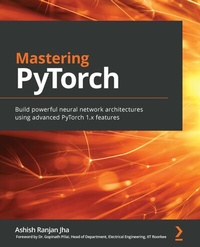
Mastering PyTorch
Build powerful neural network architectures using advanced PyTorch 1.x features
Published on 23. September 2024
450 pages
978-1-78961-640-8 (ISBN)
Description

Master advanced techniques and algorithms for deep learning with PyTorch using real-world examples
Key Features
Understand how to use PyTorch 1.x to build advanced neural network models
Learn to perform a wide range of tasks by implementing deep learning algorithms and techniques
Gain expertise in domains such as computer vision, NLP, Deep RL, Explainable AI, and much more
Book DescriptionDeep learning is driving the AI revolution, and PyTorch is making it easier than ever before for anyone to build deep learning applications. This PyTorch book will help you uncover expert techniques to get the most out of your data and build complex neural network models. The book starts with a quick overview of PyTorch and explores using convolutional neural network (CNN) architectures for image classification. You'll then work with recurrent neural network (RNN) architectures and transformers for sentiment analysis. As you advance, you'll apply deep learning across different domains, such as music, text, and image generation using generative models and explore the world of generative adversarial networks (GANs). You'll not only build and train your own deep reinforcement learning models in PyTorch but also deploy PyTorch models to production using expert tips and techniques. Finally, you'll get to grips with training large models efficiently in a distributed manner, searching neural architectures effectively with AutoML, and rapidly prototyping models using PyTorch and fast.ai. By the end of this PyTorch book, you'll be able to perform complex deep learning tasks using PyTorch to build smart artificial intelligence models.What you will learn
Implement text and music generating models using PyTorch
Build a deep Q-network (DQN) model in PyTorch
Export universal PyTorch models using Open Neural Network Exchange (ONNX)
Become well-versed with rapid prototyping using PyTorch with fast.ai
Perform neural architecture search effectively using AutoML
Easily interpret machine learning (ML) models written in PyTorch using Captum
Design ResNets, LSTMs, Transformers, and more using PyTorch
Find out how to use PyTorch for distributed training using the torch.distributed API
Who this book is forThis book is for data scientists, machine learning researchers, and deep learning practitioners looking to implement advanced deep learning paradigms using PyTorch 1.x. Working knowledge of deep learning with Python programming is required.
Key Features
Understand how to use PyTorch 1.x to build advanced neural network models
Learn to perform a wide range of tasks by implementing deep learning algorithms and techniques
Gain expertise in domains such as computer vision, NLP, Deep RL, Explainable AI, and much more
Book DescriptionDeep learning is driving the AI revolution, and PyTorch is making it easier than ever before for anyone to build deep learning applications. This PyTorch book will help you uncover expert techniques to get the most out of your data and build complex neural network models. The book starts with a quick overview of PyTorch and explores using convolutional neural network (CNN) architectures for image classification. You'll then work with recurrent neural network (RNN) architectures and transformers for sentiment analysis. As you advance, you'll apply deep learning across different domains, such as music, text, and image generation using generative models and explore the world of generative adversarial networks (GANs). You'll not only build and train your own deep reinforcement learning models in PyTorch but also deploy PyTorch models to production using expert tips and techniques. Finally, you'll get to grips with training large models efficiently in a distributed manner, searching neural architectures effectively with AutoML, and rapidly prototyping models using PyTorch and fast.ai. By the end of this PyTorch book, you'll be able to perform complex deep learning tasks using PyTorch to build smart artificial intelligence models.What you will learn
Implement text and music generating models using PyTorch
Build a deep Q-network (DQN) model in PyTorch
Export universal PyTorch models using Open Neural Network Exchange (ONNX)
Become well-versed with rapid prototyping using PyTorch with fast.ai
Perform neural architecture search effectively using AutoML
Easily interpret machine learning (ML) models written in PyTorch using Captum
Design ResNets, LSTMs, Transformers, and more using PyTorch
Find out how to use PyTorch for distributed training using the torch.distributed API
Who this book is forThis book is for data scientists, machine learning researchers, and deep learning practitioners looking to implement advanced deep learning paradigms using PyTorch 1.x. Working knowledge of deep learning with Python programming is required.
All prices
More details
Edition
Digital original
Language
English
Place of publication
Birmingham
United Kingdom
Target group
Professional and scholarly
US School Grade: College Graduate Student
Edition type
Digital original
Product notice
Reflowable
File size
24,17 MB
ISBN-13
978-1-78961-640-8 (9781789616408)
Copyright in bibliographic data and cover images is held by Nielsen Book Services Limited or by the publishers or by their respective licensors: all rights reserved.
Schweitzer Classification
Other editions
New editions
Ashish Ranjan Jha
Mastering PyTorch
Create and deploy deep learning models from CNNs to multimodal models, LLMs, and beyond
E-Book
09/2024
2nd Edition
Packt Publishing
€31.99
Available for download
Additional editions
Ashish Ranjan Jha
Mastering PyTorch
Build powerful neural network architectures using advanced PyTorch 1.x features
Book
02/2021
Packt Publishing
€69.10
Shipment within 3-4 weeks
Person
Jha Ashish Ranjan :
Ashish Ranjan Jha received his bachelor's degree in electrical engineering from IIT Roorkee (India), a master's degree in Computer Science from EPFL (Switzerland), and an MBA degree from Quantic School of Business (Washington). He has received a distinction in all 3 of his degrees. He has worked for large technology companies, including Oracle and Sony as well as the more recent tech unicorns such as Revolut, mostly focused on artificial intelligence. He currently works as a machine learning engineer. Ashish has worked on a range of products and projects, from developing an app that uses sensor data to predict the mode of transport to detecting fraud in car damage insurance claims. Besides being an author, machine learning engineer, and data scientist, he also blogs frequently on his personal blog site about the latest research and engineering topics around machine learning.
Ashish Ranjan Jha received his bachelor's degree in electrical engineering from IIT Roorkee (India), a master's degree in Computer Science from EPFL (Switzerland), and an MBA degree from Quantic School of Business (Washington). He has received a distinction in all 3 of his degrees. He has worked for large technology companies, including Oracle and Sony as well as the more recent tech unicorns such as Revolut, mostly focused on artificial intelligence. He currently works as a machine learning engineer. Ashish has worked on a range of products and projects, from developing an app that uses sensor data to predict the mode of transport to detecting fraud in car damage insurance claims. Besides being an author, machine learning engineer, and data scientist, he also blogs frequently on his personal blog site about the latest research and engineering topics around machine learning.
Content
Table of Contents
Overview of Deep Learning Using PyTorch
Combining CNNs and LSTMs
Deep CNN Architectures
Deep Recurrent Model Architectures
Hybrid Advanced Models
Music and Text Generation with PyTorch
Neural Style Transfer
Deep Convolutional GANs
Deep Reinforcement Learning
Operationalizing Pytorch Models into Production
Distributed Training
PyTorch and AutoML
PyTorch and Explainable AI
Rapid Prototyping with PyTorch
Overview of Deep Learning Using PyTorch
Combining CNNs and LSTMs
Deep CNN Architectures
Deep Recurrent Model Architectures
Hybrid Advanced Models
Music and Text Generation with PyTorch
Neural Style Transfer
Deep Convolutional GANs
Deep Reinforcement Learning
Operationalizing Pytorch Models into Production
Distributed Training
PyTorch and AutoML
PyTorch and Explainable AI
Rapid Prototyping with PyTorch
