

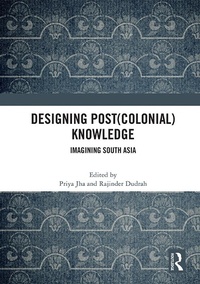
Designing (Post)Colonial Knowledge
Imagining South Asia
1st Edition
Published on 30. March 2021
160 pages
978-1-000-36922-9 (ISBN)
Description

Over the past 20 years we have seen critical design studies emerge as a springboard for scholars, activists, and those working in the creative industries. Design studies has enabled critics to link the relationship between constructions of knowledge and the emotional commitments that both practitioners and audiences bring to the making and uses of design work. A critical focus on these practices can reveal issues such as the distribution of power and emotional evocations and experiences in and through different designs.
At the same time, the use of design studies has drawn on diverse fields such as art history, architecture, public policy, and Geographic Information Systems. This collected volume, the first of its kind, engages with these fields of critical inquiry with ideas and debates in post-colonial studies, and in media and cultural studies. It contributes to a growing body of scholarship that examines material culture and its relationship between design and its construction of knowledge about multicultural identities in the colonial and postcolonial periods, with a focus on South Asia. The chapters pose questions about colonial history, colonial and postcolonial cultural practices, and the aestheticization of South Asian art, design, and media forms as they inform identities in a deterritorialized global culture.
The sites of the investigation by the contributors reflect the interdisciplinarity of design studies and share the insistence on emphasizing the vernacular: Indian fashion design, lithographic design in Muslim princely states, and Indian floor drawings live alongside museum exhibitions, shopping malls, and film spaces.
This book was originally published as a special issue of South Asian Popular Culture.
At the same time, the use of design studies has drawn on diverse fields such as art history, architecture, public policy, and Geographic Information Systems. This collected volume, the first of its kind, engages with these fields of critical inquiry with ideas and debates in post-colonial studies, and in media and cultural studies. It contributes to a growing body of scholarship that examines material culture and its relationship between design and its construction of knowledge about multicultural identities in the colonial and postcolonial periods, with a focus on South Asia. The chapters pose questions about colonial history, colonial and postcolonial cultural practices, and the aestheticization of South Asian art, design, and media forms as they inform identities in a deterritorialized global culture.
The sites of the investigation by the contributors reflect the interdisciplinarity of design studies and share the insistence on emphasizing the vernacular: Indian fashion design, lithographic design in Muslim princely states, and Indian floor drawings live alongside museum exhibitions, shopping malls, and film spaces.
This book was originally published as a special issue of South Asian Popular Culture.
More details
Edition
1. Auflage
Language
English
Place of publication
London
United Kingdom
Publishing group
Taylor & Francis Ltd
Target group
College/higher education
ISBN-13
978-1-000-36922-9 (9781000369229)
Copyright in bibliographic data and cover images is held by Nielsen Book Services Limited or by the publishers or by their respective licensors: all rights reserved.
Schweitzer Classification
Other editions
Additional editions
Book
09/2023
1st Edition
Routledge
€51.98
Shipment within 15-20 days
Book
03/2021
1st Edition
Routledge
€179.51
Shipment within 15-20 days
Persons
Priya Jha is Professor of English and Director of Media and Visual Culture Studies at the University of Redlands, USA. Her work is located in postcolonial, global, and transnational film and cultural studies. She has published widely on topics as diverse as nationalism, gender, and sexuality in Hindi cinema; Afro-Asian literature and film; and comparative feminisms. Currently, she is writing a memoir, Not That Kind of Indian, and a monograph entitled Deliberate Designs: Affect and Aesthetics in Postcolonial Literature and Culture.
Rajinder Dudrah is Professor of Cultural Studies and Creative Industries in the Birmingham Institute of Media and English, Birmingham City University, UK. He has researched and published widely across film, media, and cultural studies. His books include, amongst others, Bollywood Travels: Culture, Diaspora and Border Crossings in Popular Hindi Cinema (Routledge). He is also the founding co-editor of the journal South Asian Popular Culture.
Rajinder Dudrah is Professor of Cultural Studies and Creative Industries in the Birmingham Institute of Media and English, Birmingham City University, UK. He has researched and published widely across film, media, and cultural studies. His books include, amongst others, Bollywood Travels: Culture, Diaspora and Border Crossings in Popular Hindi Cinema (Routledge). He is also the founding co-editor of the journal South Asian Popular Culture.
Content
Introduction
Priya Jha and Rajinder Dudrah
1. Memories of violence: Of emotional geographies and planning in post-Partition Delhi, 1948-62
Aprajita Sarcar
2. Absence of the 'un-exchangeable' monument: Cinematic design and national identity in a time of partition
Aditi Chandra
3. 'Architectures of happiness': Designing the Malltiplex in India
Tupur Chatterjee
4. From deframing the oriental imagery to the making of the alternative other: Remapping the spaces of encounter
Dilpreet Bhullar
5. From craft to couture: Contemporary Indian fashion in historical perspective
Tara Mayer
6. Transnational homespun, citizen-art and Hindu-Muslim Gandhi ashrams: A working note on, against, and toward spirituality
Tim Dobe and Aaron Sinift
7. Evolving sense of visualizing the divine in popular Islam in Pakistan: An ethnographic case study
Ghulam Abbas
8. Counter-epistemologies of the global South: Indian floor drawings re-envisaged
Renate Dohmen
9. Printing princely modernity: Lithographic design in Muslim-ruled princely states
Amanda Lanzillo
10. Designing a visual palimpsest through film: A critical examination of Jodhaa Akbar and the nationalist narrative
Reema Chowdhary, Shaifali Arora and Nirmala Menon
Priya Jha and Rajinder Dudrah
1. Memories of violence: Of emotional geographies and planning in post-Partition Delhi, 1948-62
Aprajita Sarcar
2. Absence of the 'un-exchangeable' monument: Cinematic design and national identity in a time of partition
Aditi Chandra
3. 'Architectures of happiness': Designing the Malltiplex in India
Tupur Chatterjee
4. From deframing the oriental imagery to the making of the alternative other: Remapping the spaces of encounter
Dilpreet Bhullar
5. From craft to couture: Contemporary Indian fashion in historical perspective
Tara Mayer
6. Transnational homespun, citizen-art and Hindu-Muslim Gandhi ashrams: A working note on, against, and toward spirituality
Tim Dobe and Aaron Sinift
7. Evolving sense of visualizing the divine in popular Islam in Pakistan: An ethnographic case study
Ghulam Abbas
8. Counter-epistemologies of the global South: Indian floor drawings re-envisaged
Renate Dohmen
9. Printing princely modernity: Lithographic design in Muslim-ruled princely states
Amanda Lanzillo
10. Designing a visual palimpsest through film: A critical examination of Jodhaa Akbar and the nationalist narrative
Reema Chowdhary, Shaifali Arora and Nirmala Menon
