

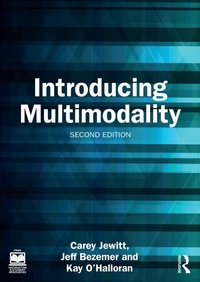
Introducing Multimodality
2nd Edition
Published on 24. March 2025
198 pages
978-1-040-31939-0 (ISBN)
Description

This accessible introduction to multimodality illuminates the potential of multimodal research for understanding the ways in which people communicate.
Readers will become familiar with the key concepts and methods in various domains while learning how to engage critically with the notion of multimodality. Now fully revised to engage with new research, include new case studies and present a more global outlook, the book challenges widely held assumptions about language and presents the practical steps involved in setting up a multimodal study, including:
formulating research questions
collecting research materials
assessing and developing methods of transcription
considering the ethical dimensions of multimodal research
With a wide range of examples, clear practical support and a glossary of terms, Introducing Multimodality is the ideal reference for undergraduate and postgraduate students in multimodality, semiotics, applied linguistics and media and communication studies. Online materials including an updated study guide, exercises and links to relevant resources are available on the Student and Instructor website at www.routledge.com/cw/jewitt and the Routledge Language and Communication Portal.
Readers will become familiar with the key concepts and methods in various domains while learning how to engage critically with the notion of multimodality. Now fully revised to engage with new research, include new case studies and present a more global outlook, the book challenges widely held assumptions about language and presents the practical steps involved in setting up a multimodal study, including:
formulating research questions
collecting research materials
assessing and developing methods of transcription
considering the ethical dimensions of multimodal research
With a wide range of examples, clear practical support and a glossary of terms, Introducing Multimodality is the ideal reference for undergraduate and postgraduate students in multimodality, semiotics, applied linguistics and media and communication studies. Online materials including an updated study guide, exercises and links to relevant resources are available on the Student and Instructor website at www.routledge.com/cw/jewitt and the Routledge Language and Communication Portal.
More details
Edition
2nd edition
Language
English
Place of publication
London
United Kingdom
Publishing group
Taylor & Francis Ltd
Target group
College/higher education
Illustrations
6 Tables, black and white; 2 Line drawings, black and white; 17 Halftones, black and white; 19 Illustrations, black and white
File size
3,10 MB
ISBN-13
978-1-040-31939-0 (9781040319390)
Copyright in bibliographic data and cover images is held by Nielsen Book Services Limited or by the publishers or by their respective licensors: all rights reserved.
Schweitzer Classification
Other editions
Additional editions

Carey Jewitt | Jeff Bezemer | Kay O'Halloran
Introducing Multimodality
Book
03/2025
2nd Edition
Routledge
€207.40
Shipment within 10-20 days
Carey Jewitt | Jeff Bezemer | Kay O'Halloran
Introducing Multimodality
Book
03/2025
2nd Edition
Routledge
€64.30
Shipment within 10-20 days

Carey Jewitt
Introducing Multimodality
Book
03/2025
Routledge
Unfortunately, price unknown
Available (delivery time upon request)
Persons
Carey Jewitt is Professor of Technology and Learning in the Department of Culture, Communication and Media at the Faculty of Education and Society, University College London. She is founding co-editor of the journal Multimodality & Society and has authored/co-authored and edited several books and journal articles in this area, including The Routledge Handbook of Multimodal Analysis and most recently Digital Touch.
Jeff Bezemer is Professor of Communication and Head of the Department of Culture, Communication and Media at the Institute of Education, University College London. He regularly publishes on multimodal interaction in healthcare, and is the co-author of Multimodality, Learning and Communication.
Kay O'Halloran is Chair Professor and Head of the Department of Communication and Media in the School of the Arts at the University of Liverpool. She is the series editor of Routledge Studies in Multimodality and is co-editor of Multimodal Studies: Exploring Issues and Domain.
Jeff Bezemer is Professor of Communication and Head of the Department of Culture, Communication and Media at the Institute of Education, University College London. He regularly publishes on multimodal interaction in healthcare, and is the co-author of Multimodality, Learning and Communication.
Kay O'Halloran is Chair Professor and Head of the Department of Communication and Media in the School of the Arts at the University of Liverpool. She is the series editor of Routledge Studies in Multimodality and is co-editor of Multimodal Studies: Exploring Issues and Domain.
Content
List of tables
List of figures
About this book
Acknowledgements
Chapter 1 Navigating a diverse field
Chapter 2 Why engage with multimodality?
Chapter 3 Systemic functional linguistics
Chapter 4 Social semiotics
Chapter 5 Conversation analysis
Chapter 6 More approaches to multimodality
Chapter 7 Designing a multimodal study
Glossary
Self-study guide
References
Index
List of figures
About this book
Acknowledgements
Chapter 1 Navigating a diverse field
Chapter 2 Why engage with multimodality?
Chapter 3 Systemic functional linguistics
Chapter 4 Social semiotics
Chapter 5 Conversation analysis
Chapter 6 More approaches to multimodality
Chapter 7 Designing a multimodal study
Glossary
Self-study guide
References
Index
