

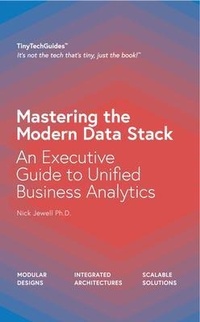
Mastering the Modern Data Stack
Description

In the age of digital transformation, becoming overwhelmed by the sheer volume of potential data management, analytics, and AI solutions is common. Then it's all too easy to become distracted by glossy vendor marketing, and then chase the latest shiny tool, rather than focusing on building resilient, valuable platforms that will outperform the competition.
This book aims to fix a glaring gap for data professionals: a comprehensive guide to the full Modern Data Stack that's rooted in real-world capabilities, not vendor hype. It is full of hard-earned advice on how to get maximum value from your investments through tangible insights, actionable strategies, and proven best practices. It comprehensively explains how the Modern Data Stack is truly utilized by today's data-driven companies.
Mastering the Modern Data Stack: An Executive Guide to Unified Business Analytics is crafted for a diverse audience. It's for business and technology leaders who understand the importance and potential value of data, analytics, and AI-but don't quite see how it all fits together in the big picture. It's for enterprise architects and technology professionals looking for a primer on the data analytics domain, including definitions of essential components and their usage patterns. It's also for individuals early in their data analytics careers who wish to have a practical and jargon-free understanding of how all the gears and pulleys move behind the scenes in a Modern Data Stack to turn data into actual business value.
Whether you're starting your data journey with modest resources, or implementing digital transformation in the cloud, you'll find that this isn't just another textbook on data tools or a mere overview of outdated systems. It's a powerful guide to efficient, modern data management and analytics, with a firm focus on emerging technologies such as data science, machine learning, and AI.
If you want to gain a competitive advantage in today's fast-paced digital world, this TinyTechGuide(TM) is for you. Remember, it's not the tech that's tiny, just the book!(TM)
More details
Content
- Intro
- Chapter 1
- Introduction
- The Need for the Modern Data Stack
- Describing the Modern Data Stack
- The Benefits of the Modern Data Stack
- Scalability
- Speed
- Flexible Data Integration
- Security and Privacy
- Do I Need All of This Functionality?
- Who Is This Book For?
- Why Write this Book?
- Practical Advice and Next Steps
- Summary
- Chapter 1 References
- Chapter 2
- What Is a Modern Data Stack?
- Tracing the Origins of the Modern Data Stack
- The Four Vs
- The Arrival of Hadoop and NoSQL
- Cloud Computing Meets Data Warehousing
- Data Pipelines Feed the Cloud
- Visual and Collaborative Analytics Goes Mainstream
- Is Centralization the Answer? It Depends
- Maturing Environments Lead to Maturing Practices
- DataOps
- MLOps
- A Complex Modern Landscape
- Pay Attention to Functions, Not Vendors
- Practical Advice and Next Steps
- Summary
- Chapter 2 References
- Chapter 3
- Data Begins Its Journey
- Understanding Data Ingestion and Transportation
- Data Sources
- Online Transaction Processing (OLTP) Databases
- ERP Platforms
- Operational Applications
- Event Collectors
- Log Files
- Application Programming Interfaces (APIs)
- Files
- Object Storage
- What Is Needed to Ingest and Transport Data?
- Disruptions in Data Pipelines
- Data Replication
- Change Data Capture: Tracking Updates in Data Sources
- Workflow Management
- How to Manage Data Moving in Real Time
- Reverse ETL
- Practical Advice and Next Steps
- Summary
- Chapter 3 References
- Chapter 4
- How to Store, Query, and Process Data at Scale
- Data Warehousing: The Early History
- From On-Premises Storage to the Cloud
- Leading from the Cloud
- Planning a Modern Data Warehousing Strategy
- The Impact of Data Gravity and Governance
- The Emergence of the Data Lake
- How Is Data Lake Storage Organized?
- The Types of Data Stored in a Data Lake
- Processing in the Data Lake
- How Spark Gets Implemented
- When Data Lakes Fail: Data Swamps
- When Data Lakes and Warehouses Converge
- The Data Lakehouse
- How a Data Lakehouse Handles Transactional Work
- Querying the Lakehouse: SQL Engines
- Data Science and Machine Learning in a Lakehouse
- Incorporating DSML and AI Processing into a Modern Data Stack
- Real-Time Analytics Databases
- Real-Time Data Architectures
- How to Plan for Real-Time Analytics
- Processing Real-Time Streams
- Practical Advice and Next Steps
- Summary
- Chapter 4 References
- Chapter 5
- Reshaping and Redefining Data
- Building a Data Transformation and Modeling Strategy
- Common Approaches to Data Modeling
- Normalized Modeling
- Dimensional (Denormalized) Modeling
- Data Vault Modeling
- One Big Table (OBT) Modeling
- Bridging the Gap Between Data Model to Data Engineering
- dbt in Focus
- Don't Write Off Traditional ETL Tools (Yet)
- Embracing Data Literacy with Analyst-Friendly Tools
- Looker and LookML
- Analytic Automation
- The Metrics Layer: Take Control or Lose It?
- Practical Advice and Next Steps
- Summary
- Chapter 5 References
- Chapter 6
- Analysis and Output in the Modern Data Stack
- Business Intelligence and Dashboarding
- How to Develop a Strong Dashboard Strategy
- The Death of the Dashboard?
- Extending the Reach with Embedded Analytics
- Exploring the Advantages of Augmented Analytics
- Data Workspaces: A Sandbox for Experts
- The Power of Analytic Application Frameworks
- Data Science, Machine Learning, and Artificial Intelligence
- The Emerging AI Stack: A Note of Caution
- Data Labeling
- Model Diagnostics
- Feature Store
- Pre-Trained Models
- Model Registry
- Model Compiler
- Model Validation and Auditing
- Experiment Tracking
- Model Delivery
- Model Deployment Architectures
- Vector Databases
- Practical Advice and Next Steps
- Summary
- Chapter 6 References
- Chapter 7
- Supporting Functions
- Data Discovery: Unveiling Insights from the Depths of Data
- Data Catalogs
- Data Governance: For a Strong Foundation
- Entitlements and Security: Safeguards and Protections
- Data Observability: The Health of the Data Stack in Focus
- Practical Advice and Next Steps
- Summary
- Chapter 7 References
- Chapter 8
- The Future of the Modern Data Stack
- Stress Points of the Modern Data Stack
- Cost Concerns: Data Movement without Breaking the Bank
- Cost Concerns: Pay-per-Row and Compute Credits
- Calculating Return on Investment for the Modern Data Stack
- Looking to the Future: Trends and Emerging Practices
- Data Mesh
- DataOps/MLOps
- Data as Code
- Zero ETL
- The Impact of the AI Revolution on Data Infrastructure
- Can a Single Vendor Make the Modern Data Stack More Manageable?
- AWS Solution Architecture
- Azure Solution Architecture
- Google Cloud Solution Architecture
- Microsoft Fabric Solution Architecture
- Practical Advice and Next Steps
- Summary
- Chapter 8 References
- Acknowledgments
- About the Author
