

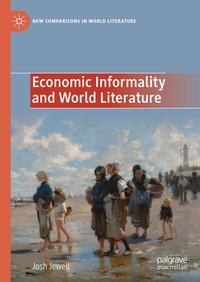
Economic Informality and World Literature
Description

This book analyses the impact of economic informality on the novel form across the modern world-system, looking specifically at works by Antonio de Almeida, Machado de Assis, Dany Laferrière, Ngugi wa Thiong'o, Nadine Gordimer, and Masande Ntshanga. It sees the representation of informal economies as a structural homology of world-literature. In chapters on the figure of the agregado in the nineteenth-century Brazilian novel; sex work in Haitian fiction; the politics of the informal economy in the post-apartheid South African novel; and Ngugi's representation African occult economies, Josh Jewell explores the relationship between the rise of improvised economic activity-and its consolidation under neoliberalism in postcolonial nations-and literary form. He shows how informal economies can be grasped as locations of strategy and improvisation whose subjects must shift constantly between officialdom and underground networks; between the realms of the licit and illicit. This produces highly heterogenous narratives oscillating between different tones and registers (unserious and tragic), social spaces (working-class and elite), and conceptions of reality. By comparing the various situated aesthetics of informality, this book instrumentalises the Warwick Research Collective's compelling but nebulous idea of a world-literature that "variously registers" a "singular modernity".
More details
Other editions
Additional editions
Person
Josh Jewell is a resident scholar in the Humanities Institute at University College Dublin, Ireland. His research analyses the relationship between labour and literary form in world-literature. His current postdoctoral research project focuses on representations of labour which falls outside of direct market mediation--such as domestic labour and peasant agriculture--in South Africa, Brazil, the Caribbean, and the European periphery.
Content
Chapter 1- From Malandros to Agregados:the Precarious Labourer and the Novel Form in 19th Century Brazil.- Chapter 2-Sex Work in Caribbean Fiction.- Chapter 3 Economic Informality in South African Fiction.- Chapter 4 -(In) formal structure in Wizard of the Crow.- Chapter 5-Precarious Core.
