

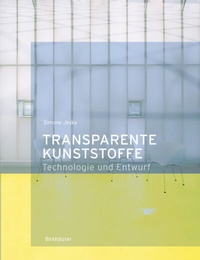
Transparent Plastics
Design and Technology
1st Edition
Published on 5. October 2007
159 pages
978-3-7643-8287-2 (ISBN)
Description

Recent years have seen the construction of buildings made of plastic, structures that are as attractive as they are unusual. After initial experiments in the 1970s, plastic is currently experiencing a tremendous boom. Originally used for temporary structures like the BMW Pavilion in Frankfurt, it is now employed in many permanent buildings as well, including the recent Catholic church in Radebeul by Staib/Behnisch. Prominent international avant-garde architects such as Shigeru Ban and Herzog & de Meuron frequently use transparent plastic for their structures. Transparent plastic seems ephemeral and thus captures the spirit of the times. Its various qualities between transparent and translucent make it possible to achieve fascinating effects with light and color. Projects presented include the Allianz Arena in Munich by Herzog & de Meuron, the Rocket Tower in Leicester by Grimshaw & Partners, the Paper Art Museum by Shigeru Ban in Shizuoka, Japan, and the public housing development Cité Manifeste in Mulhouse by Lacaton Vassal. Seit einigen Jahren entstehen ebenso attraktive wie ungewöhnliche Bauten aus Kunststoff. Nach ersten Versuchen in den 1970er Jahren erlebt der Baustoff derzeit einen ungeheuren Boom. Zunächst für temporäre Bauten wie dem BMW Pavillon in Frankfurt genutzt, entstehen mittlerweile auch zahlreiche bleibende Gebäude (wie kürzlich die Katholische Kirche von Staib/Behnisch in Radebeul). Bekannte Architekten der internationalen Avantgarde wie Shigeru Ban oder Herzog & de Meuron verwenden gerne transparenten Kunststoff für ihre Bauten. Das Material scheint ephemer, transitorisch (ohne es zu sein) und trifft damit den Nerv der heutigen Zeit. Seine unterschiedlichen Qualitäten zwischen transparent und transluzent erlauben faszinierende Licht- und Farbeffekte. Zu den dargestellten Projekten gehören die Allianz-Arena in München von Herzog & de Meuron, der Rocket-Tower in Leicester von Grimshaw & Partner, das Papiermuseum von Shigeru Ban in Shizuoka, Japan, und der soziale Wohnungsbau der Cité Manifeste in Mulhouse von Lacaton Vassal.
More details
Language
English
Place of publication
Basel/Berlin/Boston
Switzerland
Target group
Professional and scholarly
US School Grade: College Graduate Student
Illustrations
150 farbige Abbildungen, 142 s/w Abbildungen
142 b/w and 150 col. ill.
File size
41,59 MB
ISBN-13
978-3-7643-8287-2 (9783764382872)
Schweitzer Classification
Other editions
Additional editions
Book
10/2007
1st Edition
Birkhäuser Verlag GmbH
€44.95
Article exhausted; check different version
Person
Simone Jeska was born in 1965 and studied architecture at the Technische Fachhochschule in Nürnberg as well as theory and history of architecture at the ETH in Zurich. She is the author of a number of publications on architecture and is co-author of Office Buildings: A Design Manual.
Content
A Brief History of Plastic Buildings.- A Brief History of Plastic Buildings.- Material and Form - "Form Follows Material?".- Material and Form - "Form Follows Material?".- Transparent Plastics Between Intellectualisation and Trash Culture.- Transparent Plastics Between Intellectualisation and Trash Culture.- Exhibition.- BMW Bubble.- Ebo Bologna.- "Light Building" Mobile Pavilion.- Cyclebowl.- Residences.- Apartments and Studios in Cologne.- Naked House.- Lucky Drops.- Housing Project in London.- Cité Manifeste.- House and Studio in Almere.- Semi-Detached Houses in Müllheim.- Culture and Sports.- Museum of Paper Art.- Catholic Church of Jesus Christ the King, Radebeul.- DBU Conference and Exhibition Pavilion.- Allianz Arena.- Research.- Gerontology Technology Centre, Bad Tölz.- Rocket Tower.- Festo AG Technology Centre.- Glasshouses, Graz.
Transparent Plastics berween intellectualisation and trash culture (S. 30-31)
Synthetic materials have re-established themselves in the exper iments of the contemporary architectural avant-gar de in the tension between spirit and matter, form and material. I Digitally generated forms on the one hand and material fetishism on the other favour the use of transparent plastics , which are characte rised by immateriality and ambiguity.
Their random formability plus their versatility bind the synthetic material to the digitally animat ed architectura l form . Flexibility, efficiency and ada ptabi lity - the ess enti al features of synthetic materials - are ideal for so-c alled bionic architecture. Their indifferent properties predispose them for an architecture that regards metaphor as ext remely important, relies on sensuality, ambience and irritation , and takes " removal of barriers " as its key theme - specifically, the removal of barriers between inside and outside, matter and space, loadbearing structure and enclosing envelope, twodimensionality and three -dimensionality, static and dynamic, and between space and time .
PLASTIC IS SPIRIT, PLASTIC IS FORM
Free ly fo rmed, digital architect ures and transparent plastics form a conge nial symbios is in many ways. In an ana logy to the immateriality of digital forms , transparent plastics are a synonym for the su bjugati on of th e material. As transparent and at the same time almost weightless materials, they seem closer to the spiritual world than th e material world. Moulded into bubble-like shapes or designed as cushions of air , they take on spherical dimensions .
The spiritual content, as an intrinsic characteristic of synthetic materials , has from time to time been a theme in the writings of artists and intellectuals over the course of the 20th century. Roland Barthes characterised the new material as the very " spect acl e of its end-products " and defined the spiritual content of plastics by means of their "quick-change artistry". Plastic is "mor e than a substance, plastic is the very idea of its infinite transformation [... ] Plastic , sublimated as movement, ha rdly exists as substance. " The versatility (in terms of both chemistry and form) and the resulting infinite configuration optio ns, which lead to the invention of forms , are features of the computer-generated forms and the artificial materia l alike.
Robert E. Somol has given us a link between digital f orms and synthetic materials based on associations . Responsible for this is "hollowness" as a property of the computer-generated form, making a project appear as if made f rom polystyrene, sponges or aerogels ." Digitally shaped architecture can obviously express it sel f adequately in formal terms in the we ightless world of plastics , an association that is helped by the form of the mostly "anti -architectural" morphogenetic architecture
Synthetic materials have re-established themselves in the exper iments of the contemporary architectural avant-gar de in the tension between spirit and matter, form and material. I Digitally generated forms on the one hand and material fetishism on the other favour the use of transparent plastics , which are characte rised by immateriality and ambiguity.
Their random formability plus their versatility bind the synthetic material to the digitally animat ed architectura l form . Flexibility, efficiency and ada ptabi lity - the ess enti al features of synthetic materials - are ideal for so-c alled bionic architecture. Their indifferent properties predispose them for an architecture that regards metaphor as ext remely important, relies on sensuality, ambience and irritation , and takes " removal of barriers " as its key theme - specifically, the removal of barriers between inside and outside, matter and space, loadbearing structure and enclosing envelope, twodimensionality and three -dimensionality, static and dynamic, and between space and time .
PLASTIC IS SPIRIT, PLASTIC IS FORM
Free ly fo rmed, digital architect ures and transparent plastics form a conge nial symbios is in many ways. In an ana logy to the immateriality of digital forms , transparent plastics are a synonym for the su bjugati on of th e material. As transparent and at the same time almost weightless materials, they seem closer to the spiritual world than th e material world. Moulded into bubble-like shapes or designed as cushions of air , they take on spherical dimensions .
The spiritual content, as an intrinsic characteristic of synthetic materials , has from time to time been a theme in the writings of artists and intellectuals over the course of the 20th century. Roland Barthes characterised the new material as the very " spect acl e of its end-products " and defined the spiritual content of plastics by means of their "quick-change artistry". Plastic is "mor e than a substance, plastic is the very idea of its infinite transformation [... ] Plastic , sublimated as movement, ha rdly exists as substance. " The versatility (in terms of both chemistry and form) and the resulting infinite configuration optio ns, which lead to the invention of forms , are features of the computer-generated forms and the artificial materia l alike.
Robert E. Somol has given us a link between digital f orms and synthetic materials based on associations . Responsible for this is "hollowness" as a property of the computer-generated form, making a project appear as if made f rom polystyrene, sponges or aerogels ." Digitally shaped architecture can obviously express it sel f adequately in formal terms in the we ightless world of plastics , an association that is helped by the form of the mostly "anti -architectural" morphogenetic architecture
