

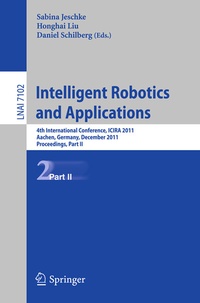
Intelligent Robotics and Applications
4th International Conference, ICIRA 2011, Aachen, Germany, December 6-8, 2011, Proceedings, Part II
Published on 3. December 2011
XXIV, 623 pages
978-3-642-25489-5 (ISBN)
Description

The two volume set LNAI 7101 and 7102 constitute the refereed proceedings of the 4th International Conference on Intelligent Robotics and Applications, ICIRA 2011, held in Aachen, Germany, in November 2011.
The 122 revised full papers presented were thoroughly reviewed and selected from numerous submissions. They are organized in topical sections on progress in indoor UAV, robotics intelligence, industrial robots, rehabilitation robotics, mechanisms and their applications, multi robot systems, robot mechanism and design, parallel kinematics, parallel kinematics machines and parallel robotics, handling and manipulation, tangibility in human-machine interaction, navigation and localization of mobile robot, a body for the brain: embodied intelligence in bio-inspired robotics, intelligent visual systems, self-optimising production systems, computational intelligence, robot control systems, human-robot interaction, manipulators and applications, stability, dynamics and interpolation, evolutionary robotics, bio-inspired robotics, and image-processing applications.
The 122 revised full papers presented were thoroughly reviewed and selected from numerous submissions. They are organized in topical sections on progress in indoor UAV, robotics intelligence, industrial robots, rehabilitation robotics, mechanisms and their applications, multi robot systems, robot mechanism and design, parallel kinematics, parallel kinematics machines and parallel robotics, handling and manipulation, tangibility in human-machine interaction, navigation and localization of mobile robot, a body for the brain: embodied intelligence in bio-inspired robotics, intelligent visual systems, self-optimising production systems, computational intelligence, robot control systems, human-robot interaction, manipulators and applications, stability, dynamics and interpolation, evolutionary robotics, bio-inspired robotics, and image-processing applications.
More details
Other editions
Additional editions

Sabina Jeschke | Honghai Liu | Daniel Schilberg
Intelligent Robotics and Applications
4th International Conference, ICIRA 2011, Aachen, Germany, December 6-8, 2011, Proceedings, Part II
Book
11/2011
Springer
€53.49
Shipment within 7-9 days
Content
- Intro
- Title page
- Preface
- Conference Organization
- Table of Contents
- A Body for the Brain: Embodied Intelligence in Bio-inspired Robotics
- Biomechatronics for Embodied Intelligence of an Insectoid Robot
- Introduction
- Biomechatronic Transfer of Morphological Features
- Bio-inspired Drive Technology for Leg and Body Joints
- Lean Communication on the Robot
- Discussion
- References
- Novel Approaches for Bio-inspired Mechano-Sensors
- Introduction
- Inspiration from Biology
- Related Work
- Approaches for Developing Tactile Sensors for Static Stimuli
- Building Tactile Sensor Arrays Using Piezoresistive Materials
- Flexible Tactile Array Sensor Using Conductive Thread Electrodes
- Flexible Tactile Array Sensor Using Conductive Polymer Electrodes
- Approaches for Developing Tactile Sensors for Dynamic Stimuli
- Experimental Results and Applications
- Data Acquisition
- Classification of Fruits and Vegetables Using Haptic Feedback
- Determination of Tactile Contact Profile of Small Objects
- Determination of Gentle Contact and Vibrations
- Conclusions
- References
- Helping a Bio-inspired Tactile Sensor System to Focus on the Essential
- Introduction
- Previous Work
- Sensor Hardware
- Interpreting Sensor Readings
- Results
- Conclusion
- References
- Robust Dataglove Mapping for Recording Human Hand Postures
- Introduction
- The Human Hand Model
- Mapping from Cyberglove to Human Hand Model
- The Thumb Abduction / Roll Sensor Mapping
- The Finger Spread Sensor Mapping
- The Abduction Sensor Dependency
- Evaluation of the Mapping
- Conclusion
- References
- Software/Hardware Issues in Modelling Insect Brain Architecture
- Introduction
- Insect Brain Model
- Software/Hardware Framework
- Robotic Platforms and Experiments
- Definition of Scenarios
- Conclusion
- References
- Higher Brain Centers for Intelligent Motor Control in Insects
- Introduction
- Learning and Memory in the Central Complex for Approaching Objects
- Experimental Evidence
- The Central Complex Model
- Intelligent Motor Control beyond the Current Model
- An Integrator for the Orientation in Gradients
- Motor Learning
- A Representation of Body Size in the Brain
- Termination of Inappropriate Behavior
- Conclusion
- References
- An Insect-Inspired, Decentralized Memory for Robot Navigation
- Introduction
- The Model
- Results
- Discussion
- References
- Models of Visually Guided Routes in Ants: Embodiment Simplifies Route Acquisition
- Introduction
- Background
- Overview of Our Approach
- Detailed Methods
- Results
- Summary
- References
- Intelligent Visual Systems
- Robust Object Tracking for Resource-Limited Hardware Systems
- Introduction
- Overview of Tracking System
- Dominant Color-Spatial Based Object Representation
- Dominant Color Mode Extraction
- Spatial Layout of the Dominant Color
- Similarity Measure for Matching
- Cross Bin-Ratio Based Color Similarity Measure
- Spatial Similarity Measure
- Swarm Intelligence Based Searching Method
- Annealed Particle Swarm Optimization
- Integral Image of Model Parameters
- Experimental Results
- Different Object Representations
- Different Similarity Measure
- Different Searching Methods
- Conclusion
- References
- Adaptive Rank Transform for Stereo Matching
- Introduction
- Adaptive Rank Transform
- The Motivation Behind Adaptive Rank Transform
- Adaptive Rank Window
- New Transform Rules
- Comparison between Adaptive and Original Rank Transform
- Obtaining the Match Window from Multiple Rank Windows
- Experiments
- Conclusion
- References
- Real Time Vision Based Multi-person Tracking for Mobile Robotics and Intelligent Vehicles
- Introduction
- Related Work
- System Overview
- System Realization
- Visual Odometry
- Object Detection
- Tracking
- Experimental Results
- Conclusion
- Acknowledgments.
- References
- A Method for Wandering Trajectory Detection in Video Monitor
- Introduction
- Algorithm Description
- Target Detection
- Determine the Initial Half-Line
- Calculate the Angle
- Judge the Type of Trajectory
- Experimental Results and Analysis
- Conclusion
- References
- The Design of a Vision-Based Motion Performance System
- Introduction
- Related Work
- System Overview
- Initialization
- Feature Detection
- Feature Tracking
- 3D Point Reconstruction and Display
- Experiments and Analysis
- Conclusion
- References
- Window Function for EEG Power Density Estimation and Its Application in SSVEP Based BCIs
- Introduction
- Experiment Setting
- Subjects
- EEG Recording
- Experimental Paradigms
- EEG Signal and Window Function
- Application in SSVEP
- Method
- Result
- Conclusion
- References
- Efficient Multi-resolution Plane Segmentation of 3D Point Clouds
- Introduction
- Related Work
- Efficient Multi-resolution Segmentation into Planar Segments
- Efficient Normal Estimation through Multiple Resolutions
- Pre-segmentation in Hough-Space
- Segmentation into Connected Components
- Accurate Segmentation through RANSAC
- Coarse-to-Fine Segmentation
- Post-Processing
- Experiments
- Conclusion and Future Work
- References
- 3D Body Pose Estimation Using an Adaptive Person Model for Articulated ICP
- Introduction
- Related Work
- Basic Algorithm
- Human Body Model
- Articulated Iterative Closest Point Algorithm
- Proposed Extensions
- Data Segmentation
- Data Assignment
- Model Adaption
- Self-collision Checking
- Model Initialization
- Experiments
- Conclusions
- References
- Self-optimising Production Systems
- Artificial Cognition in Autonomous Assembly Planning Systems
- Introduction
- Definitions
- Cognition
- Self-optimization
- State of the Art
- Software Architectures for Cognitive Technical Systems
- Cognitive Technical Systems in Production Engineering
- Assembly Planning Systems
- The Project "Cognitive Planning and Control System for Production"
- Objectives and Approach
- Cognitive Capabilities of the CCU
- Conclusion and Outlook
- References
- Self-optimization as an Enabler for Flexible and Reconfigurable Assembly Systems
- Introduction
- Self-optimizing Functions for Assembly Systems
- Grasp Planning and Configuration
- Quick Automated Commissioning of Assembly Systems after Reconfiguration
- Planar Alignment for a Bonding Process
- Summary and Outlook
- References
- Flexible Assembly Robotics for Self-optimizing Production
- Introduction
- Self-optimizing Assembly Systems
- Research Results
- Intermediate Conclusion
- Research Roadmap
- Enablers for Flexibility
- Enablers for Cognition
- Enablers for Autonomy
- Conclusion
- References
- Meta-modeling for Manufacturing Processes
- Introduction
- Meta-modeling - Definition of Process-Independent Method
- Definition of Process Properties and Model Requirements (B1)
- Selection of Parameters (B2)
- Determination of Process Domain (B3)
- Selection of Data Source (B4)
- Design and Setup of Experiment (B5)
- Generation of Data (B6)
- Selection of Model Class and Structure (B7)
- Implementation of Model (B8)
- Evaluation of Model Quality (B9)
- Conclusion
- References
- Computational Intelligence
- Control Architecture for Human Friendly Robots Based on Interacting with Human
- Introduction
- Intelligent Human Friendly Robot System
- Control Software Architecture for the Service Robot
- Experimental Result of a Control Software Architecture
- The Experiment for Clearing Table
- The Addition of a New Function to the Software Architecture
- Conclusion
- References
- Multi-modal Communication Interface for Elderly People in Informationally Structured Space
- Introduction
- Monitoring System for Elderly People
- Universal Remote Controller
- Problem of Usability
- Input Interface
- Information Visualization
- Experimental Result
- Evaluation Result of Screen Design
- Evaluation Result on Handling Ability
- Summary
- References
- Motion Control Strategies for Humanoids Based on Ergonomics
- Introduction
- Simulating Anthropomorphic Multiagent Systems
- Modeling Anthropomorphic Kinematics as Kinematic Trees
- Controlling Anthropomorphic Kinematics as Multiagent Systems
- Processing RULA
- Connecting RULA to Anthropomorphic Kinematics
- RULA Only Considers one Arm at a Time, in Its Original Form It Is Not Assessed for Both Arms at Once
- RULA Is Only Assessed for Single Work Postures, in Its Original Form It Is Not Calculated Continuously
- RULA Only Considers Postures Feasible for Humans, but Humanoids Are Typically Not Restricted to Human Joint Limits
- Motion Control Strategies from RULA
- Interpretation of RULA Scores as ``ergonomic stress
- Reduction of RULA Scores with Nullspace Motions
- Inversion of RULA to Identify Favorable Joint Configurations
- Results
- Conclusion
- References
- Fuzzy Representations and Control for Domestic Service Robots in Golog
- Introduction
- The Situation Calculus and Golog
- Qualitative Fluents and Fuzzy Controllers in Golog
- Fuzzy Fluents
- Fuzzy Controller in Readylog
- Applications in a Domestic Service Robotics Domain
- A Domestic Service Robotics Domain (RoboCup@Home)
- Qualitative Representations for Domestic Environments
- Qualitative Notions in High-level Programs
- Domestic Golog Fuzzy Controllers
- Conclusions
- References
- Robot Control Systems
- Minimum Jerk-Based Control for a Three Dimensional Bipedal Robot
- Introduction
- The Three dimensional Bipedal Robot
- Morphology
- Kinematic Model
- Dynamic Model
- Minimum Jerk-Based Control
- Simulation Results
- Conclusion
- References
- Development of a Smart Motion Control Card with an IEEE-1394 Interface
- Introduction
- Overview of IEEE 1394
- System Design
- IEEE-1394 Interface
- DSP Module
- FPGA Module
- DAC Interface
- Operation of Communication
- Experimental Tests
- Conclusion
- References
- Control System by Observer for a Hyper-redundant Robot
- Introduction
- Technological and Theoretical Preliminaries
- Dynamic Model
- Control by Boundary Observer
- Problem 1: q(t,0) Is Available for Measurement (Fig.4)
- Problem 2: q(t, l ) Is Available for Measurement (Fig.5)
- Problem 3: q(t,l) and q(t,0) Are Available for Measurement (Fig.6)
- Simulation
- Experimental Results
- Conclusions
- References
- Towards a Multi-peclet Number Pollution Monitoring Algorithm
- Introduction
- Technical Approach
- Diffusion Based Controller
- A Flow Information Controller
- Experimental Setup
- Results
- Diffusion Based (Low Peclet Number) Environment
- Medium to High Peclet Environment
- Combining Controllers
- Conclusion
- References
- Self-balancing Controllable Robots in Education: A Practical Course for Bachelor Students
- Introduction
- Realization of the Inverted Pendulum
- Hardware
- Firmware
- Essential Requirements
- Aims of the Software Project Programming Course
- Simple Controller Design
- Evaluation and Summary
- References
- Intelligent Control Design in Robotics and Rehabilitation
- Introduction
- Computer Modelling of Human Body or Humanoid Robots
- Control Structure Design and Optimal Motor Learning
- Design of Optimal Stabilizing Controllers
- Case-Studies
- Standing-Up Motion
- Upward Standing Stabilization
- Steps Performing
- On Designing Active Orthoses
- On Design Optimization of Biomechatronic Systems
- Discussion
- References
- Human-Robot Interaction
- Behavior Based Approach for Robot Navigation and Chemical Anomaly Tracking
- Introduction
- Subsumption Architecture for Robot Navigation and Chemical Anomaly Tracking
- Navigation Based on Computer Vision System
- Close Proximity Navigation
- Chemical Sensors
- Conclusion
- References
- Detection of Lounging People with a Mobile Robot Companion
- Introduction
- Related Work
- Detection of Lounging People at Places
- Definition of Places
- Color-Based User Detection
- HOG-Based User Detection
- Experiments
- Color-Based User Detection
- HOG-Based User Detection
- Conclusion and Future Works
- References
- Autonomous Control for Human-Robot Interaction on Complex Rough Terrain
- Introduction
- Mobile Manipulator Modeling
- Kinematics of the Wheeled Mobile Robot
- Kinematic Modeling of the Robot Arm
- Control Architecture
- Simulation and Results
- Conclusions
- References
- A Modular Approach to Gesture Recognition for Interaction with a Domestic Service Robot
- Introduction
- A Multi-step Approach
- Related Work
- Hand Detection and Posture Recognition
- Hand Detection
- Hand Verification and Posture Recognition
- Deictic Gestures
- Tracking and Gesture Recognition
- Hand Tracking
- Gesture Recognition
- Conclusion
- References
- Safety System and Navigation for Orthopaedic Robot (OTOROB)
- Introduction
- Architecture
- Flexible Robotic Arm Vision System Architecture
- Navigation System Architecture
- Experimental Results
- Flexible Robotic Arm Vision System Experimental Results
- Navigation System Experimental Results
- Conclusion
- References
- Approaching a Person in a Socially Acceptable Manner Using a Fast Marching Planner
- Introduction
- The ALIAS Robot and the Navigation System
- State of the Art
- The Dynamic Window Approach
- Model of the Personal Space
- Planning with Fast Marching and the Dynamic Window Approach
- Fast Marching and the Cost Function
- Extracting the Target Region
- Experiments
- Conclusions
- References
- Manipulators and Applications
- Stiffness Identification for Serial Robot Manipulator Based on Uncertainty Approach
- Introduction
- Derivation of Enhanced Stiffness Model
- Estimating the Joint Stiffness
- Identification of Joint Stiffness
- Simulating the Uncertainties of D-H Parameters
- Probability Method of Estimating the Joint Stiffness
- Experimental Setup and Results
- Prediction of Joint Stiffness and Results
- Summary
- References
- Serial Comanipulation in Beating Heart Surgery Using a LWPR-Model Based Predictive Force Control Approach
- Introduction
- A Hand-Held Instrument for Motion Compensation
- Model
- Modeling the Disturbance
- Model-Based Predictive Force Control
- Error Feedback Force Control Scheme with Anticipation Term
- General Idea of MPC
- Identification of Interaction Forces with LWPR
- LWPR
- Tuning LWPR for the Application
- Results
- Discussion
- Overview and Conclusions
- References
- Application of Wavelet Networks to Adaptive Control of Robotic Manipulators
- Introduction
- Wavelet Networks
- Robot Manipulators Dynamics
- Control Design
- Simulation Results
- Conclusion
- References
- Development of a Deep Ocean Master-Slave Electric Manipulator Control System
- Introduction
- Manipulator System Overview
- Hardware and Software of the Control System
- Structure of Control System Hardware
- Structure of Control System Software
- Sensor System
- Ultra-Sonic Sensor
- Underwater Vision
- Experiments
- Ultra-Sonic Underwater Experiment
- Grasp Experiment
- Conclusion
- References
- Modelling of Flexible Link Manipulators
- Introduction
- Kinematic Equations
- Hamiltonian Equations of Motion
- Application to a Single-Link Manipulator
- Conclusion
- References
- An Outline for an Intelligent System Performing Peg-in-Hole Actions with Flexible Objects
- Introduction
- State of the Art and Own Contributions
- The Four Modules of the System
- Sensing of Object Shape
- Sensing of Material Properties
- Modeling and Prediction
- Execution and Learning
- Discussion
- References
- Stability, Dynamics and Interpolation
- Framework for Use of Generalized Force and Torque Data in Transitional Levels of Autonomy
- Introduction
- Generalized Force Data
- Force Data Collection
- Framework for Use of Generalized Force Data
- Safety
- Task Completion
- Operator Burden
- Framework
- Demonstration and Implementation
- Conclusions
- References
- A New Solution for Stability Prediction in Flexible Part Milling
- Introduction
- Mathematical Model of Milling Dynamics
- Full-Discretization Method
- Simulation and Experimental Verification
- Discussion and Conclusions
- References
- A Practical Continuous-Curvature B´ezier Transition Algorithm for High-Speed Machining of Linear Tool Path
- Introduction
- Definition of $G^2$ Continuous Transition Curve
- $G^2$ Continuous Blending of a Linear Tool Path
- $G^2$ Continuity Condition
- Analytical Solution of the Maximal Curvature of the Transition Curve
- Upper Bound Curvature under the Constraint of Approximation Error
- Global Optimization of Curvature Radii in Transition Curves
- Computational Example
- Conclusion
- References
- Design of a FPGA-Based NURBS Interpolator
- Introduction
- NURBS Interpolation Algorithm
- Look-Ahead Algorithm and Hardware-Interpolator
- Look-Ahead Algorithm
- Hardware-Interpolator
- System Description
- Experiments and Conclusions
- Experiments
- Conclusions
- References
- Iso-scallop Trajectory Generationfor the 5-Axis Machining of an Impeller
- Introduction
- Tool Path Planning
- Tool Orientation Determination
- Case Study
- Conclusions and Future Work
- References
- Evolutionary Robotics
- Swarm Robot Flocking: An Empirical Study
- Introduction
- Modeling and Realization of Robots
- Triangular Formation Algorithm (TFA)
- Experiments and Discussion
- Conclusions
- References
- Self-reconfiguration Path Planning Design for M-Lattice Robot Based on Genetic Algorithm
- Introduction
- Analysis of Self-reconfiguration Progress in M-Lattice Modular Robot System
- Introduction of M-Lattice Modular Robot System
- Math Representation of Self-Reconfiguration Problem
- Path Planning Based on Genetic Algorithm
- Introduction of Genetic Algorithm
- Application of Genetic Algorithm
- Simulation Experiments
- Conclusions
- References
- Mobile Robot Controller Design by Evolutionary Multiobjective Optimization in Multiagent Environments
- Introduction
- Mobile Robots for Navigation
- Basic Behaviors
- Behavior Coordination
- Sensory Network
- Application of an EMO Algorithm
- Computational Experiments
- Experimental Setting
- Experimental Results for Four Mobile Robots
- Experimental Results for Situation Change
- Conclusions
- References
- Learning Intelligent Controllers for Path-Following Skills on Snake-Like Robots
- Introduction
- Description of PIKo Robot
- Path-Following Learning Algorithm
- Example-Based Learning Stage
- Tuning Stage
- Results
- Simulation Setup
- Path-Following
- Conclusions
- References
- Bio-inspired Robotics
- Modular Behavior Controllerfor Under water Robot Teams: A Biologically Inspired Concept for Advanced Tasks
- Introduction
- Recent Research Directions
- Goal of the Work
- Biological Inspiration
- 3-Layer Behavior Control Architecture
- Sensing Module
- Swarming Module
- Mission Module
- Hierarchical Allocation of the Modules
- Conclusion and Outlook
- References
- BioMotionBot - A New 3D Robotic Manipulandum with End-Point Force Control
- Introduction
- Design
- Specification
- Design Overview
- Kinematics and Actuation
- Sensor and Electronics
- Control System
- User Interface
- Results
- Conclusion
- References
- Adaptive Control Scheme with Parameter Adaptation - From Human Motor Control to Humanoid Robot Locomotion Control
- Introduction
- Dynamic Reduction in Modeling
- Control Scheme Design
- Basic Control Scheme
- Additional Parameter Adaptation
- Humanoid Robot Control Application
- Conclusion
- References
- Online Walking Gait Generation with Predefined Variable Height of the Center of Mass
- Introduction
- Dynamical Modeling
- Gait Generation
- Model Predictive Control
- Constraints
- Results
- Walking Underneath an Obstacle
- Extending Kinematic Limits
- References
- Image-Processing Applications
- Visual Control of a Remote Vehicle
- Introduction
- The Vision System
- Why Euler?
- The Figure and Its Raison d'"705Eetre
- Algorithm
- Relative Pose
- Spatial Location
- Constrains
- Practical Application
- The Vehicle
- Filtering the Data
- Car Control
- The Hardware
- The Results
- References
- Longitudinal and Lateral Control in Automated Highway Systems: Their Past, Present and Future
- Introduction
- The Platoon System Based on the Project KONVOI
- The Past and Present of Automated Highway Systems
- Future: The Automated Highway System to Be Developed
- Possible Solutions for Heterogeneous Platoons and Unstructured Environment
- Conclusion
- References
- Surface Defects Classification Using Artificial Neural Networks in Vision Based Polishing Robot
- Introduction
- Related Works
- System Design
- Material and Defects Classification
- Sensor and Actuator
- Surface Defects Classification
- Image Acquisition
- Image Adjusting and Filtering
- Multilevel Threshold and Contour Region
- Classification Using Artificial Neural Networks (ANN)
- Parameters Selection
- Network Architecture
- Result and Discussion
- Conclusion
- References
- Efficient Skin Detection under Severe Illumination Changes and Shadows
- Introduction
- Related Work
- Proposed Method
- Log-Chromaticity Color Space Properties
- Skin Detection in Log-Chromaticity Color Space
- Experimental Results
- Skin Detection in Log-Chromatic Color Space
- Comparative Results
- Robustness against Illumination Variation and Shadow
- Conclusion
- References
- Author Index
